Last updated October 31, 2026
Choosing the Right Insulation Brand: A Buyer’s Guide for Rancho Santa Margarita
Here’s the counterintuitive truth about insulation brands: Owens Corning makes pink fiberglass you can buy at any big-box store, and they also make high-density batts that outperform half the spray foams installed in Southern California. Same logo, wildly different products. Homeowners in Rancho Santa Margarita who ask “which brand is best?” are asking the wrong question entirely. The right question is: which specific product, installed at what depth, paired with what air-sealing approach, actually solves the problem in your house? This guide breaks down what brand names mean, what they don’t, and the product specifications that determine whether your home stays comfortable through a Santa Ana heat wave or leaks conditioned air all summer. For more guides & resources, see our blog.
Quick Answer
The best insulation brand for a Rancho Santa Margarita home is the one whose specific product line matches your application, climate needs, and budget. For a deeper look at all your options, read The Complete Guide to Insulation in Rancho Santa Margarita. For most attics, Owens Corning and Johns Manville blown-in fiberglass perform well at proper depths; for fire-resistance and soundproofing in WUI zones, Rockwool mineral wool is hard to beat; for air-sealing performance in older RSM homes, Icynene open-cell or Demilec closed-cell spray foam deliver results that batts cannot. Brand matters less than product specification and installation quality.
Table of Contents
- What Brand Labels Actually Mean (and What They Don’t)
- Reading the Technical Data Sheet: The Specs That Matter
- Brand Breakdown for the Rancho Santa Margarita Market
- The House Brand Trap: Generic vs. Manufacturer-Branded Products
- Why Installer Certification Matters More Than Brand Loyalty
- Rancho Santa Margarita Climate and Code Considerations
- Common Mistakes to Avoid
- When to Call a Professional
- Frequently Asked Questions
- The Bottom Line
What Brand Labels Actually Mean (and What They Don’t)
An insulation brand name is a promise of manufacturing consistency, not a guarantee of performance in your specific house. Owens Corning, Johns Manville, CertainTeed, Knauf, Rockwool, Icynene, Demilec, GreenFiber – these companies invest heavily in quality control, product R&D, and independent testing. That’s real value. But every major manufacturer produces a range of products at different price points, densities, and performance levels.
Take CertainTeed as an example. Their InsulSafe SP fiberglass blown-in insulation carries a different settled R-value specification than their OPTIMA system, which uses a proprietary blowing machine to install a denser, more uniform blanket. Both are quality products under the CertainTeed name. One is more appropriate for a standard attic over a tract home in Rancho Santa Margarita; the other might be the better call for a custom home with complex rooflines near Robinson Ranch. The brand didn’t change. The product did.
What the Brand Name Actually Guarantees
- Manufacturing consistency: The bag you buy in Mission Viejo has the same fiber diameter, binder content, and density as the bag sold in Irvine.
- Independent testing: Major brands submit products to ASTM and UL testing for R-value, fire rating, and moisture resistance. You can look up the data sheet and verify claims.
- Warranty backing: A branded product typically carries a manufacturer’s warranty that survives the contractor, assuming installation meets the manufacturer’s specification.
- R&D investment: Brands like Icynene and Demilec spend heavily on formulating spray foam chemistry that holds up to specific climate conditions.
What the Brand Name Does Not Guarantee
- Performance in your specific house: An R-30 batt installed with gaps around plumbing stacks performs like R-19, regardless of whose logo is on the package.
- Correct product selection: A brand doesn’t know whether your RSM home needs vapor-permeable or vapor-retardant insulation. That’s a specification decision.
- Installation quality: The manufacturer certifies the product, not the installer, unless the installer holds a separate manufacturer certification.
We’ve walked into attics in Rancho Santa Margarita where premium branded fiberglass was installed so poorly that the homeowner would have been better off with a less expensive product installed correctly. The brand was fine. The execution destroyed the performance. This is the single biggest reason why installer expertise matters more than brand preference in most residential applications.
Reading the Technical Data Sheet: The Specs That Matter
Every insulation product ships with a technical data sheet (TDS) that lists performance characteristics under controlled test conditions. Most homeowners never see this document. The ones who do often don’t know which numbers actually predict real-world performance. Here are the specifications that matter for Rancho Santa Margarita homes, and why.
Settled R-Value vs. Initial R-Value (The Spec That Separates Good from Great)
This is the specification most homeowners miss, and it’s the one that explains why two blown-in products with identical price tags perform differently after two years. The initial R-value is what the product achieves immediately after installation, measured in a lab setup. The settled R-value is what the product delivers after gravity and vibration cause the material to compress over time.
Blown-in fiberglass is the worst offender here. A bag of Johns Manville Climate Pro might list an initial R-value of R-3.0 per inch but settled at R-2.5 per inch. Cellulose from GreenFiber typically lists a closer spread between initial and settled values because the material is denser from the start. The practical implication: if you install blown-in fiberglass at “R-38” based on the initial value and it settles to R-30 within a year, your attic is now below California’s Title 24 minimum for new construction. A contractor who understands settled R-value will blow the material deeper on day one, anticipating settlement. One who doesn’t will hand you an R-38 attic that becomes R-30 before your next energy bill cycle.
Vapor Permeability
Vapor permeability is measured in perms, and it describes how readily moisture passes through the insulation material. This matters in Rancho Santa Margarita because of the marine layer that pushes cool, moist air inland from the Pacific during winter nights, and the occasional heavy winter rain spells that dump moisture on roofs.
For attics over occupied spaces in RSM, vapor-permeable insulation typically performs best. Open-cell spray foam, fiberglass, and cellulose all allow moisture to pass through and dry out naturally. Closed-cell spray foam and dense mineral wool, by contrast, are vapor-retardant or barrier materials. In a vented attic, that’s often fine because moisture has a drying path to the outside. In a poorly vented attic or a roof cavity without proper detailing, vapor-retardant insulation can trap moisture against framing, creating conditions for mold and decay. The product data sheet will list perm ratings. A knowledgeable contractor will read that number in the context of your roof assembly and typical RSM weather patterns.
Fire Rating Class
Rancho Santa Margarita sits in a region with a well-documented history of wildfire risk, and many neighborhoods fall within Wildland-Urban Interface (WUI) zones recognized by Cal Fire. Building codes in WUI zones carry specific requirements for ignition-resistant construction and materials. Insulation is one component of that compliance picture.
Rockwool mineral wool products carry a Class A fire rating and are non-combustible throughout their thickness, unlike some foam products that can ignite at higher temperatures. For homeowners in the hillside communities of RSM or in neighborhoods adjacent to open space, fire-rating class should be a primary specification, not an afterthought. The TDS will list the surface burning characteristics under ASTM E84. Class A is the strongest rating.
Recycled Content Percentage
California building codes and green building standards like CALGreen and LEED award points for materials with recycled content. This isn’t about feeling good; it affects your project’s compliance paperwork if you’re renovating to achieve a green certification. GreenFiber cellulose insulation typically runs 85% recycled content or higher, primarily from post-consumer newsprint. CertainTeed and Owens Corning fiberglass products run 40% to 60% recycled content, depending on the specific line. The TDS is the authoritative source for this number.
Brand Breakdown for the Rancho Santa Margarita Market
Here’s a category-by-category look at which manufacturers’ products are routinely specified for homes in the Rancho Santa Margarita market. This is not a definitive ranking – the right product depends on your house, your roof assembly, and your priorities. But these are the brands OC insulation specialists reach for most often, and the reasons why.
Blown-In Fiberglass: Owens Corning and Johns Manville
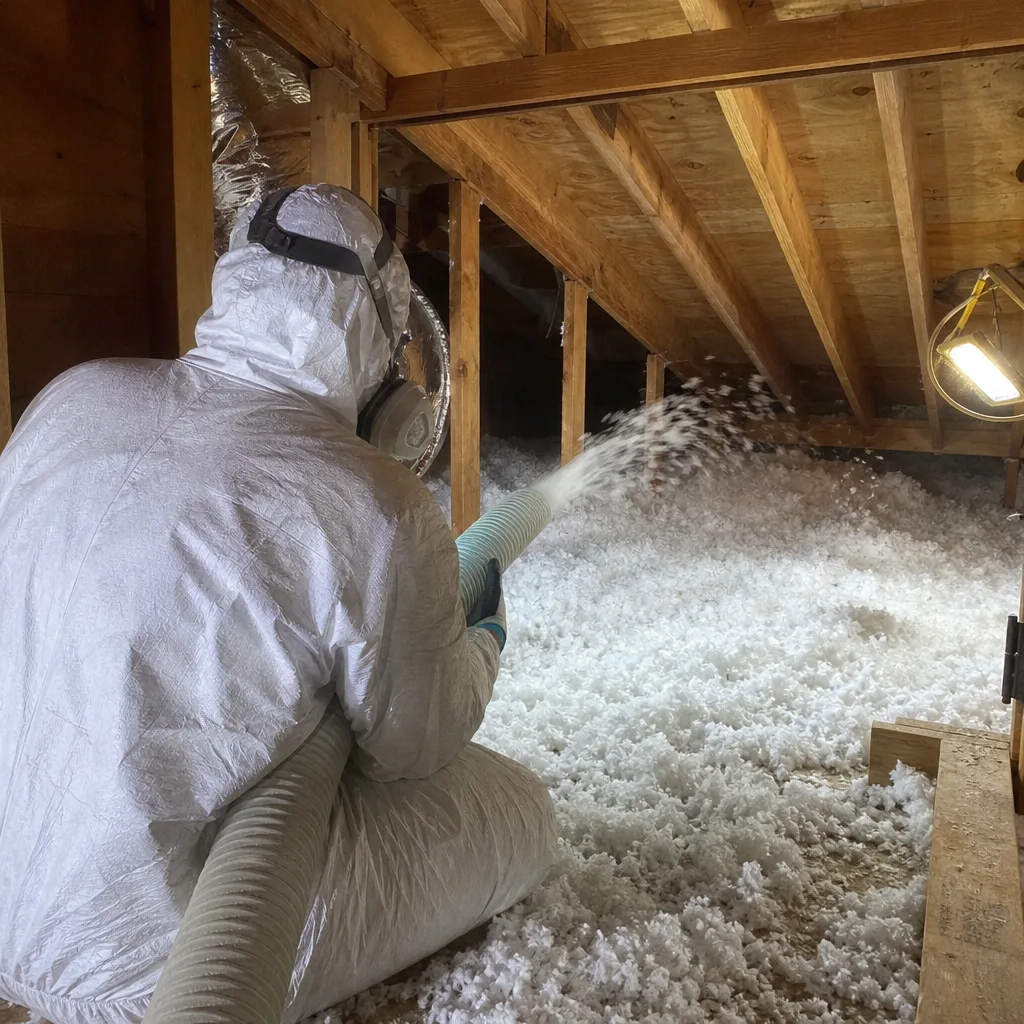
When the job is a standard attic over a production home in RSM, blown-in fiberglass remains the workhorse. Owens Corning ProPink L77 and ProCat, along with Johns Manville Climate Pro, are the two product families we see specified most. Both offer reliable coverage at depth, both are widely available, and both have predictable settled R-value curves that enable precise installation math.
Owens Corning’s ProCat line uses a proprietary thermal-acoustic fiber that reduces airborne sound transmission, which is a nice bonus for homes near major collector streets like Antonio Parkway. Johns Manville Climate Pro offers slightly better blow coverage characteristics in tight, low-slope attic cavities, which matters for older RSM homes with shallow truss bays. A homeowner asking which brand is better is missing the point; both brands, installed at correct depth with proper air-sealing, will resolve the attic energy-loss problem in a typical RSM single-family home.
Cellulose: GreenFiber
For homeowners who prioritize recycled content and air-infiltration resistance, GreenFiber cellulose products are worth a close look. GreenFiber’s SANCTUARY line is a formaldehyde-free, fire-retardant cellulose with excellent settled R-value stability and a recycled content percentage above 85%. Cellulose performs differently than fiberglass in real-world conditions: the material is denser, so it interferes more effectively with air movement through the insulated layer. That means fewer convection loops in the attic during those brutal inland Southern California summer afternoons when temperatures on the roof surface hit 140°F or more.
The tradeoff with cellulose in Rancho Santa Margarita is installation nuisances: dust during installation, the need for proper moisture management in the attic, and the importance of keeping the material away from flue terminations and recessed light fixtures that may not be IC-rated. A competent installer manages these details; a rushed one leaves you with a dusty attic and potential fire-code issues.
Mineral Wool: Rockwool
Rockwool is the brand to know if fire resistance and soundproofing sit at the top of your priority list. Rockwool SAFE’n’SOUND and COMFORTBATT products are made from spun volcanic rock and steel slag – stone wool, not glass. The material is non-combustible throughout, carries a Class A fire rating, and does not melt or smoke when exposed to flame. For WUI-adjacent homes in RSM, that’s a meaningful differentiator.
Rockwool also delivers superior sound attenuation, which matters in multi-story homes where thermal insulation in floor cavities doubles as acoustic isolation. The material is dense, slightly more expensive per square foot than fiberglass, and installs as batts, which means detailed cutting around penetrations is essential. A contractor who knows how to work with mineral wool gets performance results that generic fiberglass batts simply cannot match. A contractor who treats it as identical to fiberglass will underperform the material.
Spray Foam: Icynene and Demilec
Spray foam is where installer certification matters most, because the chemistry has to be mixed and applied correctly in a single pass. Two brands dominate the open-cell and closed-cell product categories relevant to RSM homes: Icynene for open-cell and Demilec for closed-cell.
Icynene’s classic open-cell formulation has decades of proven field performance in Southern California climates, in part because open-cell foam’s vapor permeability suits coastal-inland climate zones better than closed-cell in many applications. The material air-seals effectively while allowing moisture to dry through the assembly. Demilec’s closed-cell products (Heatlok HFO and Heatlok Soya) provide higher R-value per inch and structural racking strength, useful for unvented attics and cathedral ceilings where space is limited and air-sealing plus thermal performance must both be maximized.
The reason both brands appear on the roster is that neither solves every problem. Open-cell foam is the right tool for some assemblies; closed-cell is the right tool for others. A contractor limited to a single spray foam brand will inevitably steer your house toward that brand’s product, whether or not it’s the best fit. Having both Icynene and Demilec available means the product decision is driven by your house, not by supply-chain convenience. This is the same reason we install GreenFiber and Owens Corning and Rockwool – because the correct material for a tract home attic in central RSM is different from the correct material for a remodeled custom home near Dove Canyon.
The House Brand Trap: Generic vs. Manufacturer-Branded Products
Walk into any big-box home improvement store in Rancho Santa Margarita or the surrounding area and you’ll find insulation products under store brands or proprietary labels that look identical to the name-brand products sitting two aisles over. Sometimes they are identical. Sometimes they are not. Here’s how the house brand trap works and how to avoid it.
How the Trap Works
- Private-labeling. A major manufacturer produces insulation for a retailer under a store label. The product is often functionally equivalent to the name-brand product but may carry slightly different density, binder, or R-value specifications.
- Spec drift. The store brand product may be manufactured at a different plant with different quality tolerances, meaning the R-value certification applies at baseline level but real-world performance varies more.
- Discontinued-line dumping. A manufacturer discontinues a product line and sells remaining inventory to a retailer at a discount. The product is fine, but it may lack current code certifications or warranty support.
How to Verify You’re Getting the Specified Product
- Ask for the manufacturer’s technical data sheet, not the retailer’s spec sheet. Every genuine product line has a TDS published by the manufacturer with ASTM test numbers. If you can’t find a TDS, you’re looking at a house-brand product.
- Check the label for a third-party certification seal. NAIMA, UL, and GREENGUARD labels indicate independent verification. House-brand products may carry these seals too, which is a good sign, but the specific R-value and settled performance numbers must match what your contractor specified.
- Verify the product name matches the bid document. If your contract says “Owens Corning ProCat R-38” and the installer shows up with “Builder’s Choice R-38,” that’s a substitution. It may perform similarly, but it’s not what was specified. A contractor who substitutes without asking is signaling something important about how they do business.
In our experience specifying products for Rancho Santa Margarita homes, the house brand issue comes up most often with home builders doing final-tier work and with “blow-and-go” insulation crews hired by general contractors. The homeowner never sees the product label, never checks the spec sheet, and assumes that because the invoice says R-38, the attic delivers R-38. It may not.
Why Installer Certification Matters More Than Brand Loyalty
Spray foam insulation is the clearest example of why installer-to-manufacturer relationships matter, but the principle applies across all insulation types. Manufacturers like Icynene and Demilec certifies installers, not just products. Here’s what that means for your project.
What Manufacturer Certification Entails
- Formal training. Certified installers complete manufacturer-run coursework covering product chemistry, equipment calibration, substrate preparation, and safety protocols.
- Ongoing auditing. Most manufacturers require periodic recertification or spot-checks of installer work, giving the homeowner an extra layer of quality assurance beyond the contractor’s own QC.
- Warranty integration. When a certified installer applies the product, the manufacturer extends warranty coverage that includes both material and workmanship. If an uncertified crew installs the same product, the material warranty may not apply at all.
- Access to formulation updates. Spray foam chemistry evolves. Certified installers receive current product formulations and application guidance; uncertified contractors may be applying product purchased through third-party channels with no update pipeline.
How to Verify Certification
Ask your contractor directly: “Are you a certified installer for this product, and can I see the certification?” A legitimate certified contractor will produce documentation without hesitation. You can also call the manufacturer and ask whether the contractor is on their list of certified applicators. For Icynene, certification is verifiable through the manufacturer’s dealer locator. For Demilec, the same applies. Contractors who cannot prove certification but are applying branded spray foam should raise a red flag immediately.
The same logic applies to blown-in products. CertainTeed’s OPTIMA system, for example, requires a proprietary blowing machine and installer training to achieve the specified density and coverage. A contractor running generic equipment with CertainTeed product in the hopper will not deliver OPTIMA’s performance curve, regardless of what the bag says.
Rancho Santa Margarita Climate and Code Considerations
Rancho Santa Margarita sits in California Climate Zone 8 represented by the CEC, but its inland geography creates microclimatic conditions that differ from coastal towns 15 miles west. Understanding these conditions is what separates a correctly specified insulation project from an approximate one.
Summer Temperature Extremes
RSM regularly sees summer daytime highs in the 90s and occasional triple digits, with roof surface temperatures in attics pushing well past 150°F. This heat load is the primary driver of energy bills and discomfort in RSM homes, and it’s why attic insulation depth and air-sealing matter so much. A roof’s heat penetrates through conductive transfer and radiated heat, and the insulation’s job is to slow that conductive path. More R-value means slower heat transfer, which means less load on your AC system and more consistent interior temperatures between rooms.
Marine Layer and Winter Moisture
That same geography puts RSM in the path of the Pacific marine layer during winter and spring mornings, when cool, moist air pushes inland. Most days that moisture burns off by mid-morning. Some days it doesn’t. For insulation, the relevant issue is condensation potential on cold surfaces inside attics and wall cavities. Proper air-sealing from the conditioned space prevents moisture-laden indoor air from leaking into the attic and condensing on cold roof sheathing. Certain foam products with specific vapor permeability characteristics manage moisture better than others, and selecting the right product depends on understanding RSM’s specific winter humidity profile.
Title 24 and Local Code Requirements
California’s Title 24 energy efficiency standards set minimum R-value requirements for insulation across all new construction and major remodels. Rancho Santa Margarita falls under the Southern California Edison service territory, which triggers specific Title 24 compliance pathways for renovations. Attic insulation in RSM residential projects is typically specified at R-38 minimum for most fiberglass and cellulose applications. Spray foam applications use a prescriptive method that recognizes the foam’s air-sealing contribution alongside its thermal resistance.
WUI Zones and Fire Rating Implications
Portions of Rancho Santa Margarita lie in Wildland-Urban Interface zones. Homes in these areas must comply with Chapter 7A of the California Building Code (materials and construction methods for exterior wildfire exposure) and local fire safe ordinances. While insulation installed inside the conditioned space is not typically a Chapter 7A-controlled component, insulation used in exterior wall assemblies and attics adjacent to the wildland edge can be part of the code compliance picture. Rockwool’s non-combustible mineral wool products make sense for these applications in a way that generic fiberglass does not. If your home is in a WUI-designated area, this should be part of the product selection conversation.
Common Mistakes to Avoid
- Choosing brand before application. Deciding “I want spray foam” before knowing whether your attic is a vented or unvented assembly puts the product decision before the building science. Determine the problem first, then select the material, then pick the brand.
- Ignoring settled R-value. Accepting an initial R-value quote without verifying settled performance will leave you under-insulated after year one. Ask for the settled specification on the bid document.
- Skipping air-sealing. Insulation without air-sealing is like wearing a down jacket in the wind with the zipper open. In RSM’s hot summers, attic air-sealing is half the energy benefit. Many contractors skip it because it takes time and doesn’t photograph well.
- Trusting the big-box label. House-brand insulation at a retailer’s store in Rancho Santa Margarita may look identical to the name-brand product but carry different density and R-value specs. Verify the TDS.
- Hiring a generalist for insulation. A contractor who splits time between roofing, HVAC, and insulation won’t have manufacturer certifications for spray foam, settled R-value calculators for blown-in products, or the depth of product knowledge to specify correctly. Insulation is a specialty trade.
- Ignoring ventilation interaction. Insulation and attic ventilation are one system. Upgrading insulation without addressing ventilation in an older RSM home can create condensation problems in winter when the marine layer is present.
- Choosing the cheapest bid without checking product specifications. Two bids at the same price can specify different products with different settled R-values, fire ratings, and recycled content percentages. The bid line should name the exact product, not just “R-38 insulation.”
When to Call a Professional
If your RSM home has rooms that run 5 degrees warmer than the rest of the house in summer, or your energy bills spike during the Santa Ana heat waves, the problem is most likely under-performing attic insulation and air-sealing failure. For a full walkthrough of attic-specific solutions, see The Complete Attic Insulation Guide for Rancho Santa Margarita Homeowners. If you can see your attic floor joists, you’re under-insulated, period. If your home is older than 15 years and has never had insulation upgraded, Title 24 energy standards have moved significantly since it was built. If you’re in a WUI-adjacent neighborhood and fire-rating is part of your compliance conversation, the product selection gets more nuanced. These are all scenarios where a trained insulation specialist will see what a general contractor misses. Orange County Insulation offers free estimates in Rancho Santa Margarita – call (877) 680-3557 to schedule an attic inspection and product recommendation.
Frequently Asked Questions
There is no single best brand for every Rancho Santa Margarita home, because the right product depends on your roof assembly, WUI status, and performance priorities. For most standard attics, Owens Corning and Johns Manville blown-in fiberglass are excellent choices. For fire-resistance, Rockwool is superior. For air-sealing performance, Icynene and Demilec spray foams deliver results batts cannot. The brand matters less than the specific product and the installer’s ability to apply it correctly.
You should always buy insulation through a certified contractor. Big-box stores sell house-brand and manufacturer-branded products side by side, and the product you pick up may not match the specification your project requires. Contractors with manufacturer relationships buy product through certified channels, which preserves the warranty and ensures the product is fresh and correctly specified.
In many RSM homes, yes. Open-cell spray foam such as Icynene air-seals and insulates in a single application, which addresses the air leakage that drives much of the energy loss in older homes. Not sure whether to tackle this yourself or hire a pro? Read DIY vs Professional Insulation: The Rancho Santa Margarita Homeowner’s Decision Guide. Closed-cell Demilec products add R-value per inch and structural strength for unvented roof assemblies. Spray foam costs more than blown-in fiberglass, but the air-sealing contribution typically pays for the difference within a few years in homes that currently leak significant air.
Initial R-value is the insulation’s thermal resistance immediately after installation. Settled R-value is the R-value after the material compresses over time due to gravity, vibration, and loading. Blown-in fiberglass products typically list both numbers, and the settled value is always lower. A contractor who installs based on initial R-value is delivering less insulation than specified within a year. Ask for the settled R-value calculation on your bid.
Homes built in RSM in the 1990s typically have substantially less attic insulation than current Title 24 requirements and often lack adequate air-sealing. Blown-in fiberglass to R-38 or higher, combined with proper attic air-sealing, addresses the primary energy-loss path in most of these homes. If the roof is complex or the attic will become a usable space, spray foam may be the better choice. A professional attic inspection will determine the right path.
It matters if your home sits in or near a WUI zone. Rockwool mineral wool is non-combustible throughout its thickness and carries a Class A fire rating, making it the strongest option for fire-conscious RSM homeowners. Fiberglass and cellulose both carry fire-rated formulations but respond differently to direct flame exposure. The product’s fire-rating class should be part of your specification discussion if fire risk is a concern in your neighborhood.
The Bottom Line
Brand names are a starting point, not a decision. The best insulation for any Rancho Santa Margarita home is the specific product that matches the application, installed at the correct depth with proper air-sealing, by a contractor who carries manufacturer certification and knows how to read the technical data sheet. Owens Corning, Johns Manville, Rockwool, Icynene, Demilec, GreenFiber, CertainTeed – each produces excellent products when matched to the right situation. The contractor who stocks all of them and can explain why one fits your house and another doesn’t is the one you want making that call.
We only do insulation, which means we do it better. Orange County Insulation installs every major product type and carries the certifications to back the work up. If your attic isn’t performing the way it should, Orange County Insulation home has the answer. For a complete guide to Attic Insulation in Rancho Santa Margarita, see our dedicated page. If you’re considering Spray Foam Insulation in Rancho Santa Margarita, we cover open-cell and closed-cell options in detail. And for homes where Blown In Insulation in Rancho Santa Margarita is the right answer, we offer the full range of fiberglass and cellulose products.
Stop guessing why your energy bills are high. Call (877) 680-3557 for a free estimate, and we’ll tell you exactly which product fits your situation and why.
Written by the team at Orange County Insulation, serving Rancho Santa Margarita since 2013.