Last updated October 31, 2026
The Complete Guide to Insulation in Rancho Santa Margarita
Most insulation guides written for “Southern California” were actually written for coastal San Diego or the LA basin – climates that share almost nothing with Rancho Santa Margarita’s canyon-bowl geography, which can hit 105°F in August and drop below 40°F on December nights. If you’ve ever noticed your upstairs bedrooms baking while the downstairs feels like a cave, or your AC running nonstop from July through October, you’re not imagining it. The problem isn’t your HVAC system. It’s what’s missing in your attic and walls. This guide explains what insulation actually does in a place like Rancho Santa Margarita, why code-minimum often isn’t enough, and how to match the right material to your specific home – not the one a coastal contractor happens to stock.
Quick Answer
Homes in Rancho Santa Margarita need a dual-season insulation strategy because the canyon-bowl microclimate creates both intense radiant heat gain from above in summer and cold-air pooling at night in winter. Most RSM homes are under-insulated for this specific condition – not because builders cut corners, but because California’s Title 24 code minimums were written for statewide averages, not inland canyon thermal swings. The most effective approach for most Rancho Santa Margarita homes is air-sealing combined with blown-in insulation in the attic (at R-38 to R-49) and the right density in exterior walls, with spray foam reserved for specific problem zones like vaulted ceilings and rim joists.
Table of Contents
- Why Rancho Santa Margarita’s Climate Is Different from the Rest of Orange County
- Title 24 Requirements for Climate Zone 8: What’s Code vs. What Actually Works
- Insulation Materials Compared: What Works in RSM Homes and What Doesn’t
- Why Air-Sealing Matters More Here Than in Humid Climates
- Wildfire Smoke, Santa Ana Winds, and Indoor Air Quality
- Matching Insulation to RSM Housing Types: Tract Homes vs. Hillside Custom Builds
- What Insulation Costs in Rancho Santa Margarita in 2026
- Common Mistakes to Avoid
- When to Call a Professional
- Frequently Asked Questions
- The Bottom Line
Why Rancho Santa Margarita’s Climate Is Different from the Rest of Orange County
Rancho Santa Margarita sits in a canyon bowl at the base of the Saddleback Mountains, which means it doesn’t get the marine layer cool-down that keeps San Clemente or Newport Beach mild. In August, temperatures regularly climb past 100°F while coastal communities sit in the 70s. But here’s the part most people don’t realize: at night, that same bowl shape lets cold air drain down from the foothills and pool around homes, dropping temperatures 40 degrees or more in twelve hours.
That temperature swing isn’t just uncomfortable. It’s a structural challenge for your insulation. Materials that perform well in a stable climate behave differently when they’re asked to block 105°F radiant heat at 3 p.m. and retain interior warmth at 3 a.m. We’ve seen attics in Rancho Santa Margarita measure 140°F in late afternoon – hot enough that the insulation itself becomes a thermal battery, radiating heat down into living spaces well after sunset.
The other overlooked factor is humidity. RSM gets late-summer humidity spikes, particularly in August and September when monsoonal moisture works its way up from the Gulf of California. This isn’t New Orleans humidity, but it’s enough to condense inside wall cavities and attics when insulation and air barriers aren’t working together properly. Our Orange County Insulation home guides explain the basics, but the specifics here matter.
In our experience working on homes throughout the Saddleback Valley, the most common failure pattern we see is this: a homeowner has decent attic insulation by coastal standards (R-30, for instance), but the air-sealing is inconsistent, so hot air finds its way through recessed lights, attic hatches, and wall-top plates. The result is a home that never fully cools in summer and never fully warms in winter, no matter what the thermostat says.
Title 24 Requirements for Climate Zone 8: What’s Code vs. What Actually Works
Rancho Santa Margarita falls into California Climate Zone 8, which covers inland Orange County and the Saddleback Valley corridor. Title 24 – California’s energy code – sets minimum insulation requirements for new construction and major remodels. For Climate Zone 8, the current prescriptive requirements are R-30 to R-38 for attic insulation and R-13 to R-21 for walls, depending on the specific compliance path and construction type.
Here’s the problem: those are minimums. And in a climate with 40-degree daily swings, minimums perform like minimums. A home built to code fifteen years ago in Rancho Santa Margarita likely has R-30 fiberglass batts in the attic that have settled, absorbed dust, and lost some thermal performance. Settlement alone can reduce effective R-value by 20% or more.
What do high-performance homes in RSM actually use? Here’s what we specify most often:
- Attic: R-38 to R-49 blown-in cellulose or fiberglass, with air-sealing done first. This exceeds code and accounts for settlement over the life of the home.
- Walls (existing): Retrofit wall insulation is often impractical in Rancho Santa Margarita’s stucco tract homes, but where accessible, R-15 to R-21 achieves good results.
- Walls (new construction): R-21 batt or closed-cell spray foam for superior thermal break and air-sealing in a single application.
- Vaulted ceilings and cantilevered floors: Closed-cell spray foam or dense-packed cellulose, because traditional batts can’t conform to irregular cavities.
- Rim joists and band boards: Closed-cell spray foam or mineral wool, both of which handle thermal bridging better than fiberglass.
The pattern is clear: code-minimum insulation in Rancho Santa Margarita will pass inspection, but it won’t deliver the comfort or energy performance most homeowners expect. And once a home is occupied, the cost to upgrade later is far higher than doing it right the first time. If you’re planning a remodel or addition, getting the insulation right at the rough-in stage is the single most cost-effective decision you’ll make—though many homeowners first weigh the DIY vs Professional Insulation: The Rancho Santa Margarita Homeowner’s Decision Guide before committing.
Insulation Materials Compared: What Works in RSM Homes and What Doesn’t
There are four main insulation material categories used in Rancho Santa Margarita homes, and each has a specific role. The right answer is never “whatever the contractor has on the truck.” We stock and install eight manufacturer brands – including Johns Manville, Knauf, Rockwool, and CertainTeed – because different jobs require different products, and no single brand makes the best option for every application.
Fiberglass batts (Johns Manville, Knauf, CertainTeed): The most common insulation in RSM tract homes. Batts are inexpensive and work acceptably in standard stud cavities when installed carefully – but “carefully” is the operative word. Compressed batts lose R-value, and gaps around electrical boxes and plumbing create thermal bypasses. For open attics and wall cavities with regular framing, batts remain a practical choice, but they’re not the best choice for irregular cavities or anywhere air infiltration is a concern.
Blown-in fiberglass and cellulose: Blown-in insulation fills irregular spaces more completely than batts, and it’s the go-to solution for existing attics. Cellulose (like the GreenFiber we install) has the added benefit of being manufactured from recycled paper, so it appeals to homeowners who want an eco-conscious option. Blown-in materials also layer well – you can add more on top of existing insulation to reach R-49 without removing what’s already there. For most RSM homes built before 2015, topping off attic insulation is the single highest-ROI improvement available. See our full guide to Blown In Insulation in Rancho Santa Margarita for specifics.
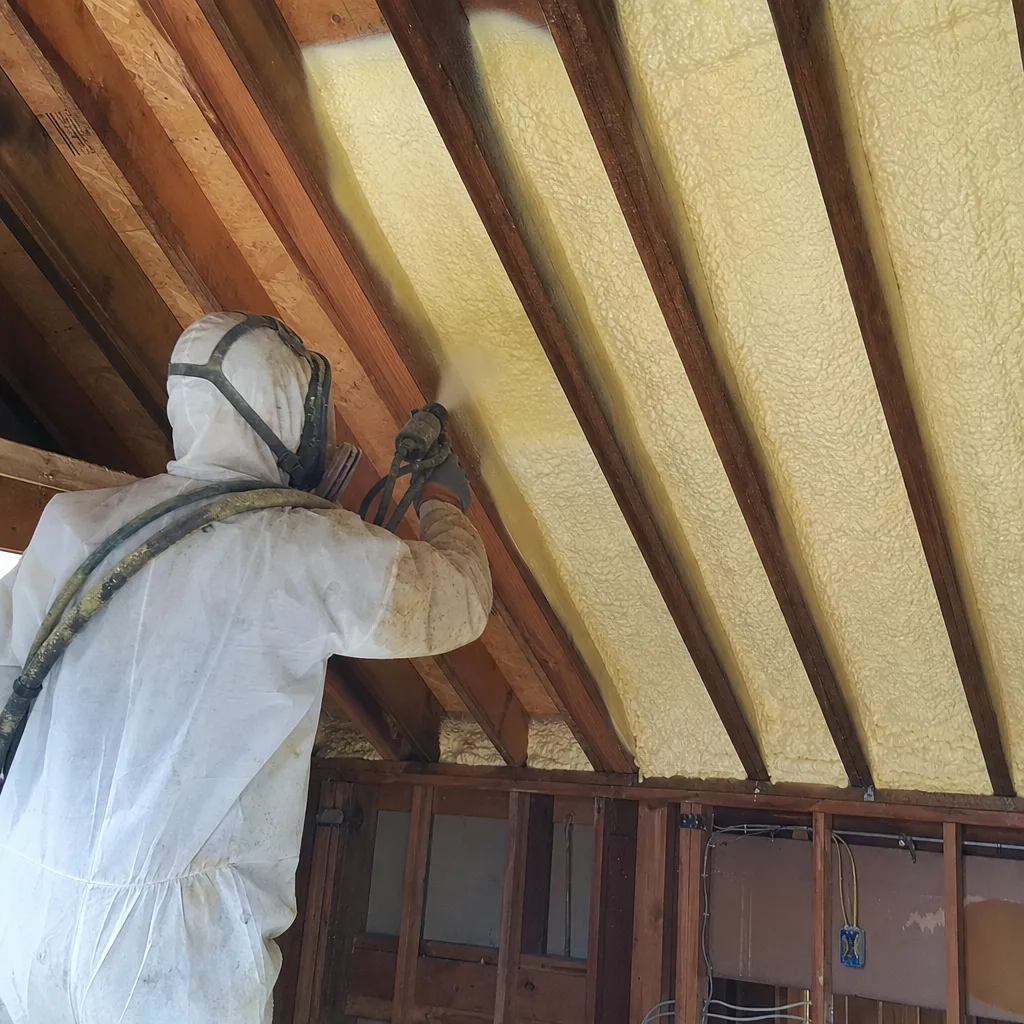
Spray foam (open-cell and closed-cell): Spray foam is the only insulation that combines thermal resistance and air-sealing in one application. Open-cell foam (like Icynene) is lighter, less expensive, and excellent for interior sound control. Closed-cell foam (like Demilec) is denser, more expensive, and adds structural rigidity along with a higher R-value per inch. In Rancho Santa Margarita, closed-cell is particularly valuable for vaulted ceilings, cantilevered floors, and rim joists – the places where other insulation methods underperform. Our detailed guide to Spray Foam Insulation in Rancho Santa Margarita covers the differences in depth.
Mineral wool (Rockwool): Mineral wool offers something no other batt material does: inherent fire resistance and excellent sound-dampening. In a region like Rancho Santa Margarita, where wildfire-adjacent areas are a real consideration and many homes are built close together on gentle slopes, mineral wool gives some homeowners added confidence. It’s also dimensionally stable – it won’t slump or settle over time, which matters in walls and cathedral ceilings.
The table below maps the most common materials to the applications where they make the most sense in Rancho Santa Margarita:
- Attic (existing, open access): Blown-in fiberglass or cellulose, R-38 to R-49
- Attic (new construction, truss-framed): Blown-in or batts at R-38+
- Walls (standard 2×4 stud, existing): Dense-packed cellulose retrofit where accessible
- Walls (new construction): R-21 batts or closed-cell spray foam
- Vaulted ceilings / cathedral ceilings: Closed-cell spray foam
- Crawl spaces and rim joists: Closed-cell spray foam or mineral wool
- Interior sound control: Mineral wool or open-cell spray foam
Why Air-Sealing Matters More Here Than in Humid Climates
Here’s the counterintuitive truth about insulation in Rancho Santa Margarita: air movement does more damage to your comfort and efficiency than conduction through the insulation itself. In humid climates, the enemy is moisture-laden air infiltrating walls. Here, the enemy is dry, superheated air finding its way into the conditioned space through gaps in the building envelope.
During Santa Ana wind events, the pressure differential across your home is significant. Air is pushed against the windward side and pulled away from the leeward side, creating a vacuum effect that actively draws conditioned air out through every gap in the attic floor, wall plates, and penetrations. This isn’t a minor leak. It’s the equivalent of leaving a window open year-round.
Here’s the sequence we recommend for any attic insulation upgrade in Rancho Santa Margarita:
- Identify and seal all penetrations first. Recessed lights, bathroom fans, attic hatches, plumbing vents, electrical boxes, and wall-top plates. This is the least glamorous and most important step.
- Seal the attic hatch or pull-down stair. An unsealed attic hatch can leak as much air as a small window. Weatherstripping and an insulated cover are inexpensive fixes.
- Create consistent coverage after sealing. Add blown-in material to reach R-38 to R-49 across the entire attic floor, including the edges near the eaves.
- Verify ventilation. After sealing, make sure soffit vents still have airflow so the attic doesn’t become a hotbox that bakes your insulation from above.
- Confirm no settling or gaps after 30 days. A quick visual check catches installation issues before they become permanent performance problems.
We’ve seen homes in Rancho Santa Margarita where someone added a fresh layer of blown-in insulation without sealing the ceiling below it – and the owner noticed almost no difference in comfort or utility bills. The insulation was doing its job, but the air leaks were bypassing it entirely. That’s why the order matters: seal first, then insulate.
Wildfire Smoke, Santa Ana Winds, and Indoor Air Quality
Rancho Santa Margarita sits at a transition point between suburban development and open wildland. During fire season, smoke from the Cleveland National Forest and the Santa Ana Mountains can settle over the Saddleback Valley for days at a time. And even outside of fire events, the dry Santa Ana winds carry fine particulate matter that finds its way indoors through the same gaps that let heat escape.
This is where air-sealing and insulation become an indoor air quality strategy, not just an energy strategy. Here’s what happens in a typical under-sealed RSM home during a smoke event: the stack effect pulls outdoor smoky air into the attic, and from there through ceiling penetrations into the living space. By the time you notice the smell inside, the particulates are already throughout the house. A properly air-sealed envelope dramatically reduces that infiltration.
The practical implication is this: when you’re choosing insulation for a Rancho Santa Margarita home, think about the building envelope as a system. Insulation slows heat transfer. Air-sealing slows air and particulate transfer. They work together. If you do one without the other, you get partial results.
For homeowners who are particularly sensitive to air quality, we recommend combining air-sealing with blown-in cellulose in the attic. Cellulose is denser than fiberglass and does a better job of slowing air movement through the material itself, which provides an additional layer of particulate resistance. It’s not a substitute for proper sealing, but it’s a meaningful complement.
Matching Insulation to RSM Housing Types: Tract Homes vs. Hillside Custom Builds
Rancho Santa Margarita has two distinct housing profiles, and they need very different insulation strategies. Understanding which one you have is the first step to choosing the right approach.
Stucco tract homes (built 1980s to 2000s): The majority of RSM homes fall into this category. They typically have wood-framed walls with stucco exteriors, composition shingle or concrete tile roofs, and attic access through a standard hatch. Insulation in these homes was installed to the code of their era – often R-19 or R-30 in the attic, and fiberglass batts in the walls. These homes are excellent candidates for attic upgrades, because the attic is easily accessible and the payback period is short. Wall retrofit is harder with stucco exteriors, so the focus should be on the attic, rim joists (where accessible), and any cantilevered floor sections.
Custom hillside builds (2000s to present): Homes on the slopes above Dove Canyon and around Robinson Ranch frequently have vaulted ceilings, open floor plans, large window walls with western or southern exposure, and complex roof geometries. These homes often have less attic space but more irregular cavities – and that changes the material calculus. Closed-cell spray foam becomes far more important here, because it conforms to irregular shapes and provides structural rigidity along with thermal performance. Mineral wool is also popular in these homes for its sound-dampening and fire-resistance qualities, particularly in interior wall assemblies and between floors.
The takeaway: if you live in a standard tract home, your highest-ROI move is almost always an attic sealing and insulation upgrade. If you live in a custom hillside home, the conversation shifts to specific problem zones – vaulted ceilings, cantilevers, rim joists, and mechanical rooms. Our Attic Insulation in Rancho Santa Margarita guide goes deeper on common attic-specific issues, including access challenges and ventilation design.
What Insulation Costs in Rancho Santa Margarita in 2026
Insulation pricing in Orange County varies based on material, square footage, attic accessibility, and the condition of existing insulation. Here’s what homeowners in Rancho Santa Margarita can expect to pay for the most common insulation projects in 2026:
- Attic air-sealing + blown-in insulation (R-38, 1,500 sq ft attic): $2,200 to $4,500
- Attic air-sealing + blown-in insulation (R-49, 2,000 sq ft attic): $3,000 to $5,800
- Spray foam (open-cell) on attic roof deck: $1.50 to $3.00 per square foot of foam surface area
- Spray foam (closed-cell) on attic roof deck or walls: $2.50 to $4.50 per square foot
- Rim joist and band board sealing with closed-cell foam: $800 to $2,000 for a typical single-family home
- Mineral wool batts (new construction or remodel, walls): $1.20 to $1.90 per square foot installed
- Dense-packed cellulose wall retrofit: $2.00 to $3.50 per square foot of wall area
These are local price ranges for Rancho Santa Margarita and the nearby Saddleback Valley, not statewide averages. Costs in RSM tend to run slightly higher than coastal Orange County due to attic access challenges in two-story tract homes and the prevalence of vaulted ceilings in hillside communities. The good news: insulation improvements are among the few home upgrades that pay for themselves through lower utility bills within three to seven years, depending on your current insulation levels and how much you run your HVAC system.
If you’re trying to decide between repair and replacement, the question is simpler than most people think. Insulation doesn’t “fail” in the way a furnace or water heater fails – but it does degrade performance slowly and silently. If your home was built before 2010 and you’ve never had the attic insulation checked, you’re almost certainly under-insulated by today’s standards for RSM’s climate. Topping off is straightforward and affordable compared to the ongoing cost of an overworked AC system.
Common Mistakes to Avoid
- Adding new insulation without air-sealing first. You’re spending money to insulate a leaky envelope. The thermal payoff is tiny when air bypasses the insulation entirely.
- Using fiberglass batts in irregular cavities. Vaulted ceilings, sloped rooflines, and odd framing don’t accept batts cleanly. The gaps and compression kill performance, and spray foam or blown-in is the right tool.
- Blocking soffit vents with blown-in insulation. If you fill the attic so deeply that soffit vents are covered, you’ve created a moisture problem. Baffles must be installed to maintain the airflow channel.
- Choosing the cheapest quote without comparing scope. An insulation bid that’s 20% cheaper usually means thinner coverage, no air-sealing, or a lower-grade material. The spec sheet is what matters, not just the price.
- Ignoring rim joists and band boards. These are some of the leakiest spots in a typical Rancho Santa Margarita home, and they’re almost never insulated in tract construction. Sealing them makes a disproportionate difference.
- Assuming code-minimum is enough. Title 24 sets a floor, not a target. Homes built to the floor in Climate Zone 8 underperform in RSM’s specific thermal and air quality conditions.
- Waiting until summer to act. Insulation contractors get booked out every year as the first heat wave hits. If you schedule an assessment in spring or fall, you’ll get better availability and more attention to your project.
When to Call a Professional
Insulation evaluation is not a DIY project, and there are specific scenarios where calling a professional is not just helpful but necessary. If you see mold or dark staining on insulation (a sign of moisture intrusion), hear rodents in the attic, notice rooms that are consistently 10 degrees different from the rest of the house, or discover that your attic has vermiculite insulation (common in some older RSM homes and requiring specialized handling), call someone who does insulation full-time. You also want a professional when the project involves spray foam application, which requires specialized equipment, proper ventilation during installation, and experience with expansion characteristics that differ between open-cell and closed-cell formulations.
Orange County Insulation offers free estimates in Rancho Santa Margarita – call (877) 680-3557 to schedule an assessment. We only do insulation – which means we do it better. And with eight brands and three installation methods under one roof, you get the right material for your home, not the easiest one for us to install.
Frequently Asked Questions
For a typical 1,500-square-foot attic in Rancho Santa Margarita, air-sealing plus blown-in insulation to R-38 runs between $2,200 and $4,500 in 2026, depending on access difficulty and the amount of existing material that needs to be managed. Larger attics or upgrades to R-49 run $3,000 to $5,800. Call (877) 680-3557 for an exact quote – estimates are free.
Title 24 requires R-30 to R-38 for attics in Climate Zone 8, but high-performance homes in Rancho Santa Margarita typically use R-38 to R-49 to compensate for the canyon-bowl temperature swings and reduce HVAC load during 100-degree summer peaks. Most existing RSM homes fall short of even the code minimum due to settlement and initial spec choices.
Insulation isn’t generally “repaired” – it’s topped off or replaced. If the existing insulation is dry, mold-free, and reasonably intact, adding blown-in material on top is the most cost-effective approach and usually costs 40-60% less than full removal and replacement. Full replacement is warranted only when insulation is compromised by moisture, pests, or contamination.
Yes – attic insulation upgrades are done from above through the attic hatch, so there’s no disruption to living spaces. Dense-packed cellulose wall retrofit requires drilling small access holes through the exterior or interior wall surface, which are then patched. Spray foam applications in existing attics are similarly non-invasive to the living area.
Yes, but only if air-sealing is part of the project. Insulation alone slows heat transfer, but smoke enters through air gaps. A properly air-sealed attic with dense insulation reduces smoke and particulate infiltration significantly, which matters in Rancho Santa Margarita where seasonal wildfire smoke can linger for days.
Look at the attic floor: if you can see the tops of the ceiling joists, you have less than about R-19 of insulation, which is inadequate for a Rancho Santa Margarita home. If the insulation appears thin, settled, or scattered unevenly, you’re losing performance. The most reliable method is a professional assessment that checks R-value, air leaks, and ventilation together. Orange County Insulation offers free assessments in RSM – call (877) 680-3557.
The Bottom Line
Rancho Santa Margarita homes face thermal and air-quality conditions that coastal insulation advice simply gets wrong. The canyon-bowl microclimate demands a dual-season strategy: high attic R-values to block radiant heat gain in summer, consistent air-sealing to prevent cold-air pooling and particulate infiltration in winter and fire season, and material choices matched to your specific home type – not whatever’s easiest to install. If you take one action from this guide, make it this: have your attic assessed by an insulation specialist who understands the difference between RSM’s inland climate and the rest of Orange County. For ongoing updates, explore our more guides & resources. The right fix, done once, pays for itself in comfort and lower bills for as long as you own the home.
Written by the team at Orange County Insulation, serving Rancho Santa Margarita since 2013.