Last updated October 31, 2026
DIY vs Professional Insulation: The Rancho Santa Margarita Homeowner’s Decision Guide
Blowing in attic insulation looks deceptively simple on YouTube, and the loose-fill part mostly is. The part that isn’t is air-sealing first, because insulation without air-sealing in a Rancho Santa Margarita home is like adding more blankets to a bed with no sheets. Professionals know this sequencing. Most DIYers skip it entirely, then wonder why their energy bills didn’t move. This guide walks through which insulation tasks in Rancho Santa Margarita are genuinely learnable for a homeowner, which ones aren’t, and how to figure out which camp you’re in before you spend a dollar, with more guides & resources available for homeowners who want deeper context.
Quick Answer
DIY insulation in Rancho Santa Margarita makes financial sense for exactly one scenario: adding loose-fill fiberglass or cellulose on top of existing attic insulation in a home where you’ve already air-sealed, and you can rent a blower machine and haul material yourself. Everything else, including spray foam of any kind, dense-packing walls, batt removal, or working around vermiculite, costs more to do twice than to hire a specialist the first time. The savings only materialize if the installed R-value actually performs, and that hinges on air-sealing, which most homeowners skip.
Table of Contents
- The Skill Question: Which Insulation Tasks Are Actually Learnable
- Hidden DIY Costs in the Rancho Santa Margarita Market
- California-Specific DIY Limitations and Permit Triggers
- The Air-Sealing Prerequisite That Determines DIY Success
- The RSM Homeowner Decision Tree: Three Scenarios
- Material Matching: Why the Product Choice Changes the DIY Math
- Common Mistakes to Avoid
- When to Call a Professional
- Frequently Asked Questions
- The Bottom Line
The Skill Question: Which Insulation Tasks Are Actually Learnable
The DIY-versus-professional insulation question in Rancho Santa Margarita isn’t really about money, though that’s how most homeowners frame it. It’s about which tasks are genuinely skill-dependent and which are just labor-intensive but learnable. The distinction matters because an underperforming DIY job has a real cost: another summer of a hot upstairs, another winter of a cold master bedroom, and eventually another project to fix the first one.
Genuinely DIY-Viable Tasks
These are the jobs where the installed product performs close to its rated R-value even when installed by a homeowner who reads instructions carefully:
- Blown-in attic toppers: Adding loose-fill fiberglass or cellulose on top of existing attic insulation is the most DIY-friendly insulation job that exists. You rent a blower machine from a home center, feed bales into the hopper while someone in the attic holds the hose, and work from the eaves back toward the hatch. The material self-levels. The physics are forgiving. The performance difference between a careful DIYer and a professional here is minimal, provided the air-sealing is already done.
- Batt replacement in accessible attic floor cavities: If an attic has open joist bays and no existing insulation to remove, laying fiberglass batts or mineral wool batts is straightforward. You cut with a utility knife, notch around wiring, and avoid compressing the material. It’s slow and uncomfortable, but it’s not skilled work.
- Weatherstripping around the attic hatch: This is a 20-minute job that belongs in the DIY column nearly always, because even professionally insulated attics often have a leaky hatch that undermines the whole assembly.
Professional-Only Tasks
These jobs require equipment, training, or both to hit the rated performance. A DIY attempt rarely produces an acceptable result, and the failure mode is usually invisible until the next utility bill arrives:
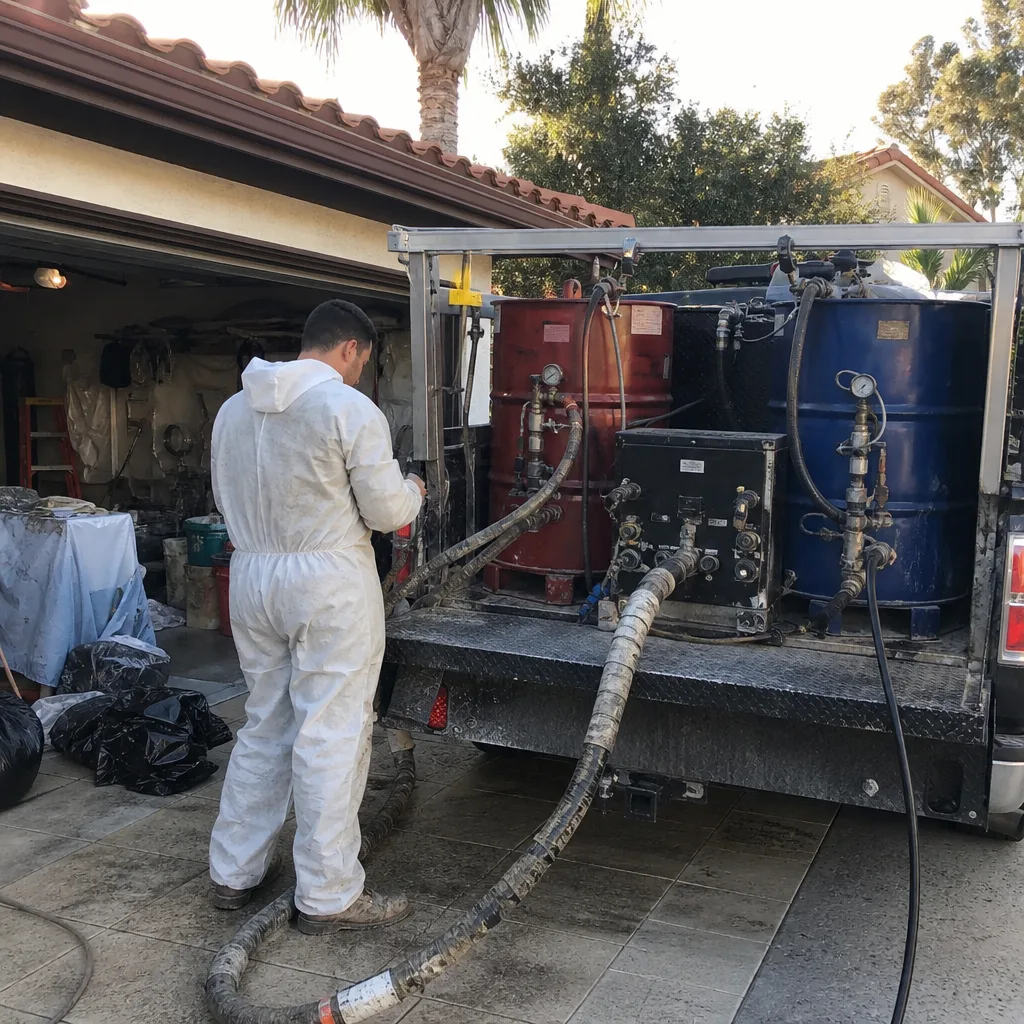
- Spray foam of any kind, open-cell or closed-cell: Spray foam is a chemical reaction happening at the gun tip, and the installer is managing temperature, pressure, substrate moisture, and pass thickness in real time. Two-part foam that’s applied incorrectly off-gasses, delaminates from the sheathing, or cures with voids that no thermal camera will forgive. We stock Icynene and Demilec products and run them through dedicated rigs with heated hoses. The equipment cost alone would eat a homeowner’s budget before any foam hits the wall. This is the clearest “hire it out” call on the list.
- Dense-packing closed wall cavities: Retrofitting insulation into existing walls requires drilling access holes, threading a fill tube to the bottom of each bay, and packing material to a specific density. Too loose and the insulation settles, creating a void at the top of the cavity. Too dense and you risk pushing drywall off its fasteners. This is measured work with calibrated equipment. It’s not a homeowner task.
- Removal of contaminated or compromised material: If the existing insulation is water-damaged from a roof leak, full of rodent droppings, or contains vermiculite from the asbestos era, removal involves containment, respirators, and disposal protocols. Homeowners should not handle this. In Rancho Santa Margarita homes built before the mid-1980s, vermiculite is a real possibility, and any disturbance requires professional assessment first.
Where does attic insulation in Rancho Santa Margarita fit into this? It depends entirely on what’s already up there. Clean, accessible joist bays with no air-sealing needed? DIY is plausible. Existing material to remove, recessed can lights to seal, or a low-slope roof that makes the attic hostile terrain? The calculus shifts fast.
Hidden DIY Costs in the Rancho Santa Margarita Market
The advertised cost of DIY insulation is always the material price, and the material price is always the smallest line item. Here are the costs that show up after you’ve committed, with numbers that reflect what Rancho Santa Margarita homeowners actually pay in 2026; for a detailed breakdown, see our Insulation Cost Breakdown: The Rancho Santa Margarita Homeowner’s Reference for 2026.
Equipment Rental
Loose-fill insulation requires a blower machine, and you can’t run a hose into an attic without one. Home centers in the Rancho Santa Margarita area rent blowers for roughly $100 to $150 per day when purchased with a minimum material buy. If you’re doing the job over a weekend, that’s one rental day. If you run out of material because you miscalculated coverage depth, that’s two. The blower rental is the tip of the hidden-cost iceberg.
Old Material Disposal
If the existing attic insulation has to come out before new material goes in, you’re filling contractor bags with material that weighs more than you expect. Disposal in south Orange County runs $50 to $80 per pickup-load at a transfer station, plus your time and gas. A 1,400-square-foot attic with 6 inches of old fiberglass produces a surprising number of bags. This line item erases a meaningful chunk of DIY savings.
The Second-Project Penalty
This is the cost nobody puts in a spreadsheet. If the DIY job goes in without air-sealing, or with gaps around the hatch, or with compressed batts in the corners, the home’s energy performance doesn’t improve by the amount the R-value math promised. The fix is a second project. The second project means either tearing out what you installed or hiring a professional to work around it, and professional retrofits of DIY attempts consistently cost more than professional installation would have cost originally. We’ve seen this in Rancho Santa Margarita more times than we can count, because the original decision was framed as “save money on installation” rather than “achieve a specific R-value at a specific cost per square foot.”
The Math in Practice
- DIY blown-in attic topper, 1,200 sq ft: $400 to $600 in material, $100 to $150 blower rental, zero disposal cost, one weekend of labor. Total out-of-pocket: $500 to $750.
- Professional blown-in attic topper, same attic: $1,000 to $1,500, depending on material choice and air-sealing scope. Includes blower, labor, disposal of any waste, and the performance guarantee that the coverage depth is uniform.
- DIY “savings” if air-sealing gets skipped: Negative, because the job doesn’t achieve the comfort or energy outcome, and the eventual correction costs more than the spread between the two numbers above.
For homeowners researching blown in insulation in Rancho Santa Margarita, the material price is the easy number to find online. The total project cost is the one that matters, and it includes the things YouTube tutorials don’t mention.
California-Specific DIY Limitations and Permit Triggers
California’s energy code, Title 24, shapes what a homeowner can legally do without a licensed contractor. The rules aren’t suggestions, and they’re enforced differently depending on the scope of the project and whether a permit is involved.
What Requires a Licensed Contractor Regardless of Preference
- Any insulation work tied to a building permit: If the insulation is part of a larger remodel, addition, or envelope upgrade that Rancho Santa Margarita’s building department has permitted, the insulation portion typically must be installed by a licensed contractor. The permit drawings specify R-values, and the inspector will verify the installed product. A homeowner cannot sign off on their own insulation in this context.
- Rebate applications through utility programs: Programs through Southern California Edison and SoCalGas that offer insulation rebates require installation by a participating, licensed contractor. A DIY job does not qualify, which means the rebate is forfeited, and the rebate sometimes equals more than the labor cost a homeowner was trying to avoid.
- Work involving vermiculite or suspect existing material: If the existing attic insulation is vermiculite, which was mined and sold for decades and can contain asbestos fibers, California regulations require testing before disturbance. If the test comes back positive, removal is abatement work, and that’s a licensed activity with containment protocols. This is not a DIY scenario under any reading of the rules, and Rancho Santa Margarita’s older neighborhoods, particularly the original tract homes from the 1980s, have attics where this is a live consideration.
- Spray foam application in enclosed cavities: California has specific health and safety requirements for two-part spray foam application, including occupancy windows during off-gassing. The products themselves carry installer training requirements, and the manufacturers that spray foam insulation in Rancho Santa Margarita professionals use, from Icynene to Demilec, sell through licensed contractors for this reason. The chemistry and the code both say professional.
What Homeowners Can Do Without a License
The California residential exemption allows an owner-occupant of a single-family home to perform certain work on their own residence without a contractor’s license, and adding loose-fill or batt insulation to an accessible attic generally falls under this. The key phrase is “owner-occupant.” Rental property owners, house flippers, and spec builders don’t get this exemption. If you own a rental in Rancho Santa Margarita and you’re considering insulating it yourself, you’re doing unlicensed contracting on someone else’s home, and the legal exposure isn’t worth the labor savings.
The Air-Sealing Prerequisite That Determines DIY Success
Insulation slows conductive heat transfer. Air sealing stops convective heat loss, which is the movement of conditioned air through gaps, cracks, and penetrations in the building envelope. If a Rancho Santa Margarita attic has a 2-inch gap around the plumbing vent stack, a recessed can light without an airtight trim, and an unsealed attic access hatch, conditioned air is leaving the house through those openings regardless of how much insulation sits on the attic floor. The insulation R-value is real, but it’s doing a fraction of its rated work.
The Top-10 Air Bypass Locations in a Typical RSM Tract Home
These are the penetrations and gaps we find in Rancho Santa Margarita homes, almost without exception, when we open the attic hatch. Addressing them before insulation goes in is the single highest-leverage move in the entire project.
- Attic access hatch: The hatch or pull-down stair is almost never weatherstripped or insulated from the top. It leaks continuously and is the easiest fix on this list.
- Recessed can lights: Older cans ventilate directly into the attic and double as chimneys for conditioned air. They need airtight covers or replacement with IC-rated sealed fixtures.
- Plumbing vent stacks: The pipe penetrates the top plate, and the gap around the pipe is often wide open. Foam sealant closes it in minutes.
- Electrical wire penetrations: Every wire entering the attic from the wall below is a small opening, and a typical home has dozens of them. Small openings add up fast.
- HVAC register boots and duct chases: The gaps around where supply and return ducts pass through the ceiling are frequent bypass points, especially where the drywall wasn’t cut tightly.
- Interior wall top plates: The wall cavities of interior partition walls are open to the attic in many tract homes, creating a direct lane from the attic into the wall space and out through electrical outlets.
- Bathroom exhaust fan housings: The fan body vents into the attic unless it’s sealed and ducted to the exterior properly. The housing itself is a leak point.
- Chimney and flue chases: Metal flues need fire-rated sealing, not foam, but the gaps around the chase enclosure are open bypass lanes.
- Knee wall top plates in vaulted ceiling sections: Any home with a partial vaulted ceiling has knee walls where the wall cavity is open to unconditioned space.
- Dropped soffits above kitchen cabinets: In many Rancho Santa Margarita floor plans, the soffit above the upper cabinets opens directly into the attic, bypassing the ceiling plane entirely.
The reason most DIY attic projects underperform is not that the loose-fill was installed poorly. It’s that these ten locations were never sealed, and the new insulation went in right on top of a leaky envelope. A professional insulation contractor treats air-sealing as step one and insulation as step two. A DIYer who watches a loose-fill tutorial never sees step one, because step one doesn’t photograph well and doesn’t make good video content.
The RSM Homeowner Decision Tree: Three Scenarios
The right answer to the DIY-versus-professional question depends on who you are and what you’re optimizing for. Here are the three most common homeowner situations in Rancho Santa Margarita, with the optimal call for each.
Scenario 1: The Owner-Occupant With Time and Basic Tools
The situation: You own and live in a single-family home in Rancho Santa Margarita. You’re reasonably handy, you own a ladder and a utility knife, and you have a free weekend. Your attic has existing insulation that’s just below current recommended depth, and you’re trying to lower cooling costs during the inland summer months when temperatures regularly sit in the 90s.
The optimal call: This is the one scenario where DIY can genuinely work. The job is a blown-in attic topper, the attic is accessible, and there’s no existing material to remove. The sequence that makes it work: seal the attic hatch, install airtight covers over any recessed lights, seal the visible penetrations with foam or caulk, then blow in enough material to reach the target depth for the R-value you want. Rent the blower, buy the material, and follow the coverage chart on the bag. The performance will be close to professional if the air-sealing is thorough. Where it goes wrong: skipping the air-sealing, miscalculating depth and leaving thin spots, or trying to do the job in August when the attic is 130 degrees and the material sticks to your sweat. Do this job in the fall or spring.
Scenario 2: The Rental Property Owner
The situation: You own a condo or single-family rental in Rancho Santa Margarita. The tenant has complained about the upstairs heat or the heating bill, or you’ve decided the property needs an insulation upgrade before the next lease cycle. You’re optimizing for long-term value and you don’t want to touch the project personally.
The optimal call: Professional installation, no question. First, the California owner-occupant exemption doesn’t apply to you, so doing the work yourself is unlicensed contracting. Second, the IRS treats insulation improvements on rental property as capital improvements that depreciate over time, and having professional documentation strengthens the cost basis. Third, a tenant’s comfort complaint has a timeline, and a weekend DIY project doesn’t fit it. The material choice for a rental is usually fiberglass batts or blown-in fiberglass, which are cost-effective and easy to maintain. We recommend Orange County Insulation home as a resource for rental property owners who want a single insulation-only contractor handling the estimate, the material selection, and the installation, so there’s one accountable party for the whole job.
Scenario 3: The Homeowner Preparing to Sell
The situation: You’re listing a Rancho Santa Margarita home in the next six to twelve months. The attic has the original insulation from when the home was built, which is thin by current standards. You’re looking at this as a value-add before listing, and you need to decide whether the upgrade will pay for itself at sale.
The optimal call: Professional installation with documentation. Here’s the logic: a home inspector is going to open the attic hatch during escrow, and the inspector will note the insulation depth. If the insulation looks thin, the buyer will request a credit. The credit request will be larger than the cost of professional installation, because buyers overestimate the cost of everything they’ve never paid for. If you install professionally before listing, you get to market the upgrade in the listing, and the documentation answers the inspector’s question before it’s asked. The material choice here is usually blown-in fiberglass or cellulose, because they’re the most cost-effective way to hit a target depth. The DIY savings don’t materialize because the sale timeline doesn’t have room for a weekend project, and you’re selling documentation and performance, not labor hours. A secondary factor: Rancho Santa Margarita buyers are increasingly asking about energy costs, and having a professionally installed insulation upgrade in the disclosure packet is a tangible answer.
Material Matching: Why the Product Choice Changes the DIY Math
One of the least discussed aspects of the DIY-versus-professional question is material selection. The DIY aisle at the home center stocks fiberglass batts, loose-fill fiberglass, and maybe one cellulose option. That’s three products, and they’re all fine for specific applications. But the professional insulation world in 2026 has a much broader material palette, and the material choice changes the DIY math in ways that aren’t obvious from a YouTube tutorial.
The DIY Material World
The home center selection covers the basics: fiberglass batts for open joist bays, loose-fill fiberglass for attic toppers, and cellulose if the store stocks it. These materials are forgiving, inexpensive, and predictable. For a DIY attic topper, any of them works. The limitation is that the selection stops there. If the right material for a specific Rancho Santa Margarita home is mineral wool for fire resistance, or closed-cell spray foam for a low-slope roof deck, or open-cell for a vaulted ceiling cavity, the home center doesn’t stock it and doesn’t sell the equipment to install it.
The Professional Material World
An insulation-only contractor carries multiple product lines specifically because different houses call for different materials. Orange County Insulation stocks and installs products from eight manufacturers, including Rockwool, CertainTeed, Icynene, and Demilec. The point of that breadth isn’t brand loyalty. It’s that each product has a distinct performance profile, and the right material for a specific attic or wall cavity is a technical decision. Rockwool mineral wool batts, for example, offer fire resistance and soundproofing that fiberglass doesn’t match, and they’re the right call for some Rancho Santa Margarita homes with attached ADUs or garage conversions. CertainTeed fiberglass is a workhorse for standard attic and floor applications. Icynene open-cell spray foam and Demilec closed-cell spray foam are two different tools for two different jobs, and the choice between them depends on the building’s moisture profile, the roof assembly, and the performance target. A DIYer with a home center card doesn’t have access to most of these products, which means the DIY-versus-professional question isn’t just about labor. It’s about whether the job got matched to the right material or to the material that happened to be on the shelf.
The Material-Matching Reality Check
This is where the “which specific tasks are genuinely skill-dependent versus labor-intensive but learnable” framing gets clarified. The learnable tasks are the ones where the material choice is forgiving. Blown-in attic toppers are forgiving. Batt installation in open cavities is forgiving. The skill-dependent tasks are the ones where the material chemistry or the application method determines performance. Spray foam is the clearest example, but dense-packing walls is on the same list because the material’s density spec is the performance spec. If the material matching question has more than one right answer, a professional can explain why one choice fits better. If the material selection is obvious and the application is forgiving, DIY has a real shot.
Common Mistakes to Avoid
These are the mistakes we see in Rancho Santa Margarita attics when a DIY project preceded a professional assessment, and the mistakes homeowners make when deciding whether to DIY at all, especially when they haven’t consulted an Insulation Emergency Preparedness Guide for Rancho Santa Margarita Homes before starting.
- Skipping air-sealing and going straight to insulation: The insulation goes in, the conditioned air keeps leaving through the penetrations, and the energy bill doesn’t budge. This is the number one DIY failure mode, and it’s almost universal among homeowners who learned the process from a loose-fill tutorial video.
- Using the wrong R-value for the climate zone: Rancho Santa Margarita sits in a climate zone that requires specific minimum R-values under Title 24, and the current code assumes a higher performance floor than older homes were built to. A DIYer who matches the old insulation depth isn’t matching the current standard.
- Blocking soffit vents with blown-in material: Loose-fill insulation installed without baffles at the eaves blocks the soffit vents, which kills the attic ventilation that keeps the roof deck dry and the attic from baking. Installing baffles is a tedious step, and DIYers who skip it create a moisture and heat problem.
- Compressing batts to fit around obstructions: Batt insulation works by trapping air in its loft. Compressing a batt to fit around a wire or a brace drops its R-value dramatically. The fix is careful cutting, not stuffing, and it’s a skill that takes a while to learn.
- Ignoring the vermiculite question in older Rancho Santa Margarita homes: Homes with vermiculite insulation should have it tested before anyone disturbs it. A DIYer who digs into a vermiculite attic without testing has created a potential asbestos exposure and likely rendered the material harder to remediate cleanly.
- Underestimating the attic environment: Working in a Rancho Santa Margarita attic in summer is dangerous. Attic temperatures exceed 130 degrees, dehydration comes fast, and the work slows to a crawl. Professionals schedule attic work for cooler seasons or early mornings. DIYers who go up in July often come down before the job is half done.
When to Call a Professional
Call a professional if the job involves spray foam, dense-packing walls, removal of contaminated or suspect material, or any work tied to a permit or rebate. Call a professional if the attic has vermiculite, if there are moisture issues or mold, or if the roof assembly is complex enough that the air-sealing scope is unclear. Call a professional if you own the property as a rental, if you’re preparing to sell, or if the DIY budget math falls apart once you account for equipment rental, disposal, and the risk of a second project. We only do insulation, which means we do it better than a generalist, and we’re set up to match the right material, from Rockwool to CertainTeed to Icynene and Demilec, to the specific house. Orange County Insulation offers free estimates in Rancho Santa Margarita. Call (877) 680-3557 to schedule one.
Frequently Asked Questions
Professional attic insulation in Rancho Santa Margarita typically costs between $1,000 and $3,000 depending on attic size, material choice, existing insulation removal needs, and air-sealing scope. DIY material costs for a blown-in topper run $400 to $750. Call (877) 680-3557 for a free estimate specific to your home.
It’s cheaper to DIY only if the job is a blown-in topper over existing insulation, the air-sealing is done thoroughly first, and nothing goes wrong. If any of those conditions fail, the correction costs exceed the original professional quote, and the DIY route ends up more expensive.
No. Spray foam requires specialized equipment, manufacturer training, and California-compliant installation protocols for off-gassing periods. The products, including Icynene and Demilec, are sold through licensed contractors for performance and safety reasons. This is a professional-only job.
Yes, with conditions. Owner-occupants of single-family homes can perform certain insulation work under the residential exemption, but the work cannot be tied to a building permit or rebate program, and rental property owners don’t qualify. Any work involving vermiculite requires testing and likely abatement by licensed professionals.
Current Title 24 building code calls for R-38 to R-49 in attic floors for new construction in the Rancho Santa Margarita climate zone, depending on the specific assembly. Many existing homes have R-19 or less from original construction. An attic assessment determines what’s there now and what it will take to reach current performance levels.
Yes, but only when combined with air-sealing. Insulation without air-sealing in a Rancho Santa Margarita home typically delivers a fraction of the expected energy reduction. The combination of thorough air-sealing and proper insulation depth is what moves the monthly bill, and that’s the sequence professionals follow.
The Bottom Line
The DIY-versus-professional insulation decision in Rancho Santa Margarita comes down to one question: is the job forgiving enough that a careful amateur can hit rated performance, or does performance depend on skills, equipment, and material access that only come with professional installation? Blown-in attic toppers over a properly air-sealed envelope are the DIY sweet spot. Everything else belongs in the professional column, and the hidden costs of DIY, from equipment rental to the second-project penalty, erase most of the advertised savings. The homeowners who make the right call are the ones who frame the decision as “what will this actually cost if it’s done wrong” rather than “what does the material cost at the store.” We only do insulation, which means we can tell you honestly which category your project falls into. Call (877) 680-3557 and we’ll assess your attic, explain the air-sealing scope, and give you a straight answer on whether this is a weekend project or a professional one.
Written by the team at Orange County Insulation, serving Rancho Santa Margarita since 2013.