Last updated October 31, 2026
Insulation Emergency Preparedness Guide for Rancho Santa Margarita Homes
During the 2020 Silverado Fire, some Foothill Ranch and Portola Hills homes near Rancho Santa Margarita maintained interior temperatures 15-20°F cooler than outdoor ambient for over four hours after power loss. That was not luck. It was insulation quality. The same thermal boundary that keeps an attic from roasting in August also determines how long a house remains livable when the grid goes down and the air conditioner stops. This guide explains how to assess your home’s emergency thermal performance, why smoke infiltration is an insulation problem, and what specifically to fix in a Rancho Santa Margarita home before the next wildfire season or heat-driven outage. For more on this topic, see our Insulation Warning Signs: A Rancho Santa Margarita Homeowner’s Reference Guide. You will learn how to calculate your home’s thermal autonomy, audit your attic in under an hour, and understand the real relationship between insulation and backup power sizing.
Quick Answer
Insulation directly determines how long your Rancho Santa Margarita home stays livable during a wildfire evacuation holdout or a summer power outage. Homes with well-sealed, properly insulated attics and exterior walls maintain safe interior temperatures 2-4 times longer than under-insulated homes after HVAC loss, and they slow the infiltration of wildfire smoke into living spaces. An insulation emergency audit costs nothing, takes about an hour, and identifies the specific gaps that most compromise your thermal buffer.
Table of Contents
- Calculating Your Home’s Thermal Autonomy
- Wildfire Smoke Infiltration and the Air-Sealing Connection
- The One-Hour Emergency Insulation Audit
- Post-Wildfire Insulation Assessment
- Insulation and Backup Power Planning
- Material Selection for Emergency Performance
- Common Mistakes to Avoid
- When to Call a Professional
- Frequently Asked Questions
- The Bottom Line
Calculating Your Home’s Thermal Autonomy
Thermal autonomy is the number of hours your home can hold a livable temperature after the HVAC system stops running. It matters because Rancho Santa Margarita summer highs routinely reach the mid-90s, and during a Public Safety Power Shutoff or heat-driven outage, you may have no cooling for 4 to 12 hours. A well-insulated home in Rancho Santa Margarita might gain only 4-6°F in the first four hours after loss of cooling. An under-insulated home can gain 15°F or more in the same window.
Three factors determine your thermal autonomy: ceiling insulation R-value, wall insulation presence and depth, and the air-tightness of the building envelope. You can estimate the number using a simple approach:
- Find your ceiling insulation R-value. In most Rancho Santa Margarita homes built before 2000, it’s R-19 to R-30. California Title 24 current code requires R-38 minimum in attics for new construction. If you do not know your R-value, check the attic: fiberglass batts that are 11-12 inches thick are roughly R-38; 6-7 inches is roughly R-19 to R-22.
- Assess your wall insulation. Most RSM homes built after 1980 have R-13 to R-15 in exterior walls. Homes built earlier often have nothing. Wall insulation quality has a smaller effect than attic insulation, but it compounds over hours.
- Estimate your thermal lag. As a rule of thumb, a Rancho Santa Margarita home with R-38 attic insulation, R-13 walls, and reasonable air-sealing will hold interior temperature within 10°F of the starting point for 4-6 hours on a 95°F day. Drop that attic to R-19 with gaps and the window shrinks to 2-3 hours.
The single highest-leverage improvement for emergency holdout time is attic insulation depth plus air-sealing. We have measured attics across Rancho Santa Margarita where blown-in fiberglass had settled to R-11 in spots, leaving bedrooms directly below 20°F hotter than the rest of the house within two hours of cooling loss.
For a deeper breakdown of what proper attic insulation looks like in this climate, see our guide to Attic Insulation in Rancho Santa Margarita.
Wildfire Smoke Infiltration and the Air-Sealing Connection
Wildfire smoke enters your home the same way air does: through gaps in the ceiling, around attic hatches, through recessed lights, and along wall top plates. The quality of your air-sealing, which typically parallels how well your insulation was installed, directly determines how quickly outdoor PM2.5 concentrations reach indoor air. A tightly sealed Rancho Santa Margarita home can keep indoor particulate levels at 20-30% of outdoor levels for several hours during a smoke event. A leaky home will reach 70-80% of outdoor concentration within an hour.
This is not a filter problem. A HEPA purifier helps, but it cannot out-work a leaky attic. The attic in most RSM homes sits under negative pressure relative to the living space when doors and windows are closed, which means attic air, including smoke drawn in through vents, gets pulled down through ceiling penetrations and into bedrooms and hallways.
Here is how the leakage pathways work in a typical Rancho Santa Margarita home:
- Attic hatch and pull-down stairs: the single most common unsealed opening. A 1/8-inch gap around the perimeter of a 22-by-30-inch hatch is equivalent to leaving a 9-square-inch hole open to the attic continuously.
- Recessed can lights: older non-rated recessed fixtures have vent slots that allow attic air to pass directly into the room. Upgrading to IC-rated, sealed fixtures or covering non-rated cans with airtight boxes eliminates this path.
- Wall top plates and electrical penetrations: the seam where interior walls meet the ceiling is often unsealed behind drywall, allowing attic air to short-circuit around wall insulation.
- Whole-house fan louvers: if not insulated and gasketed, they act as a permanent 4-square-foot hole in the ceiling.
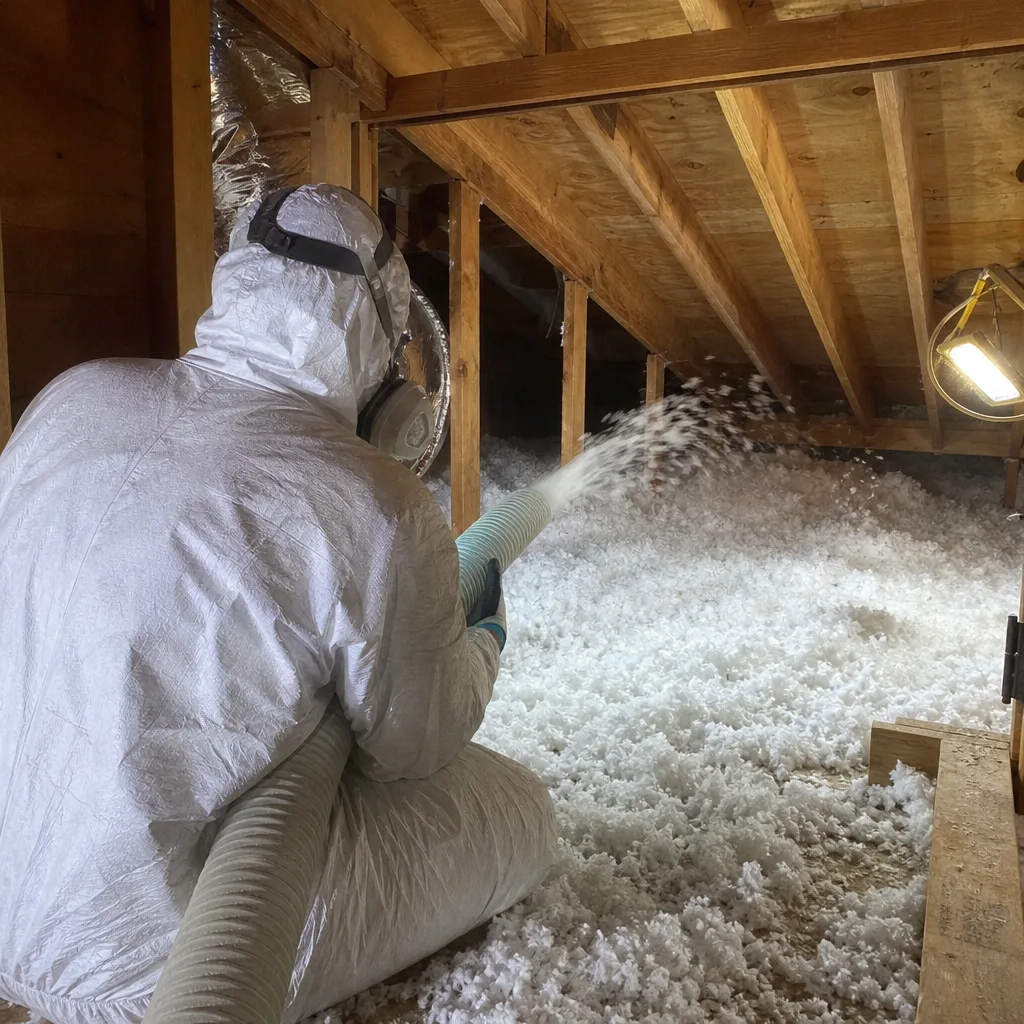
The same air-sealing work that reduces smoke infiltration also improves thermal autonomy and cuts year-round energy use. In a Rancho Santa Margarita home, sealing the attic floor before adding or topping off blown-in insulation is the highest-return emergency preparedness step available. Our Blown In Insulation in Rancho Santa Margarita page covers what that process involves in detail.
The One-Hour Emergency Insulation Audit
You can identify the specific gaps that most compromise your thermal holdout time in about sixty minutes. This audit does not require specialized equipment beyond a flashlight, a tape measure, and a stick of incense or a candle. The goal is to find where attic air enters the living space and where insulation coverage is thinnest.
Here is the step-by-step process we recommend for Rancho Santa Margarita homeowners:
- Locate and inspect the attic hatch (10 minutes). From inside the house, check if the hatch has weatherstripping around its perimeter and weight on top. If you can see light around the edges or feel air movement, the hatch is unsealed. From the attic side, it should have an insulated lid, not bare drywall.
- Check recessed light fixtures from below (5 minutes). Look at the trim ring. If there are small slots or louvers in the trim, it’s a non-sealed fixture that ventilates attic air into the room. On a smoke-prone day, these fixtures will show dust streaks around the trim ring after a few years, which is a telltale sign of attic airflow.
- Measure insulation depth in at least six attic locations (15 minutes). Use your tape measure. If you find 14 inches in one corner and 4 inches near the eaves, you have a coverage problem. Uneven coverage matters more than average depth. In Rancho Santa Margarita’s tract-home construction, the areas over garages, hallways, and above stairwells are frequently under-insulated.
- Look for wall top plate gaps at interior walls (10 minutes). From the attic, you may see fiberglass batts pushed away from the drywall where an interior wall intersects the ceiling. A 2-by-4 top plate with no insulation over it creates a direct thermal bridge from the attic into the wall cavity and down into the room.
- Check bathroom fan and plumbing vent penetrations (10 minutes). Each penetration through the attic floor should be sealed with foam or caulk at the drywall level. If light passes through the annular gap around a vent pipe, attic air is entering the stud bay.
- Do a smoke test at the attic hatch (10 minutes). Turn on kitchen and bathroom exhaust fans to depressurize the house. Hold a lit incense stick near the attic hatch seam. If the smoke stream pulls toward the hatch, the seal is failing under negative pressure, which is exactly what happens during a smoke intrusion event.
After the audit, prioritize repairs in this order: seal the attic hatch, seal or box recessed fixtures, seal wire and pipe penetrations, add insulation over wall top plates, and then even out insulation depth. Our Seasonal Insulation Care for Rancho Santa Margarita: Year-Round Homeowner’s Guide covers maintenance timing to keep these fixes effective. In our experience, fixing the top three items can extend a Rancho Santa Margarita home’s thermal holdout time by 60-90 minutes on a hot day, and it dramatically slows smoke entry during the next fire event.
Post-Wildfire Insulation Assessment
After smoke or ember exposure, common insulation materials behave differently. Understanding which materials are recoverable and which need remediation helps you make a sound decision instead of either ignoring the problem or paying for a full replacement that may not be necessary.
Here is what smoke and ember exposure actually does to the common insulation types found in Rancho Santa Margarita homes:
- Fiberglass (batts and blown-in): the glass fibers themselves are inert and do not absorb smoke odor into the material structure. However, dust and soot particulate can settle on exposed surfaces, especially on batts facing upward in an open attic. In most cases, surface contamination can be lifted with a HEPA vacuum attachment, and the material remains functional. If the fiberglass is wet from firefighting water and has compressed, it should be replaced because wet fiberglass loses its loft permanently.
- Cellulose: smoke odor is typically recoverable because the material is treated with borates that do not bind smoke molecules. But compressed or water-damaged cellulose from firefighting activity must be removed. Damp cellulose clumps, settles, and creates channels for air movement.
- Mineral wool (Rockwool): inert, non-combustible, and highly resistant to smoke absorption. Rockwool products do not support smoldering and will not off-gas smoke odor the way some other materials can. If surface soot is present, HEPA vacuuming is sufficient. This is one reason some Rancho Santa Margarita homeowners choose Rockwool batts after a fire event when they want a material that adds fire resistance to the wall assembly.
- Closed-cell spray foam: this is the material to watch carefully. Closed-cell spray foam has a plastic facing and cellular structure that can absorb and retain smoke-odor compounds, especially when smoke is hot and carries volatile organics. If closed-cell foam has direct charring, it must be cut out and replaced. If it only has surface soot, scrubbing followed by an odor-sealing primer may be adequate, but lingering odor months later is common. Some spray foam facings also off-gas breakdown products after exposure to temperatures above 200°F.
- Open-cell spray foam: the open cellular structure is more porous and holds smoke odor more readily than closed-cell. If the foam was not charred but smells strongly of smoke after cleaning, remediation often means replacement.
After any significant fire event near Rancho Santa Margarita, we recommend a professional attic inspection that includes odor testing, moisture readings, and an assessment of material integrity at roof-deck level. Do not attempt to remediate charred spray foam yourself. Removing it requires full respiratory protection, and the replacement point requires understanding how the existing foam is integrated with the roof assembly.
Insulation and Backup Power Planning
If you are considering a home battery system or whole-home generator, the single most cost-effective step is to improve the thermal envelope before sizing the backup system. The reason is simple arithmetic: an 18 SEER air conditioner in a leaky, under-insulated Rancho Santa Margarita home may run 10-12 hours per day to hold 78°F. The same AC in a well-insulated, air-sealed home may run 5-6 hours per day for the same setpoint. That runtime difference directly determines how much battery capacity you need to ride out a two-day outage.
Here is a realistic example for a 2,200-square-foot RSM home:
- Current state: R-19 attic insulation, unsealed attic floor, single-pane or thin dual-pane windows. AC draws roughly 3.5 kW when running. Cooling-only demand during a hot August day may be 30-38 kWh per day. A 13.5 kWh battery would be exhausted in 10-14 hours running HVAC plus baseline loads, and that assumes no other major draws.
- After upgrade: R-38 to R-49 attic insulation, air-sealed top plate, hatch gasketed, window gaps sealed. Cooling demand drops to 15-20 kWh per day. The same 13.5 kWh battery now covers 16-20 hours, and the home holds temperature longer between compressor cycles.
The battery cost difference between maintaining comfort for 24 hours versus 48 hours can be $15,000 to $30,000. An insulation upgrade on the same home is often $3,000 to $8,000, depending on material choice and square footage. In other words, the insulation pays for itself several times over when it shrinks the backup power system you actually need. This is one of the most under-discussed points in emergency planning conversations we have with Rancho Santa Margarita homeowners. For Insulation Permits, Codes & Inspections in CA: What You Need to Know, see our dedicated guide.
Spray foam insulation plays a particular role here for homes with attic-mounted HVAC equipment or ductwork in the attic. A conditioned attic with Spray Foam Insulation in Rancho Santa Margarita keeps the air handler and ducts inside the thermal boundary, which reduces AC energy draw on a hot day by 20-30% compared to the same equipment in a vented attic at 140°F. That reduction carries directly over to your backup power budget.
Material Selection for Emergency Performance
Not every insulation material performs the same way in an emergency. When we talk to Rancho Santa Margarita homeowners about preparing for wildfire and outage scenarios, three characteristics rise to the top: fire resistance, thermal stability at high attic temperatures, and how the material behaves if it gets hot or wet.
Rockwool (mineral wool) stands out for fire resistance. It is non-combustible, does not ignite, and will not contribute fuel to a fire that reaches the attic. Its melting point exceeds 2,000°F, and it maintains insulating performance at temperatures where fiberglass facings have already failed. Rockwool batts are dense, which means they hold their R-value and position over time better than fiberglass in high-temperature attics. For homeowners on the urban-wildland interface above and around Rancho Santa Margarita, Rockwool in the attic floor or wall cavities is a defensible choice for fire-hardening reasons alone, and it also provides measurable sound reduction, which matters when sirens and helicopters are part of the event.
Knauf and CertainTeed fiberglass products are widely specified because they’re cost-effective, readily available in R-38 and R-49 formulations, and inert under smoke exposure. Their limitation in emergency scenarios is that batts only perform to spec if installed without gaps, compression, or voids, and they depend entirely on air-sealing for smoke resistance. Blown-in fiberglass from the same manufacturers performs well in open attic floors where the installer achieves consistent depth.
For dedicated air-sealing and the highest thermal resistance per inch, closed-cell spray foam from brands like Demilec or open-cell Icynene changes the behavior of the attic itself. A sealed, conditioned attic is the strongest emergency configuration for both thermal holdout and smoke resistance because the building envelope moves to the roofline, eliminating the leaky attic floor problem entirely. The trade-off is cost. We discuss the material decision in more depth on our Orange County Insulation home page and the specific service pages linked throughout this guide.
Common Mistakes to Avoid
- Assuming new windows will solve smoke and heat problems. Windows are a small fraction of the building envelope. A Rancho Santa Margarita home with new dual-pane windows but R-19 attic insulation and unsealed attic penetrations will still gain heat and smoke through the ceiling, which is the primary pathway. Fix the attic first.
- Adding insulation without air-sealing first. Blowing R-38 over a leaky attic floor is like adding a thicker down jacket over a windbreaker with the zipper open. Air movement through ceiling penetrations will short-circuit the insulation’s performance. Seal first, then insulate.
- Venting the attic more aggressively during a smoke event. Ridge vents, gable vents, and powered attic fans pull more outside air through the attic. If the attic floor is leaky, that pulls more smoke into the house. More attic ventilation is good for moisture control but does not help smoke intrusion, and increasing airflow without ceiling sealing makes it worse.
- Plugging up all vents during a fire event. Some homeowners tape over eave vents thinking it will keep smoke out. In practice, it traps heat in the attic, raises roof deck temperatures, and can pull smoke-laden air into the living space through any remaining ceiling gap because of stack effect. Leave the vents functional; focus on the ceiling plane.
- Replacing insulation solely because it smells smoky after a fire event. Smoke odor on fiberglass or mineral wool surfaces often responds to HEPA vacuuming and time. Replacing insulation prematurely costs thousands. But if the smell persists after 6-8 weeks or the material was water-saturated, replacement is justified. The distinction matters.
- Overlooking the garage in outage planning. Many RSM homes have attached garages with shared walls and ceiling cavities open to the attic. Uninsulated garage ceilings mean the garage becomes a 120°F room that heats adjacent bedrooms through the shared wall. Insulating the garage ceiling and shared wall extends thermal holdout in the living space.
When to Call a Professional
Some insulation work is genuinely DIY-friendly: weatherstripping an attic hatch, sealing a simple pipe penetration, adding weight to an uninsulated hatch lid. But several emergency-preparedness tasks should be handled by a specialist with the right equipment and product access. You should call a professional when your attic has evidence of uneven coverage that requires a reblow, when you need air-sealing that involves sealing recessed fixtures or wall top plates, when you are considering converting a vented attic to a conditioned attic with spray foam, or when you need a post-fire assessment after a nearby wildfire event. Spray foam installation in particular requires controlled temperature and humidity conditions, proper PPE, and a manufacturer-certified installer to avoid off-gassing problems and substrate adhesion failures. Orange County Insulation offers free estimates in Rancho Santa Margarita. Call (877) 680-3557 to schedule an insulation evaluation that includes your attic’s emergency thermal performance.
Frequently Asked Questions
Insulation slows the rate of heat gain into your home after the air conditioner stops running. A well-insulated RSM home with R-38 or better attic insulation and effective air-sealing will stay within 10°F of its starting temperature for 4-6 hours on a hot day, versus 1-2 hours for an under-insulated home. This thermal buffer is what allows you to stay in the home safely during a short outage while you decide whether to evacuate or activate backup power. Call (877) 680-3557 to discuss what your current insulation is providing in terms of thermal holdout time.
Insulation alone cannot keep smoke out, but air-sealing, which is done alongside insulation, is the biggest lever you have. Sealing the attic floor plane, attic hatch, recessed lights, and wall top plates reduces the air exchange between the attic and living space that carries PM2.5 into bedrooms and hallways. A tightly sealed home can hold indoor particulate concentrations at a fraction of outdoor levels for several hours during a smoke event. The insulation material matters less for smoke than the quality of the air-sealing work done at the drywall plane.
For Rancho Santa Margarita’s inland Orange County climate, R-38 is the minimum we recommend for meaningful thermal holdout time, and R-49 is better for homes that want to maximize outage comfort. Current California Title 24 requires R-38 minimum, but many older RSM homes sit at R-19 or less. Call (877) 680-3557 for a free attic inspection to see what you actually have up there.
Usually not, unless the material is charred or water-saturated. Surface soot on fiberglass or mineral wool can be HEPA-vacuumed and the material remains functional. Closed-cell spray foam that was exposed to high heat may absorb odor compounds that do not dissipate, and charred foam must be removed. Have a professional assess the specific material in your attic before committing to replacement. The cost difference between remediation and replacement is significant.
Yes, and the effect is substantial. Air-sealing and upgrading attic insulation typically cuts cooling energy demand by 30-50% in a Rancho Santa Margarita home. Because battery capacity is sized to the home’s hourly energy draw during an outage, reducing that draw by a third to a half can shrink the required battery system by one or two units, saving $10,000 to $30,000. The insulation upgrade costs a fraction of that and keeps paying back every year in lower bills. Call (877) 680-3557 to get a realistic picture of what your home’s post-upgrade energy demand would look like.
Weatherstripping and insulating the attic hatch is the single fastest, cheapest, highest-return fix. It takes under an hour, costs $30-$80 in materials, and seals one of the largest intentional openings between the attic and living space. After that, replacing non-sealed recessed can lights with sealed LED retrofit kits or installing airtight boxes over the cans are the next steps. Both are DIY-accessible if you can work safely from the attic floor or below the ceiling without stepping onto drywall.
The Bottom Line
Rancho Santa Margarita sits at the intersection of two recurring emergency scenarios: wildfire smoke events and heat-driven power outages. Insulation is the quiet variable that determines how comfortable and safe your home remains in both situations. A well-sealed, properly insulated attic buys you hours of thermal holdout time when the AC dies, keeps particulate concentrations low when smoke rolls over the hills, and shrinks the backup power system you might otherwise need to buy. The audit takes an hour. The fixes range from a $50 hatch seal to a full attic reblow. Start with the attic floor plane, seal before you insulate, and call (877) 680-3557 if you want a professional assessment of where your home stands before the next emergency, not after it.
Written by the team at Orange County Insulation, serving Rancho Santa Margarita since 2013. Browse more guides & resources on home insulation and energy efficiency.