
Last updated October 31, 2026
The Complete Attic Insulation Guide for Rancho Santa Margarita Homeowners
The Complete Guide to Insulation in Rancho Santa Margarita is different from most attic insulation guides written for “Southern California” as if Trabuco Canyon and the coast are the same place. They’re not. Rancho Santa Margarita sits in a thermal bowl behind the Santa Ana Mountains, where summer highs regularly climb 15 to 25 degrees above what Laguna Beach feels on the same afternoon. That temperature gap changes everything about what R-value your attic actually needs, how your insulation should be installed, and why the standard California one-size-fits-all advice falls short. This guide builds a specification around RSM’s real conditions: canyon heat, cool night swings, Santa Ana wind cycles, and the three attic configurations common in our tract homes.
Quick Answer
Attic insulation in Rancho Santa Margarita should target R-49 to R-60 for most homes, exceeding California’s Title 24 minimum of R-38, because inland summer heat loads and Santa Ana wind infiltration demand more thermal resistance than coastal specifications assume. The most effective approach starts with air sealing the attic floor, then adding blown cellulose or fiberglass to the correct depth, or installing spray foam at the roofline for cathedral and vaulted ceiling configurations. For most RSM tract homes built between 1985 and 2010, upgrading from the original R-19 or R-30 batts to R-49 or higher cuts cooling costs measurably and eliminates the “upstairs won’t cool down” problem that plagues two-story floorplans in this climate.
Table of Contents
- Why Rancho Santa Margarita’s Climate Demands More Than Title 24 Minimums
- The Three Attic Types in RSM Homes and How Insulation Strategy Differs
- Santa Ana Winds and Air Infiltration: Why Sealing Comes First
- How to Read Your Current Insulation and Calculate Your Actual R-Value
- Product Matchups for RSM Conditions: Cellulose, Batts, and Spray Foam
- When Spray Foam at the Roofline Is Worth the Premium
- What Attic Insulation Costs in Rancho Santa Margarita
- DIY vs. Professional Installation: What Actually Matters
Why Rancho Santa Margarita’s Climate Demands More Than Title 24 Minimums
California’s Title 24 building code sets a minimum attic insulation level of R-38 for new construction in our climate zone. That number was written as a statewide compromise, and it does not reflect what happens in Rancho Santa Margarita between June and October. We regularly see attic temperatures in RSM reach 130°F to 145°F during peak afternoons, while nighttime temperatures drop into the 50s and 60s. That 70-degree daily swing means your attic insulation is working harder than it would in almost any coastal Orange County city.
Here’s the practical implication: R-38 slows heat transfer, but at 140°F attic temperatures, the heat still moves through. The thermal driving force, the temperature difference between your attic and your conditioned living space, is simply larger here. R-49 cuts that heat flow by roughly 23 percent more than R-38. R-60 cuts it another 18 percent beyond R-49. Those numbers translate directly into how many hours your air conditioner runs on a 95-degree day, and how comfortable your upstairs bedrooms feel by 4 p.m.
Our recommendation for Rancho Santa Margarita specifically: R-49 minimum for flat-ceiling attics with standard ventilation, R-60 if you have a dark-colored roof or an attic that receives full afternoon sun. Homes on the western slopes near Canada Vista or along Antonio Parkway with unshaded southern exposures benefit most from the higher spec. The extra two or three inches of insulation costs a few hundred dollars more on most jobs and pays back through reduced cooling load every summer you live in the home.
The Three Attic Types in RSM Homes and How Insulation Strategy Differs
Rancho Santa Margarita’s housing stock breaks down into three primary attic configurations, and each one requires a different insulation approach. Knowing which one you have determines what your options are before anyone gives you a quote.
1. Standard Flat-Ceiling Attic with Access Hatch
This is the most common configuration in RSM’s tract neighborhoods built from the late 1980s through the 2000s: Trabuco Highlands, Robinson Ranch, and most of the original Rancho Santa Margarita Village. These homes have a ventilated attic space above a flat ceiling, with insulation laid on the attic floor. The strategy here is straightforward: air seal the attic floor, then blow insulation to the target depth. Both fiberglass and cellulose work well. The hatch itself is a critical detail. An uninsulated attic hatch leaks conditioned air and loses thermal performance equivalent to leaving a window cracked open all year. We insulate and weatherstrip every hatch on every job.
2. Vaulted or Cathedral Ceilings
Homes with vaulted ceilings, common in the custom and semi-custom homes above the lake and in portions of Dove Canyon, have no usable attic floor space above the living area. Insulation must go directly against the roofline, either in rafter bays or on top of the roof deck. This is where spray foam insulation earns its keep. Open-cell foam fills the rafter cavity and air seals the roofline in one step. Closed-cell foam adds structural rigidity and a vapor barrier, which matters in the few RSM homes with exposed beam ceilings or limited rafter depth. Batt insulation can work in vaulted cavities, but it leaves air gaps unless installed with meticulous care, and it does not air seal. For vaulted ceilings in our climate, we recommend open-cell spray foam at the roofline in nearly every case.
3. Coffered or Tray Ceilings
Coffered ceilings, seen in many of the larger floorplans in Walden and along the golf course communities, create segmented attic floor elevations. These transitions are where air leaks concentrate, because framing seams and electrical penetrations follow the ceiling’s stepped geometry. Insulation depth is harder to maintain consistently across these transitions. The fix is a combination approach: foam seal the transition points, then blow insulation over the entire attic floor at a uniform depth. This gets more complex than a simple flat ceiling, which is why some contractors skip the detail work. We don’t, because these transitions are exactly where the performance gets lost.
Santa Ana Winds and Air Infiltration: Why Sealing Comes First
Santa Ana wind events are not just a fire concern. They are also a heating and cooling problem that most attic insulation guides completely ignore. During a Santa Ana cycle, wind speeds in Rancho Santa Margarita can gust 30 to 50 mph, and sustained pressure on the structure forces air through every gap in the building envelope. Your attic is the single largest collection of those gaps.
Here’s what happens in a typical RSM home during a Santa Ana event: wind pushes against the house, finding leaks at recessed light fixtures, attic hatches, plumbing penetrations, electrical drops, and drywall seams. The attic’s ridge and eave vents, designed for natural ventilation, become pressure exchange points. Conditioned air from your living space gets pulled into the attic, and hot attic air gets pushed into the house. The result is increased cooling load in summer, increased heating load in winter, dust intrusion year-round, and significantly higher energy bills during wind season.
Adding insulation over these leaks does not fix them. Fiberglass and cellulose both filter air, but neither stops it. The correct order of operations is: air seal first, then insulate. Here is the process we follow on every Rancho Santa Margarita attic job:
- Remove or move existing insulation to expose the attic floor penetrations.
- Seal every penetration with expanding foam or caulk: recessed lights (non-IC cans get foam boxes), wiring holes, plumbing stacks, duct chases, and the attic hatch perimeter.
- Repair any disconnected or leaking ductwork before re-insulating. Leaky ducts pull attic air into the living space.
- Verify vent baffles at every eave so insulation does not block soffit ventilation.
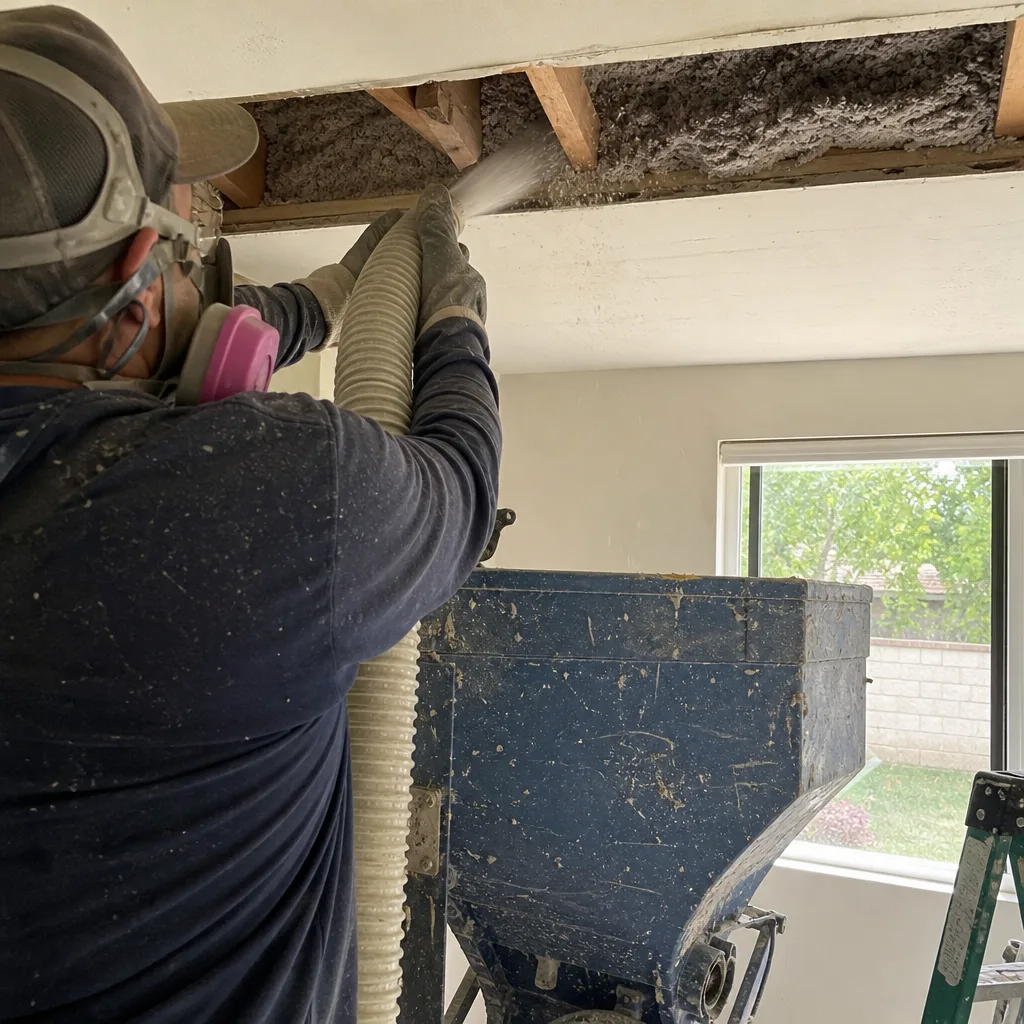
- Blow insulation to the target depth, maintaining uniform coverage across the entire attic floor.
This process adds an hour or two to the job, but it is the difference between an insulation upgrade that reduces bills and one that just looks thicker. In Rancho Santa Margarita’s wind-exposed neighborhoods, particularly on ridgelines and open hillsides, skipping air sealing means paying to insulate an attic that still leaks air through a dozen holes. Our attic insulation service in Rancho Santa Margarita includes this as standard procedure, not an upsell.
How to Read Your Current Insulation and Calculate Your Actual R-Value
Before you decide what to add, you need to know what you currently have. You can check this yourself in five minutes, without hiring anyone.
- Access your attic. Most RSM homes have a hatch in a hallway ceiling, a bedroom closet, or the garage. Use a ladder and a flashlight.
- Identify the insulation type. White, pink, or yellow fluffy material is fiberglass batt or blown fiberglass. Gray, papery, dense material is cellulose. Rigid foam boards or a hard, smooth surface indicates spray foam.
- Measure the depth. Use a ruler or a marked stick. Measure in three or four locations across the attic floor, because depth varies.
- Multiply depth by the material’s R-value per inch. Fiberglass batt: R-2.2 to R-2.9 per inch depending on age and compression. Blown fiberglass: R-2.2 to R-2.7 per inch. Cellulose: R-3.2 to R-3.8 per inch. Spray foam: R-3.6 per inch for open-cell, R-6.0 to R-6.5 per inch for closed-cell.
- Compare your number to the R-49 target. If you have six inches of old fiberglass batt, you have roughly R-15 to R-19 to be generous after settling. That is less than half of what your home needs in this climate.
One caution about old fiberglass batts: they compress over time, and R-value drops with compression. A six-inch batt that has been walked on, covered with stored boxes, or simply aged for 25 years performs closer to a five-inch batt. If your insulation is original to the home and the home predates 2000, assume it is underperforming its nominal rating. Most RSM homes built before the 2000s have R-19 or R-30 batts that are now doing R-15 to R-25 work. That gap is what you are paying for on every SDG&E bill.
Product Matchups for RSM Conditions: Cellulose, Batts, and Spray Foam
No single insulation material is “best” for every attic in Rancho Santa Margarita. The right choice depends on your attic type, your budget, and your priorities. Here is how we match products to conditions in this specific climate.
Blown Cellulose: The Default for Flat-Ceiling Attics
For most RSM tract homes with accessible attic floors, blown cellulose is the strongest all-around choice. GreenFiber’s cellulose performs at R-3.7 per inch, which means R-49 requires about 13.5 inches of depth. It settles into corners and around framing better than batts, and it resists air movement far better than fiberglass, which matters during Santa Ana wind cycles. Cellulose also carries a Class 1 fire rating, which is a comfort point in a fire-prone region. We recommend cellulose as the default for standard attics in Rancho Santa Margarita unless there is a specific reason to choose something else.
Fiberglass Batts: The Practical Choice for Specific Situations
Batts from manufacturers like Knauf, Owens Corning, and CertainTeed still have their place. They work well for walls, for rim joists, and for retrofit situations where the attic floor must remain accessible or the ceiling cannot support the weight of deep blown insulation. They are also the most economical upfront option. The tradeoff: batts leave seams and gaps unless installed painstakingly, and they do not air seal. In an RSM attic subject to wind-driven air movement, batts alone underperform their rated R-value. If you choose batts, the air-sealing step becomes even more critical.
Mineral Wool: When Fire Resistance and Sound Matter
Rockwool mineral wool insulation offers R-4.2 per inch, a higher density than fiberglass, fire resistance to 2,000°F, and sound dampening far beyond either fiberglass or cellulose. For Rancho Santa Margarita homeowners in fire-aware neighborhoods or homes close to major roads, mineral wool is a meaningful upgrade. It costs more than fiberglass or cellulose, but for the right homeowner, the fire and sound benefits justify it. We stock and install Rockwool for exactly these situations.
Spray Foam: The Right Call for Vaulted Ceilings and Problem Attics
Spray foam is the only material that insulates and air seals in one step. For homes with vaulted ceilings, attics with HVAC equipment and ductwork in unconditioned space, or rooms that will not cool no matter what has been tried, spray foam at the roofline is the definitive fix. We install both open-cell and closed-cell foam, backed by Icynene and Demilec. Open-cell foam, around R-3.6 per inch, is the workhorse for rafter bays. Closed-cell foam, at R-6.0 to R-6.5 per inch, provides maximum insulation in limited depth and adds rigidity to the roof deck. Both turn the attic into conditioned space, which changes how the whole house performs in our summer heat. For more on this option, see our spray foam insulation in Rancho Santa Margarita page.
When Spray Foam at the Roofline Is Worth the Premium
Spray foam insulation costs two to three times more than blown insulation upfront. For some homes, it is still the cheapest option over the life of the home because of what it fixes. Here are the specific situations in Rancho Santa Margarita where we recommend spray foam at the roofline without hesitation.
Vaulted or cathedral ceilings. There is no attic floor to insulate. Roofline insulation is the only option, and spray foam is the only material that fills rafter bays completely while air sealing. Any batt alternative leaves gaps that will show up as hot patches on the ceiling.
HVAC equipment in the attic. Many RSM two-story homes have the air handler and ductwork in the attic. In summer, that equipment sits in 130°F air, fighting against its own duct losses before it even starts cooling the living space. Moving the thermal boundary to the roofline with spray foam brings that equipment into conditioned space, which typically cuts cooling costs by 20 to 30 percent in our climate. For these homes, spray foam is not a luxury, it is the correct engineering solution.
Rooms that will not cool, no matter what. If you have a bedroom over the garage, a bonus room, or an upstairs west-facing room that runs eight to ten degrees hotter than the rest of the house, the problem is usually the attic above that space. Blown insulation helps some; spray foam fixes it. The difference is air sealing plus thermal boundary relocation, not just more R-value.
Santa Ana wind problem homes. Homes on exposed ridgelines in Rancho Santa Margarita, particularly in Robinson Ranch and the higher streets of Trabuco Highlands, get hammered by wind-driven air infiltration. Spray foam at the roofline creates an unbroken air barrier that no amount of caulking on the attic floor can replicate.
For everyone else, a properly air-sealed attic floor with R-49 to R-60 blown insulation delivers 85 to 90 percent of the performance at a third of the cost. That math matters, and any honest insulation contractor will tell you so. We do.
What Attic Insulation Costs in Rancho Santa Margarita
Attic insulation pricing in Rancho Santa Margarita varies by home size, attic type, and material choice. Here is what we see across our jobs in this market for a typical 2,000 to 2,800 square foot home.
| Scope | Typical Cost Range |
|---|---|
| Air sealing + blown cellulose to R-49, standard attic | $2,400 – $4,200 |
| Air sealing + blown fiberglass to R-49, standard attic | $2,200 – $3,800 |
| Roofline open-cell spray foam, vaulted ceiling home | $7,500 – $14,000 |
| Roofline closed-cell spray foam, vaulted ceiling home | $11,000 – $19,000 |
| Mineral wool batts at roofline or attic floor | $3,200 – $5,500 |
| Attic hatch insulation and weatherstripping (add-on) | $150 – $300 |
These ranges reflect Rancho Santa Margarita market pricing for 2024-2025. Home size, attic accessibility, existing insulation removal, and the condition of the attic floor all move the number. A home with a finished attic or limited headroom costs more to insulate properly. A home with asbestos-containing vermiculite insulation requires abatement before any new work, which adds significant cost. The only way to get an accurate number for your home is an inspection and quote, which we provide at no charge. Call (877) 680-3557 for a free estimate.
DIY vs. Professional Installation: What Actually Matters
You can rent a blown-in insulation machine from a big-box store and add insulation yourself. We are not going to pretend that is impossible. But there are three things that separate a DIY job from a professional one in Rancho Santa Margarita, and they are the things that determine whether your insulation actually performs.
Air sealing. Most DIY jobs skip air sealing entirely, because it requires crawling the entire attic, moving existing insulation, and sealing dozens of penetrations. That is the single most important step for performance in our wind-exposed climate. Skip it, and you have paid for thicker insulation that still leaks air.
Depth consistency. Blown insulation settles, and manufacturers specify an installed depth that accounts for settling. A homeowner running a rented blower tends to under-insulate corners and edges, where heat loss concentrates. A professional crew measures depth as they work, ensuring you get the R-value you paid for.
Ventilation preservation. Plugging soffit vents with insulation causes moisture problems, and it is one of the most common DIY mistakes we find. Vent baffles must be installed at every eave before blowing insulation, and this requires getting to the attic edges, often in tight, low-clearance spaces.
The most valuable thing a professional brings is not the ability to run a blower. It is the judgment to match the right material to the right attic, seal the right things, and not create a moisture problem. We only do insulation, and we have seen what happens when the wrong product goes in the wrong place under RSM’s specific conditions. That assessment is what you are really paying for. Our blown in insulation service for Rancho Santa Margarita includes all of this, every time.
Common Mistakes to Avoid
- Adding insulation without air sealing first. In Rancho Santa Margarita’s Santa Ana wind corridors, unsealed attic penetrations will undermine thick insulation. Sealing first is not optional.
- Using R-38 because “it meets code.” Title 24 minimums are written for statewide averages, not inland canyon heat loads. Aim for R-49 to R-60 in RSM.
- Ignoring the attic hatch. An uninsulated, unsealed hatch leaks conditioned air year-round and undercuts everything else you did. It takes 20 minutes to fix.
- Blocking soffit vents with new insulation. This causes moisture buildup and reduces attic ventilation. Vent baffles go in first, every time.
- Choosing batts for a flat-ceiling attic because they are cheaper. The upfront savings evaporate when batts leave seams and gaps in a wind-exposed attic. Blown cellulose or fiberglass covers uniformly.
- Treating vaulted ceilings like flat attics. Vaulted ceilings need roofline insulation, not attic floor insulation. The wrong approach here means hot ceilings and wasted money.
- Skipping the duct inspection. Leaky attic ducts pull 130°F air into the living space regardless of how much insulation you add. Ducts get sealed before insulation goes in.
When to Call a Professional
Call a professional if your attic has vaulted or cathedral ceilings, if your HVAC equipment and ductwork are in the attic, if you have rooms that will not cool, or if you find signs of moisture, mold, or pest damage during an attic inspection. Call if you are unsure what R-value you currently have and want an honest assessment. Call if you have an older home with original insulation and you are tired of high summer bills. A professional inspection costs nothing in most cases and tells you exactly what your attic needs. Orange County Insulation offers free estimates in Rancho Santa Margarita. Call (877) 680-3557 and we will inspect your attic, tell you what you have, and give you a straight answer on what it needs.
Frequently Asked Questions
Most homes in Rancho Santa Margarita should target R-49 to R-60, which exceeds California’s Title 24 minimum of R-38. The inland canyon climate, with summer highs regularly 15 to 25 degrees above coastal Orange County, makes the higher spec worth the incremental cost.
For a typical RSM home, air sealing plus blown insulation to R-49 ranges from $2,200 to $4,200 depending on home size, attic accessibility, and material choice. Spray foam at the roofline runs higher, typically $7,500 to $19,000, but it is the correct choice for vaulted ceilings and attics with HVAC equipment. Call (877) 680-3557 for an exact quote – estimates are free.
In most cases, adding insulation on top of existing material is more cost-effective than removing and replacing, as long as the existing insulation is dry and uncontaminated. Removal is necessary only for mold, pest damage, or vermiculite. A professional inspection determines which path applies to your attic.
Yes, if the problem is attic-related, which it usually is for upstairs rooms and rooms over garages in Rancho Santa Margarita. Air sealing plus upgraded insulation often drops room temperatures by 5 to 10 degrees. Rooms with vaulted ceilings or HVAC ductwork in the attic may need spray foam at the roofline.
Most attic insulation jobs in RSM take one day: air sealing in the morning, blown insulation in the afternoon. Spray foam jobs at the roofline typically take one to two days depending on square footage. We schedule around your availability.
Yes. Homes in RSM with original R-19 or R-30 attic insulation typically see measurable cooling cost reductions after upgrading to R-49 with proper air sealing, often in the 15 to 25 percent range. The biggest difference shows up in August and September, the hottest months in our climate.
The Bottom Line
Rancho Santa Margarita’s inland climate makes attic insulation a higher-stakes decision than most California guides suggest. The right target is R-49 to R-60, not the R-38 code minimum. The right order of operations is air sealing first, insulation second. The right material depends on your attic type: blown cellulose for standard flat ceilings, spray foam for vaulted ceilings and attics with ductwork, mineral wool for fire and sound priorities. Check your current insulation depth before you do anything else, because most RSM homes are operating at half the R-value they need. And if you want a straight answer on what your attic needs, Orange County Insulation home offers free estimates throughout Rancho Santa Margarita. We only do insulation, which means we can tell you exactly which material fits your home and why.
Written by the team at Orange County Insulation, serving Rancho Santa Margarita since 2013. For more guides & resources, visit our blog.