Last updated October 31, 2026
Insulation Permits, Codes & Inspections in CA: What You Need to Know
In California, you can pull a permit, pass a final inspection, and still end up with an attic that loses 25% more conditioned air than it should. The permit system confirms your insulation meets the state’s minimum building code. It does not confirm the insulation was installed well. That gap between code minimums and installed performance costs homeowners in Rancho Santa Margarita hundreds of dollars a year in energy costs, and it’s the single most misunderstood part of California’s insulation rules. This guide explains when you actually need a permit, what Title 24 requires in your climate zone, what inspectors look at, and where the system leaves gaps you need to close yourself. For more guides & resources on insulation and energy efficiency, visit our blog.
Quick Answer
Insulation work in California requires a building permit when it’s part of new construction, a major addition, or certain HVAC replacement projects. Simple re-insulation of an existing attic or wall cavity is typically permit-exempt. What actually matters for energy savings is Title 24 compliance, which sets specific R-value minimums by climate zone. In Rancho Santa Margarita (Climate Zone 8), that means R-30 to R-38 in attics depending on your compliance path. Passing a permit inspection means you hit code minimums; it does not guarantee the insulation performs as rated.
Table of Contents
- When a Permit Is Actually Required in California
- Title 24 and Climate Zone 8: The R-Values That Apply to Rancho Santa Margarita
- Prescriptive vs. Performance Compliance: Why the Difference Matters
- What a Title 24 Insulation Inspection Actually Checks
- What Inspections Don’t Check (and What That Costs You)
- How Permits Affect Utility Rebates and CEC Programs
- DIY Insulation vs. Contractor Installation: Where the Permit Line Moves
- Common Mistakes to Avoid
- When to Call a Professional
- Frequently Asked Questions
- The Bottom Line
When a Permit Is Actually Required in California
Most homeowners assume all insulation work needs a permit. That assumption is wrong, and it leads people to either skip a permit they need or pull one they don’t. Here’s the actual framework under the California Building Code and California Energy Code.
Insulation itself is not a separately permitted trade the way electrical or plumbing work is. The permit trigger comes from the scope of the project the insulation is part of. In practice, that means:
- New construction and full home builds: Always permitted. Insulation is inspected as part of the building envelope before drywall goes up.
- Additions of more than 120 square feet: Permitted, with insulation inspected as part of the addition’s envelope. Additions under 120 square feet may be exempt, but only if they don’t alter the existing thermal envelope.
- HVAC system replacement: This is the one that surprises people. California requires that when a central air conditioner or furnace is replaced, the contractor verify the home’s attic insulation meets the current Title 24 requirement. If it doesn’t, the permit for the HVAC work typically requires bringing insulation up to code. We see this constantly in older Rancho Santa Margarita homes built in the 1980s and 90s, where attics have R-19 or less and a furnace swap suddenly triggers an insulation upgrade.
- Major wall demolition or re-siding: If you open a wall cavity to the studs, the exposed cavity must be brought up to current code before it’s closed. The insulation becomes part of that building permit.
- Garage conversions or attic-to-living-space conversions: Always permitted, and the insulation requirements for the new living space are enforced as part of that permit.
Then there’s the permit-exempt list:
- Re-insulating an existing attic over conditioned space: Adding or upgrading attic insulation without structural alteration is generally exempt from a building permit. This is the most common insulation project we perform for Rancho Santa Margarita homeowners, and most of it goes unpermitted without any code issue.
- Blowing additional insulation into existing wall cavities: The drill-and-fill method for walls is typically permit-exempt since no structural envelope is altered.
- Air sealing and weatherization work: Caulking, can light covers, weatherstripping, and similar envelope sealing don’t require permits.
- Insulating a crawl space or rim joist area of an existing home: Generally exempt unless it’s part of a larger remodel.
The practical takeaway: if you’re replacing old, settled, or rodent-damaged insulation in an existing home and not changing the structure, you likely don’t need a permit. If your project involves new square footage, HVAC replacement that triggers an insulation requirement, or conversion of an unconditioned space to conditioned space, you do. When in doubt, ask the building department for a written determination. Orange County’s building officials are generally responsive to homeowners who ask before they start, and the answer protects you from correction notices later.
A note on contractor responsibility: any licensed contractor doing permitted work in California is required to obtain the permit in their name or the homeowner’s name before work begins. We handle this for any project that requires it, including in Rancho Santa Margarita where the city issues permits through Orange County’s central building division. For attic insulation upgrades in Rancho Santa Margarita, most jobs fall into the permit-exempt category, which simplifies the process considerably. But we always verify against the current code cycle before we quote, because the line moves.
Title 24 and Climate Zone 8: The R-Values That Apply to Rancho Santa Margarita
California divides the state into sixteen climate zones under Title 24, Part 6 of the California Code of Regulations. Rancho Santa Margarita sits in Climate Zone 8, which is the state’s designation for the hot inland valleys and foothill areas of southern California. Zone 8 is characterized by hot, dry summers and mild winters. That climate profile shapes every R-value requirement in the code.
For Climate Zone 8, here are the prescriptive R-value minimums that apply to wood-framed residential construction:
- Attic insulation (ceiling below vented attic): R-30 minimum for the prescriptive path. Under the performance path, most homes end up between R-30 and R-38 depending on other envelope features. R-38 is common in homes with high window-to-wall ratios or west-facing glass loads, which are common in Rancho Santa Margarita’s newer neighborhoods.
- Walls (wood framed, 2×4 or 2×6): R-13 cavity insulation for 2×4 framing, R-19 for 2×6 framing. If you’re using a high-mass wall system like concrete or masonry, the numbers differ. If you’re doing a stucco or plaster finish, the code may give you credit that changes insulation requirements.
- Floors over unconditioned space: R-19 minimum. This matters for Rancho Santa Margarita homes with raised foundations or uninsulated crawl spaces.
- Slab edge insulation: Not required in Climate Zone 8 for standard slab-on-grade construction, which is good news for the many RSM homes on slabs.
- Duct insulation in unconditioned spaces: R-8 minimum if ducts run through the attic or crawl space. This is a separate requirement from building insulation, but it’s checked in the same Title 24 verification.
These numbers are the code minimums on the date of writing, and they shift with each code cycle. California updates Title 24 every three years, and each cycle typically raises attic requirements slightly. The 2022 code cycle took effect January 1, 2023, and the next cycle is on the horizon. A licensed contractor in Rancho Santa Margarita will design to the cycle in effect when your permit is pulled, not the one from your original build year.
One point that often confuses homeowners: the R-value on the label is not the R-value you get from the installation. Fiberglass batts must be installed without compression, voids, or gaps to achieve their rated performance. Blown-in insulation must settle to the right depth and be installed at the right density. Spray foam must be applied at the specified thickness and without voids against the sheathing. The code assumes a “properly installed” baseline, but the inspection system only catches the most obvious defects. For a deeper look at what to watch for, see our Insulation Warning Signs: A Rancho Santa Margarita Homeowner’s Reference Guide.
Our material lineup reflects the range of ways to hit these R-values. Spray foam insulation in Rancho Santa Margarita, for example, achieves higher effective R-values per inch than batts, which matters in tight attic configurations where depth is constrained. For standard attic floor applications, blown-in products from Owens Corning, GreenFiber, or Johns Manville are among the most cost-effective ways to reach R-38 in Zone 8. Mineral wool from Rockwool offers a denser, more fire-resistant option for walls. The right material depends on your specific framing, roof pitch, and budget.
Prescriptive vs. Performance Compliance: Why the Difference Matters
Title 24 gives builders and homeowners two paths to demonstrate energy code compliance. Most people don’t know they have a choice, and the choice can save thousands of dollars.
Prescriptive compliance is a checklist. You meet or exceed every individual minimum requirement: attic R-30 minimum, wall R-13 or R-19, window U-factor and SHGC maximums, duct R-8, and so on. If you check every box, you pass. It’s simple, but it’s rigid. You can’t trade off a better window for slightly less attic insulation, even if the trade would save more energy overall.
Performance compliance uses computer simulation. A certified energy analyst models your entire home, including orientation, window area, shading, insulation levels, HVAC system type, and local climate data for your specific California climate zone. The model determines whether your home as a whole uses no more energy than a reference building built to prescriptive standards. If it does, you pass, even if individual components don’t meet prescriptive minimums.
Why would a Rancho Santa Margarita homeowner choose performance compliance?
- You can make smarter trade-offs. If your attic is difficult to access and reaching R-38 would require costly structural work, you can compensate with better windows, a more efficient HVAC system, or added wall insulation and still pass.
- You can use materials that fit the situation rather than the checklist. Closed-cell spray foam in a cathedral ceiling might perform better than the prescriptive alternative even if it doesn’t map neatly onto the checklist numbers.
- You can lower total project cost. Prescriptive compliance sometimes forces you to spend money where it has the least energy impact. The performance path lets you direct your budget where it matters most for your house.
The trade-off: performance compliance requires a certified energy consultant and a more detailed documentation package. That adds upfront cost, typically a few hundred to a couple thousand dollars depending on project complexity. For a small insulation-only project, it rarely makes sense. For a major remodel or addition, it often does.
We see this play out routinely in Rancho Santa Margarita. A homeowner rebuilding a patio cover into a conditioned room, for instance, may find the prescriptive path requires wall insulation that’s difficult to install in an existing 2×3 framing condition. The performance path may let them compensate with increased attic insulation and improved glazing. That’s a real cost difference and a real comfort difference in a city where summer afternoons regularly push into the 90s.
Understanding this distinction also makes you a smarter consumer when you’re comparing bids. A contractor who says “we’ll just meet code” is describing prescriptive compliance. A contractor who says “we’ll model this and see what makes sense” understands the performance option. It’s one of the first things we discuss with clients who are doing permitted additions or envelope overhauls.
What a Title 24 Insulation Inspection Actually Checks
If your project does require a permit, the insulation work will be inspected before walls are closed or before final sign-off on an attic installation. Here’s what the inspector is looking for, step by step:
- Material type and R-value verification. The inspector checks the insulation material against the plans and the Title 24 compliance documentation. Batts must be labeled with the R-value. Blown-in product must match the specified type and depth. Spray foam must be the specified formulation and thickness.
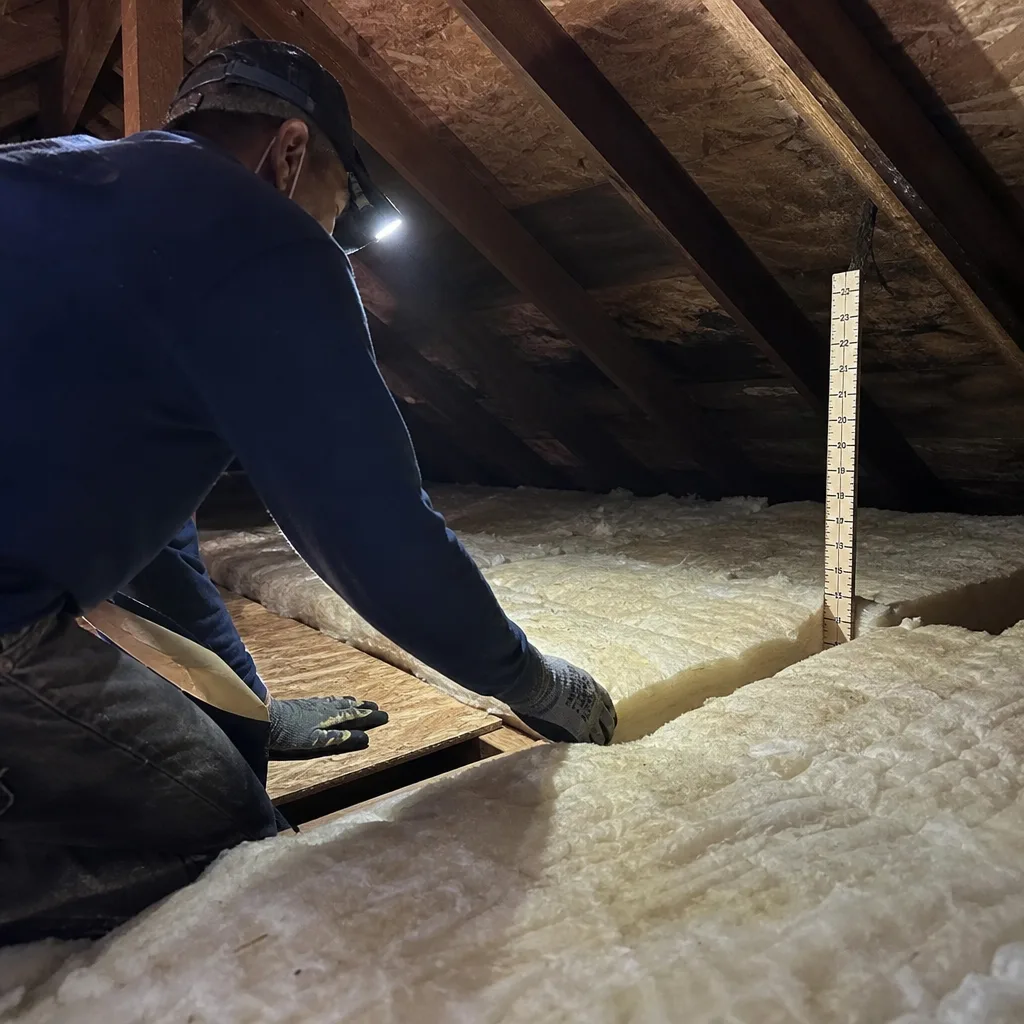
- Ceiling depth markers or thickness verification. For blown-in attic insulation, the installer should place depth markers throughout the attic so the inspector can verify consistent depth. Expect the inspector to walk the attic or view it from the access hatch.
- Wall cavity coverage. If walls are open at the time of inspection, the inspector checks that all cavities are filled, that batts are not compressed, and that there are no gaps around electrical boxes, plumbing, or blocking.
- Duct insulation condition. If the HVAC ducts run through the attic or crawl space, the inspector verifies R-8 duct insulation and checks for disconnected or crushed ducts. This is technically a mechanical inspection item, but it’s often checked in the same visit.
- Air barrier and ventilation clearance. Inspectors check that eave vents are not blocked by loose-fill insulation, which would reduce attic ventilation and create moisture problems. Baffles or vent chutes should be installed where needed.
- Envelope penetrations. The inspector looks at ceiling penetrations like recessed lights, attic hatches, and plumbing stacks to check they’re sealed or insulated appropriately. Older recessed lights often require a sealed, rated box before insulation can cover them.
These checks are thorough at the code-compliance level. They catch missing insulation, wrong R-values, and most gross installation defects. What they don’t catch is the subtler stuff that determines real-world performance. The inspection system in California is good at enforcing minimums. It is not designed to measure quality.
What Inspections Don’t Check (and What That Costs You)
Here’s the gap we’ve been building toward. In our experience working in Rancho Santa Margarita and the surrounding southern Orange County communities, here’s what a passing inspection does not guarantee:
- Thermal boundary continuity. An inspector checks that insulation is present. They don’t measure whether the thermal boundary is continuous from conditioned space to attic. A single unsealed interior wall top plate can leak more air than a four-square-foot hole in the ceiling, and it won’t be flagged.
- Air sealing quality. Title 24 has air leakage requirements, but the real-world performance difference between a house with 1,500 CFM50 of leakage and one with 3,500 CFM50 is enormous, and both can pass inspection. Sealing around can lights, plumbing penetrations, electrical boxes, and top plates is where the real energy savings live.
- Compression and density quality. A batt stuffed into a cavity at 80% of its rated loft passes a visual check. It also performs at roughly 80% of its R-value. Blown-in fiberglass fluffed too loosely settles more than specified, reducing R-value over time.
- Thermal bridging. Standard wall inspection doesn’t account for the fact that wall studs create thermal bridges. Advanced framing techniques or continuous exterior insulation improve real-world performance, but neither is required by the prescriptive path in Climate Zone 8.
- Moisture and ventilation interactions. Insulation can be installed correctly and still cause moisture problems if ventilation is inadequate or if a vapor-impermeable product is used where it shouldn’t be. Inspectors look at obvious issues, but they’re not running hygrothermal models.
The cumulative effect of these unchecked factors is significant. Independent studies conducted by the Department of Energy and various utility research programs have found that installed insulation performance typically falls 15% to 30% below rated values due to installation quality issues that would not fail a visual inspection. Let that sit: a Rancho Santa Margarita home can have a “code-compliant” R-38 attic that actually performs like R-28. The permit passed. The inspection passed. The house is still losing conditioned air through the ceiling at a much higher rate than the compliance documents assume.
This is why we tell homeowners that the permit is the beginning of the conversation, not the end. If you want the energy performance to match the numbers on the paperwork, someone on the job needs to care about installation quality in a way the inspection system does not. That’s the difference between a contractor who treats insulation as a task to complete and one who treats it as a system to optimize. We only do insulation, which means the quality of the install is the entire job, not a line item.
For homeowners in Rancho Santa Margarita specifically, this matters because of your summer electric bills. Southern California Edison rates during peak summer hours make attic insulation performance directly measurable in dollars. A 25% performance shortfall in an R-38 attic might mean an extra $200 to $400 per year in cooling costs depending on home size and thermostat habits. Over the lifespan of the insulation, that’s a five-figure loss on a project that cost a fraction of that to do correctly in the first place.
How Permits Affect Utility Rebates and CEC Programs
Here’s a point that’s rarely covered in “do I need a permit” articles: your permit status can affect whether you qualify for energy efficiency rebates, even if your insulation work was otherwise done well.
California’s investor-owned utilities (SCE, SDG&E, PG&E) administer rebate programs for residential energy efficiency improvements. Historically, the attic insulation rebate programs required proof that the work was permitted and inspected, or at minimum that a certified contractor performed the work to program standards. If a homeowner did unpermitted work or used an unlicensed contractor, the rebate application could be denied. The California Energy Commission’s statewide incentive programs have similar verification chains.
The logic is straightforward: rebate programs are funded by utility ratepayers and are intended to produce measurable energy savings. A permit and inspection give the program administrators a third-party verification that the work actually happened and met baseline code standards. Unpermitted work has no independent verification, so the program administrators can’t confirm the savings are real.
There’s a practical implication for homeowners in Rancho Santa Margarita considering a DIY or unpermitted insulation job to save money:
- The utility rebate for attic insulation in SCE territory has ranged from $0.15 to $0.30 per square foot in recent program cycles, depending on whether you’re working with an approved contractor and meeting specific program requirements.
- For a 1,500-square-foot attic, that’s $225 to $450 in rebate value.
- If the unpermitted work disqualifies you from the rebate, your “savings” from skipping the permit evaporates quickly, and you’ve also lost the independent inspection that protects you from installer error.
The calculation changes if your project is permit-exempt, which as we covered above is true for many straightforward attic re-insulation jobs in existing homes. In those cases, the rebate programs generally don’t require a permit that wasn’t legally required in the first place. What they do require is installation by a participating, licensed contractor who follows program installation standards. That’s a separate track from the building department.
Our practical advice: before you decide whether to permit or skip, check the active rebate program requirements for your project type in SCE territory. The rebate landscape shifts, and the specific requirements for insulation projects have changed several times in the past decade. If you’re working with us on an attic project in Rancho Santa Margarita, we’ll tell you the current rebate landscape and whether your project qualifies. The permit status question is part of that evaluation, not a separate decision.
DIY Insulation vs. Contractor Installation: Where the Permit Line Moves
California law allows homeowners to perform work on their own residence without a contractor’s license, provided the homeowner does the work themselves and lives in the home. That includes insulation work. It does not mean the permit requirements change if the work falls into the permit-required category, but homeowner-performed work does have some different rules.
Here’s the practical breakdown:
- Permit-exempt insulation work (existing attic, drill-and-fill walls): A homeowner can legally do this work themselves without a permit or license. This is where DIY savings are most real. The material cost for a 1,200-square-foot attic upgrade is typically $600 to $1,200 depending on R-value target and material type. Contract labor might add $800 to $2,000. If you’re capable, the DIY math works.
- Permit-required insulation work (addition, HVAC-triggered upgrade, envelope change): A homeowner can still do the work themselves if they pull the permit as owner-builder. But the owner-builder takes on all liability for code compliance, all responsibility for scheduling inspections, and all risk if something fails after the fact. The owner-builder permit also requires the homeowner to either do the work personally or hire licensed subcontractors. You cannot act as owner-builder and use unlicensed labor.
- Spray foam insulation of any kind: Spray foam is a different animal. Two-component spray foam requires specialized equipment, chemical handling knowledge, and temperature and humidity management during application. Mistakes are expensive to fix and can create indoor air quality problems that don’t show up for months. This is not a DIY product. We use Icynene for open-cell applications and Demilec for closed-cell, and both product lines require manufacturer certification for installers. There’s a reason no homeowner supply store rents spray foam rigs.
The marketplace for insulation in Rancho Santa Margarita spans the full range from weekend DIY to full-service specialty contractors. What we observe is that DIY attic insulation jobs are the most common homeowner insulation project, and they’re also the most common source of callbacks we see: insulation installed without air sealing, compressed batts in tight corners, blocked soffit vents, inadequate depth, missed areas above the garage or above a room addition, and the list goes on. The material cost is the same whether the job is done well or poorly. The performance difference is what you paid for.
Our general guidance: if you’re comfortable in your attic, have the time, and your project is a straightforward blown-in upgrade over an existing floor, DIY can work. If your project involves spray foam, vaulted ceilings, floor insulation over a crawl space, or any permit-required scope, hire someone who does this every day. For more on the material selection side of DIY, see our guide on blown-in insulation options in Rancho Santa Margarita.
We started with one material: attic insulation. That narrow focus is what built the expertise that now spans eight manufacturer brands, including Owens Corning, Johns Manville, and GreenFiber. The right material for your home depends on your framing, your budget, and your goals, and a specialist can explain the trade-offs in a way a generalist cannot.
Common Mistakes to Avoid
- Assuming a permit equals performance. We’ve covered this extensively above, but it bears repeating: the inspection system verifies compliance, not quality. If you want an R-38 attic to actually perform at R-38, installation quality is the variable that matters.
- Pulling a permit for exempt work. Simple attic re-insulation in Rancho Santa Margarita typically doesn’t require a permit. Paying permitting fees and scheduling inspections for exempt work adds cost and delay with no code benefit. A knowledgeable contractor will tell you when a permit isn’t needed rather than billing you for one anyway.
- Skipping a permit for required work. The opposite error is worse. Unpermitted additions, garage conversions, or HVAC-triggered insulation upgrades create disclosure problems when you sell and can trigger correction orders from the city. If you’re unsure, get a written determination.
- Ignoring air sealing when adding attic insulation. Blowing R-38 over an unsealed attic floor is like upgrading the windows on a car with holes in the floorboards. Insulation slows conductive heat transfer; it does not stop air leakage. Seal first, then insulate.
- Choosing a material to hit a number rather than solve a problem. R-value is one variable. It matters, but so does air permeability, moisture behavior, compression resistance, and fire rating. A home in Rancho Santa Margarita with a hot, vented attic has different material needs than a cathedral ceiling or a wall cavity retrofit. Match the material to the situation.
- Blocking attic ventilation. Blown-in insulation that covers soffit vents or fills the edges of the attic to the roofline kills attic ventilation, which leads to moisture problems and shingle damage over time. Baffles are cheap. Roof repairs are not.
- Forgetting about the garage. Homes in Rancho Santa Margarita often have attached garages with uninsulated or poorly insulated shared walls and garage ceilings under bonus rooms. Those surfaces are part of your thermal envelope, and skipping them leaves a major energy leak that no amount of attic insulation fixes.
When to Call a Professional
Call a professional if your project involves spray foam, because the chemistry and application technique are unforgiving and mistakes are expensive to undo. Call if you’re insulating a cathedral ceiling, a flat roof, or any configuration where the insulation is trapped and a ventilation or moisture error won’t show up until it’s a mold or rot problem. Call if your project requires a permit and you don’t want to be the responsible party for code compliance. Call if you’re not sure whether your project requires a permit at all, because the determination is often quick and free. And call if you want the energy performance to match the paperwork, not just pass an inspection. Orange County Insulation offers free estimates in Rancho Santa Margarita. We’ll walk your attic, evaluate your envelope, and tell you honestly what needs to happen and whether a permit is part of it. Reach us at (877) 680-3557.
Frequently Asked Questions
No, in most cases adding or upgrading insulation in an existing attic over conditioned space is permit-exempt in California. The work becomes permit-required if it’s part of a larger project like an addition, an HVAC replacement that triggers insulation verification, or a conversion of unconditioned space to conditioned space. If you’re unsure, call the building department or Orange County Insulation home team at (877) 680-3557 for a quick assessment.
Rancho Santa Margarita is in Climate Zone 8, which requires a minimum of R-30 attic insulation under the prescriptive path. Most homes end up between R-30 and R-38 depending on other envelope features and whether the project uses prescriptive or performance compliance. The current code cycle applies when the permit is pulled.
Yes, and this is common. Inspections verify that insulation is present, properly specified, and meets visual coverage requirements. They do not verify air sealing quality, thermal boundary continuity, compression defects, or long-term settling behavior. Real-world installed performance typically runs 15% to 30% below rated values even in inspected homes.
It can. Utility rebate programs and California Energy Commission incentive programs typically require permitted, inspected work or installation by a participating, licensed contractor following program standards. If the work was legally permit-exempt, no permit is required for the rebate. If a permit was required and skipped, the rebate application may be denied.
The R-value requirements are the same, but spray foam triggers additional code considerations related to vapor retarders, ignition barriers, and thermal barriers when the foam is located in specific areas. Spray foam also requires the manufacturer’s specified installation protocols to meet code and fire safety standards. Both our spray foam brands, Icynene and Demilec, require certified installers for this reason.
Prescriptive compliance is a checklist where each individual component must meet its minimum. Performance compliance uses whole-building energy modeling, allowing trade-offs between components as long as total energy use stays at or below a reference building. The performance path often enables better material choices and lower total project cost in Rancho Santa Margarita remodels and additions.
The Bottom Line
California’s insulation code is designed to set a floor, not a ceiling. Title 24 establishes minimum R-values for Climate Zone 8, and Rancho Santa Margarita homeowners should know those numbers: R-30 to R-38 attic, R-13 or R-19 walls depending on framing, R-19 floors over crawl spaces. Permits matter for specific project types and for rebate eligibility, but a permit and a passing inspection do not guarantee your insulation performs at its rated R-value. The gap between code minimums and actual performance is where the money lives, and closing that gap comes down to installation quality, air sealing, and choosing materials that fit your specific envelope rather than whatever is cheapest on the shelf. Get those things right and a code-compliant insulation project becomes a genuinely high-performing one.
Call (877) 680-3557 for a free estimate, or reach out through the Orange County Insulation home page to ask any question about your project, your attic, or your permit situation. We’d rather have a conversation that saves you from a mistake than sell you an upgrade you don’t need.
Written by the team at Orange County Insulation, serving Rancho Santa Margarita since 2013.