
Last updated October 31, 2026
Attic Insulation Maintenance Checklist for Rancho Santa Margarita Homeowners
Most Rancho Santa Margarita homeowners assume their attic insulation is a set-it-and-forget-it feature. It isn’t. A study of California attics found that homes lose an average of 30% of their insulation’s effective R-value within 10 years, not because the material disappears, but because settling, compression, and moisture intrusion quietly undermine performance while the insulation still looks fine from the attic hatch. Our Attic Insulation services team sees these failure modes regularly in RSM attics, from roof rat damage to HVAC duct boot separation, and this guide gives you a maintenance routine that keeps your thermal barrier actually doing what it’s supposed to do. By the end, you’ll know exactly what to check, when to check it, and when to call a specialist who only does insulation.
Quick Answer
The attic insulation maintenance checklist for Rancho Santa Margarita homeowners comes down to this: measure your insulation depth against the original install depth every September and November (post-summer heat and post-Santa Ana winds), inspect for rodent activity and compressed zones where roof rats have nested, seal HVAC duct boot connections that have separated from the ceiling drywall, and verify that bathroom exhaust fans vent outdoors rather than into the attic. If your blown-in insulation has settled more than an inch below the original depth marker, its R-value has already dropped enough to matter, and you should have it topped off. Most of this takes under 30 minutes twice a year.
Table of Contents
- Why RSM Attics Deteriorate Faster Than You’d Expect
- The Seasonal Maintenance Calendar for Rancho Santa Margarita
- How to Measure Insulation Depth and Settling
- Rodent and Pest Pressure in the Saddleback Foothills
- HVAC Duct Boot Connections: The Overlooked Heat Leak
- Moisture and Venting Checks for RSM’s Microclimate
- What to Inspect Yourself vs. What Needs a Pro
- Common Mistakes to Avoid
- When to Call a Professional
- Frequently Asked Questions
- The Bottom Line
Why RSM Attics Deteriorate Faster Than You’d Expect
Rancho Santa Margarita sits in a climate zone that punishes attic insulation in ways coastal Orange County cities don’t experience. Summer attic temperatures regularly exceed 140°F from July through September, and the thermal cycling that occurs daily as the attic heats and cools causes fiberglass and cellulose fibers to lose loft faster than they would in more moderate climates. Add the Santa Ana wind season from October through December, which drives fine dust and debris through soffit vents and ridge vents, and you have a recipe for gradual contamination that further compresses the material. What this means in practice: a blown-in cellulose installation rated at R-38 on day one might measure closer to R-30 within five years, and closer to R-26 within ten, even with zero visible damage. The material hasn’t gone anywhere. It’s just not performing anymore.
We’ve measured installed depth in hundreds of RSM attics, and the pattern is consistent. Homes in the older sections of the city, especially those built in the 1980s and 1990s before current Title 24 energy codes went into effect, often started with marginal insulation levels anyway. When you layer 10 to 15 years of settling and rodent activity on top of that, the result is an attic that meets its R-value on paper and fails it by 25% or more in reality. The fix isn’t always a full replacement. Sometimes it’s a top-off. But you can’t know which until you measure what’s actually up there. That’s why the maintenance checklist starts with observation, not replacement. For a deeper look at what the right installation approach looks like in this city, start with Attic Insulation in Rancho Santa Margarita.
The Seasonal Maintenance Calendar for Rancho Santa Margarita
RSM’s climate dictates two specific inspection windows each year. The first falls in late September, after the peak summer heat has finished stressing your insulation and before the cooler weather arrives. The second falls in early November, after the first significant Santa Ana wind event has blown through and potentially introduced debris, dislodged vent screens, or revealed air leaks that were masked during calmer months. If you only check your attic once a year, make it November. But the ideal routine is twice annually, timed around these two weather events.
Here’s the step-by-step seasonal schedule:
- Late September (post-summer heat): Measure insulation depth, check for heat-damaged materials near can lights and flues, inspect for any signs of rodent activity that picked up during the summer breeding season, and verify that all bath fan terminations are still sealed.
- Early November (post-Santa Ana): Re-check insulation depth in the corners and near the eaves where wind-driven dust tends to settle, inspect soffit vents for debris blockage, look for any dislodged duct connections shaken loose by wind pressure differentials, and scan for new gaps around vent penetrations.
- Optional March check (post-winter rain): If winter brought unusual rainfall to Orange County, a quick moisture check is worth the effort. RSM doesn’t get much rain, but when it does, the Saddleback foothills can channel runoff and humidity into attic spaces through micro-gaps in roof decking.
The September and November checks each take 20 to 30 minutes with a flashlight, a ruler, and a notepad. You’re looking for change from the previous inspection, not perfection. If your measurements have stayed stable across two consecutive inspection cycles, you can extend the routine. If they’ve shifted, you’ve caught a problem before it became a $400 summer cooling bill.
How to Measure Insulation Depth and Settling
Measuring settled depth is the single most important maintenance task in any Rancho Santa Margarita attic, and almost no one does it. The method is simple enough to do safely from the attic access hatch, and it gives you hard numbers instead of guesswork. Here’s the process we recommend:
- Install ruler stakes during your first inspection. Drive three thin wooden dowels or yardsticks vertically into the insulation at different points: one near the attic hatch, one in the center of the attic, and one near the farthest eave. Mark the original depth on each stake. These stakes stay in place permanently and become your reference points for every future inspection.
- Record the baseline. On the day you install the stakes, measure from the top of the insulation to the attic floor and write it down. This is your “day zero” number. If you have R-38 blown-in fiberglass, expect roughly 13 to 14 inches. R-30 cellulose runs about 9 to 10 inches. If you don’t know your target depth, the insulation’s labeled R-value divided by its per-inch R-value (2.2 for fiberglass, 3.2 for cellulose, 3.5 to 4 for mineral wool) gives you the target number.
- Measure every six months. Use your stakes as reference points. If the insulation surface is now an inch or more below the original mark, settling has reduced your R-value by a meaningful amount. One inch of lost fiberglass depth equals roughly R-2.2 in lost thermal resistance. That’s a real number on your summer AC load.
- Check the corners and eaves separately. Insulation settles fastest in the outboard areas where the attic floor meets the exterior walls. These are also the areas where wind-driven dust settles and compresses the top layer. Measure these zones independently. They’re usually the first to fall below performance thresholds.
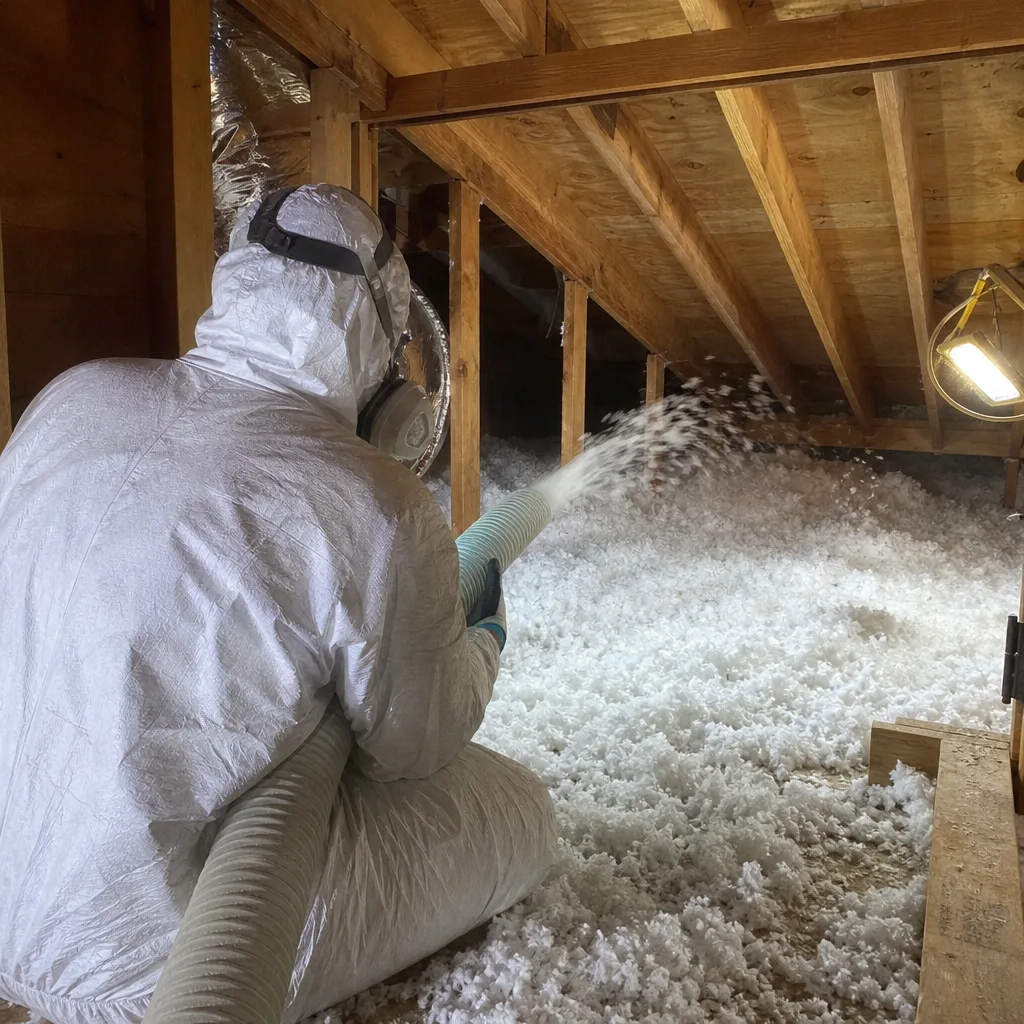
The acceptable settling threshold is 5 to 10% of original depth before performance is materially affected. Beyond 10%, you’re losing real R-value and paying for it on every cooling cycle. Blown-in products from manufacturers like Johns Manville and Knauf are engineered to minimize settling, but even the best material settles somewhat in RSM’s heat. If your measurements show you’ve crossed the 10% line, the fix is typically a top-off with additional loose-fill material, a straightforward job for anyone who does Blown In Insulation in Rancho Santa Margarita.
Rodent and Pest Pressure in the Saddleback Foothills
Rancho Santa Margarita’s location against the Saddleback foothills creates a pest pressure problem that coastal Orange County cities don’t experience to the same degree. Roof rats and ground squirrels are endemic to the area, and they don’t just visit attics, they nest in them. Blown-in insulation, especially cellulose and loose-fill fiberglass, provides an ideal burrowing medium. Rats tunnel through the material, creating compressed dead zones where thermal resistance drops to near zero, and they contaminate the insulation with urine and droppings that create odor problems and, in sufficient quantity, air quality concerns for the living space below.
What this means for your maintenance routine:
- Look for surface disturbance first. Rat tunnels appear as depressed channels or mounds in the insulation surface, often running along the eave edges where the roof meets the top plates of exterior walls. If the surface looks “worked over” rather than uniformly fluffy, you have activity.
- Check for droppings and grease marks. Rats leave dark, rice-sized droppings on top of the insulation and along the edges of framing members. They also leave dark body-oil smears along beams and duct surfaces where they travel repeatedly.
- Listen for activity at dusk. Roof rats are nocturnal. If you hear scratching, thumping, or running sounds from the attic in the early evening, you have an active infestation, not a historical one.
- Don’t just poison and forget. Poison kills the rats but leaves the contaminated insulation in place. Dead rodents decompose, creating odor and secondary pest issues. The insulation in affected zones needs removal and replacement, not just pesticide application.
One material choice that resists rodent pressure better than loose-fill is spray foam. Closed-cell foam cures into a solid, continuous barrier that rats can’t easily tunnel through, and it eliminates the fluffy nesting medium they prefer. Homeowners in the foothill-adjacent neighborhoods of RSM who have repeated rodent problems often find that switching from blown-in to Spray Foam Insulation in Rancho Santa Margarita solves both the insulation and the pest problem in one decision. It’s not the right choice for every home, but it’s the right choice for homes with repeat rat pressure.
HVAC Duct Boot Connections: The Overlooked Heat Leak
If there’s one maintenance item that matters more than most RSM homeowners realize, it’s the connection between the HVAC duct boots and the ceiling drywall. Here’s the problem: your attic ducts are sheet-metal boots that connect to flexible duct runs and terminate at the ceiling registers inside your home. Over years of thermal expansion and contraction, the seal between the metal boot and the drywall opening degrades. The mastic or tape fails. A gap of even a quarter inch opens up. And that gap connects your conditioned living space directly to a 140°F attic in summer.
The result isn’t subtle. A single separated duct boot can admit enough superheated attic air into a room to negate the R-value of the insulation across that entire ceiling zone. We’ve seen homes in Rancho Santa Margarita where a bedroom ran 6 to 8 degrees warmer than the rest of the house, not because of a failed AC system, but because two duct boots had separated and were actively pulling attic air into the room. The insulation above was doing its job. The duct connections weren’t.
Here’s what to check during your maintenance routine:
- Visually inspect every register boot from the attic side. Look for gaps between the metal collar and the drywall. Any visible daylight or visible gap means the seal has failed.
- Check for missing or degraded mastic. Proper duct boot sealing uses a brush-on or trowel-on duct mastic, not gray duct tape. Duct tape dries out and fails within a few years in attic heat. If you see peeling tape, it’s already failed.
- Feel for air movement around the boot. On a hot day with the AC running, run your hand around the perimeter of the boot from inside the home. Warm air movement around the register indicates the boot seal has separated.
- Inspect the flex duct connections at the boot collar. The flex duct should be secured with a proper connector and sealed with mastic. Zip ties that have loosened or mastic that has cracked both allow conditioned air to escape into the attic before it ever reaches the room.
This is a maintenance item that most contractors never mention because it falls between trades, HVAC and insulation. An insulation specialist who looks at the whole attic system catches it because the thermal connection between ductwork and ceiling plane is integral to insulation performance. If you’re inspecting your attic and find separated boots, the fix is a couple of hours of work with the right materials, not a full duct replacement.
Moisture and Venting Checks for RSM’s Microclimate
Rancho Santa Margarita’s climate is dry most of the year, but moisture problems in attics still happen, mainly in two forms: winter condensation from inadequate venting and bathroom exhaust fans that terminate inside the attic rather than through the roof or soffit. Both issues degrade insulation performance and, in serious cases, create conditions for mold. The maintenance checklist should include a specific moisture and venting check every time you’re up there.
What to check:
- Bathroom fan terminations. Locate every bathroom exhaust fan duct and trace it to its exit point. It should terminate through a roof vent or soffit vent, never into the open attic. A fan that dumps moist bathroom air directly into the attic introduces humidity that condenses on the underside of roof decking on cold nights, then drips onto your insulation. In RSM’s mild winters, this may only happen for a few weeks a year, but that’s enough to dampen cellulose and reduce fiberglass loft.
- Soffit vent blockage. Look up from the eave edges. Soffit vents are easy to see from the attic interior. If they’re blocked by dust, debris, or insulation that has drifted over them, air circulation stalls and the attic can’t breathe. Santa Ana winds push enormous amounts of fine particulate into vent openings from the outside; check the exterior side of soffit vents during your November inspection for accumulated grit.
- Ridge and roof vent condition. Visually confirm that ridge vents and roof vents are clear. Bird nests, fallen branches, and accumulated wind-blown debris can block the exhaust side of your attic ventilation system. A blocked ridge vent turns your attic into a heat trap in July and a moisture trap in January.
- Insulation-to-roof-deck clearance. Insulation should never touch the underside of the roof decking. There should be at least 1 to 2 inches of air space along the entire roof plane for ventilation. If insulation was overfilled and is now resting against the deck, it will trap moisture against the wood and eventually cause it to sag and lose effectiveness. This is a common problem after DIY top-offs gone wrong.
Mineral wool products, like those from Rockwool, handle incidental moisture better than fiberglass or cellulose because they don’t absorb water the same way. If you’re treating a chronic venting issue that can’t easily be corrected, mineral wool batt insulation is worth considering as a moisture-tolerant alternative in the affected zone; see Choosing the Right Insulation Brand: A Buyer’s Guide for Rancho Santa Margarita for product comparisons.
What to Inspect Yourself vs. What Needs a Pro
Every maintenance checklist needs a clear line between what a homeowner can do safely and what requires professional tools and training. Your attic in Rancho Santa Margarita is not an inherently dangerous place, but it’s also not a place to push your limits. Here’s where we draw the line based on what we see in RSM attics every week:
Safe for a homeowner to inspect:
- Insulation depth measurements using ruler stakes from within arm’s reach of the attic hatch
- Visual checks for rodent droppings, disturbed insulation, and obvious damage from the attic access point
- Duct boot visual inspection from the attic side, provided you can reach the boots from stable walkways and maintain three points of contact
- Bathroom fan termination verification (following the duct visually from the accessible portion of the attic)
- Checking for daylight penetration at vent penetrations and around flues
Leave to a professional with specialized equipment:
- Thermal imaging. A blower door test with thermal camera diagnostics can identify air leaks and insulation voids that are invisible to the naked eye. You can’t see a missing R-13 batt behind a knee wall from the attic hatch. A thermal camera sees it instantly as a heat signature anomaly.
- Blower door testing. Precise air leakage measurement requires calibrated equipment and training. The results tell you whether your maintenance efforts are actually improving your home’s air tightness or just moving air around.
- Remediation of rodent contamination. Removing rat-contaminated insulation requires proper respirator protection and disposal protocols. This is not a DIY job with a shop vac.
- Any work involving the attic electrical system. Can lights, junction boxes, and wire runs share the attic with your insulation. If your inspection reveals damaged insulation around electrical fixtures, stop and call a professional.
At Orange County Insulation, we only do insulation, which means we do it better. When a Rancho Santa Margarita homeowner calls us for a maintenance inspection, we’re not also trying to sell a roof or an HVAC system. We’re looking at one thing: whether your thermal barrier is doing its job. That single-trade focus means the inspection is honest because there’s nothing else to sell. Our Orange County Insulation home page explains more about how we work.
Common Mistakes to Avoid
- Assuming visible insulation equals working insulation. The most common mistake in Rancho Santa Margarita attics is looking at a full attic and assuming everything’s fine. Insulation that looks uniform can be 30% compromised by settling, rodent activity, or moisture. Measure, don’t eyeball.
- Sealing attic bypasses without fixing the venting balance. Sealing air leaks is good, but if you seal the attic floor without ensuring adequate soffit and ridge vent airflow, you create a moisture trap. Air sealing and venting work together. Doing one without auditing the other makes things worse.
- Adding insulation on top of rodent contamination. Blowing new insulation over rat-contaminated material traps the contamination and compounds the problem. In RSM’s foothill neighborhoods, this is a recurring issue we see when homeowners or handymen take shortcuts.
- Blocking soffit vents with new insulation. If you add loose-fill insulation and it drifts over the soffit vents, you kill the attic’s airflow. Baffles or rafter vents must be installed before any insulation top-off. Skipping this step is a classic DIY mistake.
- Ignoring the duct boots. Most maintenance checklists never mention duct boot connections because most insulation contractors don’t think about the HVAC interface. In RSM’s attic heat, a failed boot seal is a hole in your thermal envelope that no amount of insulation will fix.
- Waiting until the electric bill spikes. The entire point of this checklist is that insulation failure is silent. By the time it shows up as a $500 summer cooling month, it’s been failing for years. Check proactively, on the September and November schedule outlined above, not reactively.
When to Call a Professional
Call a professional when your measurements show insulation settling beyond 10% of original depth, when you find active rodent nesting or contaminated insulation, when duct boot seals have visibly failed at more than one location, or when you need thermal imaging to identify voids you can’t see from the access point. If your home is one of the older Rancho Santa Margarita properties built before current energy codes, a professional assessment can also tell you whether your attic insulation is fundamentally undersized for RSM’s summer heat load. For deeper context, see our article on Attic Insulation Troubleshooting: Common Problems and How to Fix Them, then call Orange County Insulation at (877) 680-3557 for a free estimate in Rancho Santa Margarita. We’ll tell you exactly what’s working, what isn’t, and what your options are: no guesswork, no upsell to unrelated trades.
Frequently Asked Questions
Check your attic insulation twice a year in Rancho Santa Margarita, once in late September after the summer heat peak and once in early November after the first Santa Ana winds. Each inspection takes 20 to 30 minutes and involves measuring settled depth, checking for rodent activity, and visually confirming venting is clear.
Your attic insulation has settled too much when the installed depth measures more than 10% below the original depth marked on your ruler stakes. For R-38 blown-in fiberglass, that means about 1.5 inches of settling. For R-30 cellulose, it’s closer to 1 inch. Beyond that threshold, the R-value loss shows up on your cooling bill. Call (877) 680-3557 for a free professional depth assessment if you’re unsure.
The most common Rancho Santa Margarita-specific problem is roof rat nesting in blown-in insulation. The Saddleback foothills create heavy rodent pressure, and rats tunnel through loose-fill insulation to create compressed dead zones while contaminating the material. Homes near the foothill edges face the highest pressure, and closed-cell spray foam is the most effective material response to persistent infestations.
You can add more insulation on top of existing material if the existing material is dry, uncontaminated, and hasn’t been compressed by rodent activity. A top-off with additional blown-in insulation is a common and cost-effective fix. But if the existing insulation contains rat droppings, moisture damage, or significant mold, removal and replacement is required first. Never cover contaminated material with new insulation.
In most Rancho Santa Margarita homes, attic insulation needs a top-off rather than a full replacement. The original material usually retains much of its condition even after settling. Full replacement is warranted when rodent contamination, significant moisture damage, or fire damage has compromised the material beyond restoration. A professional inspection can tell you which applies to your attic, and estimates are free.
Your attic insulation is the single biggest factor in your summer cooling load. When RSM attic temperatures hit 140°F and your insulation has degraded by 30%, your air conditioner works against that heat gain every single afternoon. Restoring insulation depth and sealing duct boot connections can reduce summer cooling costs by 15 to 25% in many homes, which is why the maintenance routine in this guide pays for itself within the first year.
The Bottom Line
Attic insulation in Rancho Santa Margarita fails quietly. It doesn’t break the way a water heater breaks. It settles, gets compressed by rodents, loses loft from heat cycling, and leaks air through duct boot connections until the only symptom you notice is a higher electric bill and rooms that never quite cool down. The maintenance routine in this guide, twice-yearly depth measurements on ruler stakes, rodent inspection, duct boot checks, and venting verification, catches those failures while they’re still cheap to fix. If your measurements show a problem, or if you’d rather have a specialist handle the inspection, call Orange County Insulation at (877) 680-3557. We only do insulation, and we’ll tell you exactly what your attic needs.
Written by the team at Orange County Insulation, serving Rancho Santa Margarita since 2013.