
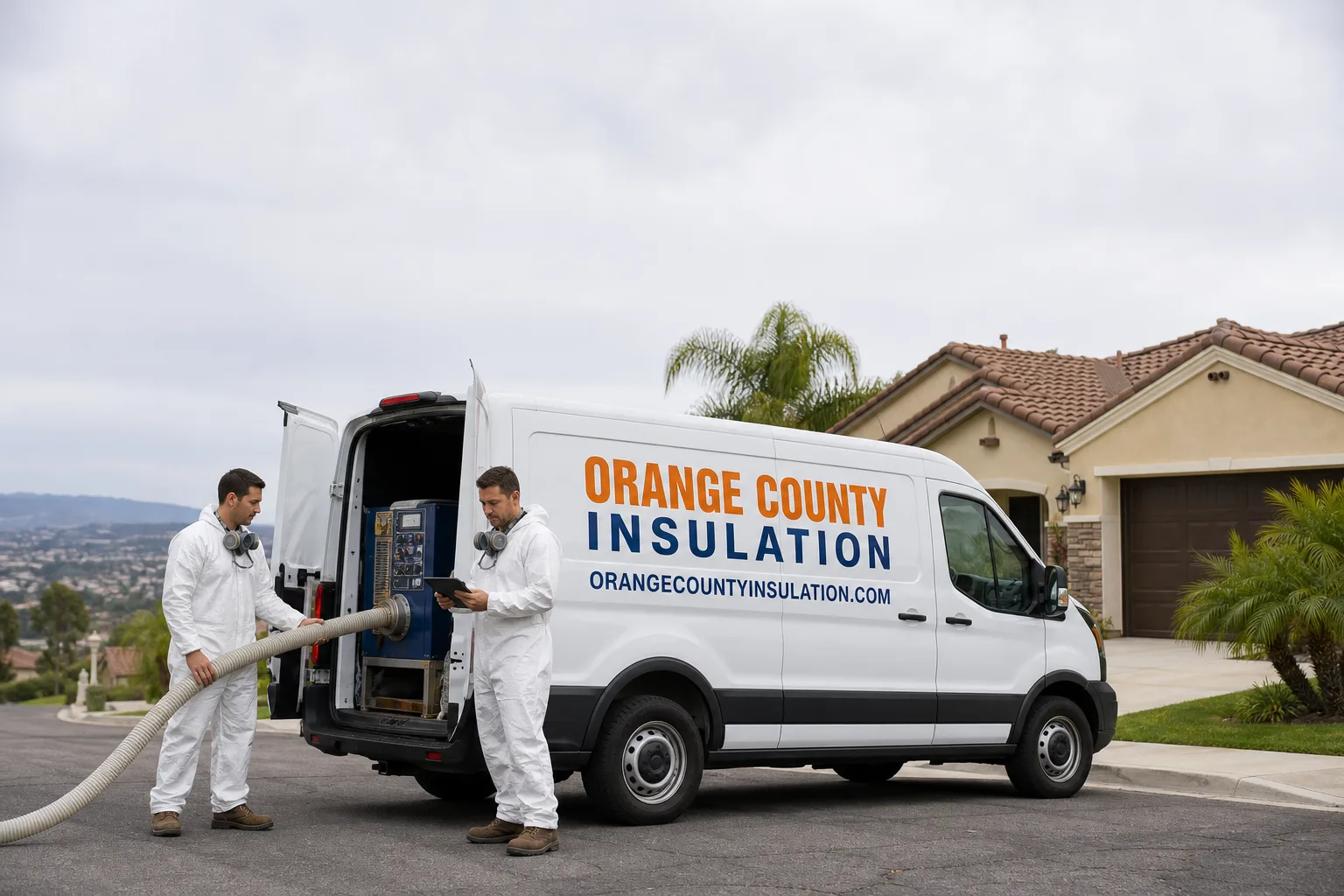
Fast, Reliable Spray Foam Insulation Across Woodcrest
Spray foam insulation in Woodcrest is the most effective way to stop the inland heat from turning your garage, attic, and add-on rooms into ovens. Homes along Van Buren Boulevard, Washington Street, and the large-lot properties off Krameria Avenue deal with summer temperatures that regularly push past 100°F, and spray foam creates an air seal that fiberglass batts simply cannot match. We get calls weekly from Woodcrest homeowners whose attics and garages hit 110°F or worse by 2 p.m., and the answer is usually the same: the original insulation was never designed for this kind of sustained heat. Our crews work throughout the 92508 zip code and know exactly what these custom 1980s-to-2000s homes need. Call us at (877) 680-3557 for a free estimate.
Key Takeaways:
- Closed-cell spray foam on a Woodcrest garage ceiling typically drops interior temps by 20-30°F
- Most Woodcrest homes built before 2000 have builder-grade fiberglass that compresses and fails under sustained heat
- We stock both Icynene and Demilec foam systems, so the foam choice matches your specific ceiling or wall condition
- Free estimates for all Woodcrest properties, including detached garages and converted add-on rooms
Why Orange County Insulation Is Woodcrest’s Preferred Spray Foam Insulation Company
We only do insulation. That’s not a tagline; it’s the reason we can tell you exactly why one foam matters more than another on your specific garage ceiling or attic plane. Orange County Insulation is led by Noel Carrasco, who built the company around product knowledge and installation discipline that general contractors simply don’t carry. When a Woodcrest homeowner asks us about open-cell versus closed-cell, we can explain it in terms of your square footage, your roof pitch, and how your attic currently vents. This is our entire trade.
Woodcrest homeowners call us because we carry eight manufacturer brands, including Demilec and Icynene for spray foam applications, GreenFiber for cellulose, and Owens Corning and Johns Manville for fiberglass and mineral wool. That breadth means we never steer you toward the one product we happen to stock. We choose the material that fits the problem. For a Woodcrest detached garage with a heat-soaked ceiling, that’s typically closed-cell foam. For a wall cavity in a converted add-on room, open-cell often makes more sense. We’ll tell you why.
Response time to Woodcrest is a real consideration, and we schedule crews for the 92508 area on a route basis, which means your estimate and install slot don’t get bumped behind jobs closer to our home base. We know the difference between a ranch home off Mockingbird Canyon and a newer custom build near Lake Mathews Drive, and we know that the thermal behavior of those two houses is not the same.
Spray Foam Attic Insulation in Woodcrest
Spray Foam Attic Insulation in Woodcrest typically targets the single biggest problem these homes face: a ventilated attic that absorbs heat all day and then radiates it into living space and garage ceilings all night. On a 105°F August afternoon, a Woodcrest attic can reach 140°F or higher, and if the ceiling plane under it is not air-sealed, that heat pushes straight down into your rooms. We usually apply closed-cell foam directly to the underside of the roof deck, which converts the attic from a superheated vented cavity into a semi-conditioned buffer zone. For most Woodcrest homes, foam on the roofline runs $7,500 to $14,000 depending on square footage and roof geometry. Foam on the attic floor, where you’re sealing and insulating rather than converting the space, runs lower: $4,000 to $8,000.
Roofline Foam for Radiant-Heat Control
This is the job we do most often in Woodcrest. Spraying closed-cell foam on the underside of the roof deck stops heat before it ever enters the attic. The result is an attic that stays within about 10 degrees of your living space, which is transformative for rooms below vaulted ceilings, where a thin layer of fiberglass is all that separates you from 140°F air.
Cathedral and Vaulted Ceiling Cavities
Woodcrest custom homes built in the 1990s and 2000s often feature vaulted ceilings with minimal insulation depth. If you can feel heat pressing down from the ceiling in your living room or master suite, the cavity is likely under-insulated. We remove what’s there and spray foam to fill the full rafter bay, which both insulates and air-seals in one step.
Spray Foam Wall Insulation in Woodcrest
Spray Foam Wall Insulation in Woodcrest is the most direct fix for the add-on rooms and converted garages that make up a surprising share of this community’s livable square footage. Those spaces are notorious here because the original builders or renovators framed them like garages, insulated them like garages, and then expected them to perform like bedrooms. The walls leak air, the kneewall cavities are empty or stuffed with compressed batts, and the result is a room that never cools down in summer. Injecting open-cell or closed-cell foam into those existing wall cavities typically runs $3,500 to $7,500 for an add-on room, and $2,500 to $5,000 for insulating the wall between a living space and an attached garage.
Kneewall and Garage-Conversion Walls
The kneewall in a Woodcrest bonus room or converted garage is typically the most under-insulated vertical surface in the home. We spray it from the attic side when the cavity is open, or inject foam behind the drywall when it’s not. Either way, the hot spot disappears.
Rim Joist and Band Board Sealing
Every Woodcrest home on a raised or crawlspace foundation has a rim joist line where the framing meets the foundation. Hot air enters that line in summer and radiated heat works its way up through the wall cavities. Sealing the rim joist with closed-cell spray foam is a two-hour job for most single-story ranch homes, and it closes a gap that fiberglass can never seal.
Trusted Brands We Service in Woodcrest
We stock Demilec and Icynene spray foam systems for Woodcrest jobs, and the choice between them comes down to the application. Icynene’s closed-cell foam works well on garage ceilings and rooflines where you need maximum R-value per inch. Demilec’s open-cell formulations suit wall cavities and areas where you want an air seal plus sound attenuation. Because we also carry Owens Corning, Johns Manville, and GreenFiber products, we can match the foam to your home instead of forcing your home to match the foam. For Woodcrest customers, that means faster turnaround on estimates and no waiting on a material order from a supplier across the county.
Common Spray Foam Insulation Problems We See in Woodcrest Homes
- Foam shrinkage at the garage ceiling plane. Woodcrest’s daily temperature swings, often 100°F by day and 60°F by night, stress the bond between foam and rafters. Within a few seasons, improperly applied foam can pull away from the deck and create gaps that let superheated attic air pour down onto your cars and stored items.
- Off-gassing from badly mixed two-component foam. Enclosed garages with little natural ventilation are common on Woodcrest’s large lots, and we see cases where an applicator skipped the 24-hour ventilation window or mixed the components at the wrong temperature. The result is a lingering chemical odor that can last for weeks.
- Foam applied over dusty or sagging fiberglass. In converted garages and add-on rooms, some installers spray directly over old batts or dusty framing. The foam adheres to the dust, not the wood, and delaminates within a couple of seasons. We remove the old material and clean the substrate first, every time.
- Missing kneewall insulation in add-on rooms. The main attic might be insulated, but the kneewall behind a bonus room or converted garage is often empty. That’s a hidden path for 110°F air to enter the room directly, and it’s invisible from the main attic hatch.
Pricing for Spray Foam Insulation in Woodcrest, CA
What you’ll pay for spray foam in Woodcrest depends on the surface you’re treating and the foam type. Here’s our honest read on the market:
- Garage ceiling in a detached 3-car garage: $2,800 – $5,500
- Attic roofline foam (full underside of roof deck): $7,500 – $14,000
- Wall cavity injection for a converted add-on room: $3,500 – $7,500
- Rim joist sealing on a typical ranch home: $1,200 – $2,800
- Kneewall or single garage-wall insulation: $1,800 – $4,200
Closed-cell foam runs about $1.10 to $1.80 per board foot installed in Woodcrest, while open-cell lands between $0.45 and $0.80. The difference matters: closed-cell gives you roughly R-6.5 per inch and acts as a vapor barrier, which is why we prefer it on garage ceilings and rooflines. Call (877) 680-3557 and we’ll give you a fixed quote based on your actual square footage and foam depth. Estimates are free.
We Also Serve Cities Near Woodcrest
Our crews routinely work in March Air Force Base, Moreno Valley, Riverside, and Mead Valley, and we know how the housing stock and heat profile differ from one neighborhood to the next. If you’re in any of these communities, the same Spray Foam Insulation expertise applies. You can see the full picture of our work across the region on our Woodcrest page.
Serving Woodcrest, CA — Our Local Coverage Area
We’re based in the Woodcrest area and know this community well. Use the map below to see our service coverage — if you’re nearby, we can almost certainly help.
FAQs About Spray Foam Insulation in Woodcrest
Yes, and the difference is structural, not incremental. Blown-in insulation slows heat transfer, but it does not air-seal, so superheated attic air still moves around and through the insulation. Closed-cell spray foam seals the ceiling plane, which means the hot air never reaches the garage interior in the first place. We recently sprayed 2 inches of closed-cell foam on the ceiling of a detached 3-car garage in the Woodcrest area near Van Buren Boulevard and Washington Street, where the homeowner’s garage regularly hit 120°F and the existing fiberglass batts had sagged and pulled away from the deck. We removed the failed batts, air-sealed the top plates and penetrations, and applied Icynene closed-cell foam to create a thermal break that dropped the garage temperature by over 25°F and stopped the condensation that was rusting the opener chain and door tracks. The homeowner reported their adjacent laundry room, previously unusable in summer, became comfortable enough to run the dryer without the AC kicking on. Call (877) 680-3557 to get a quote for your garage.
Inland heat cycling is harder on spray foam than coastal salt air is, which surprises most homeowners. A Woodcrest attic experiences daily temperature swings of 40°F to 60°F for six months of the year, and that repeated expansion and contraction is what causes poorly applied foam to shrink and pull away from the rafters. Coastal homes don’t see those swings nearly as intensely. In Woodcrest, foam failure first shows up at the garage ceiling plane, where attic heat radiates down onto stored items and parked cars. We see this in homes throughout the 92508 zip code, and it’s almost always the result of the original installer using the wrong foam thickness or skipping substrate prep. With proper application and the right closed-cell density, spray foam lasts 30-plus years here, but the application standard matters more in Woodcrest than it does ten miles west.
Yes, and this is one of the most common calls we get from Woodcrest homeowners. Converted garages and add-on rooms on large lots are notorious for uninsulated kneewalls and empty wall cavities, which create hot spots that homeowners often mistake for AC problems. The fix is to inject open-cell or closed-cell foam into those cavities, and to seal the rim joist where the addition meets the original house. In most cases, the hot spot disappears within a day of the foam curing. Call (877) 680-3557 and we’ll inspect the cavity with an infrared camera and show you exactly where the heat is entering.
Two inches of closed-cell foam on the garage ceiling is the standard we recommend for Woodcrest garages, whether attached or detached. That gives you about R-13 and, critically, an air seal that keeps superheated attic air from pressing down through the ceiling. If you’re planning to run a portable AC or mini-split in a detached garage, adding a third inch brings the R-value up toward R-20 and makes the space genuinely semi-conditioned. We’ll assess your specific ceiling plane and tell you whether two or three inches makes sense for how you use the space.
We use both Icynene and Demilec systems for Woodcrest homes, and the choice depends on the surface. Icynene closed-cell is our go-to for garage ceilings and rooflines where you need maximum R-value per inch. Demilec open-cell is ideal for wall cavities and kneewalls where you want an air seal plus sound control. As for odor, the fix is simple and non-negotiable: we follow the manufacturer’s mixing temperatures exactly, and we always ventilate the space for the required 24-hour window after curing. Off-gassing in Woodcrest garages almost always traces back to an applicator skipping that window or mixing the components at the wrong temperature. We don’t skip it. Call (877) 680-3557 for a free estimate and we’ll walk you through the exact foam recommendation for your home.
Written by Noel Carrasco, Owner at Orange County Insulation, serving Woodcrest and the surrounding Inland Empire communities.