
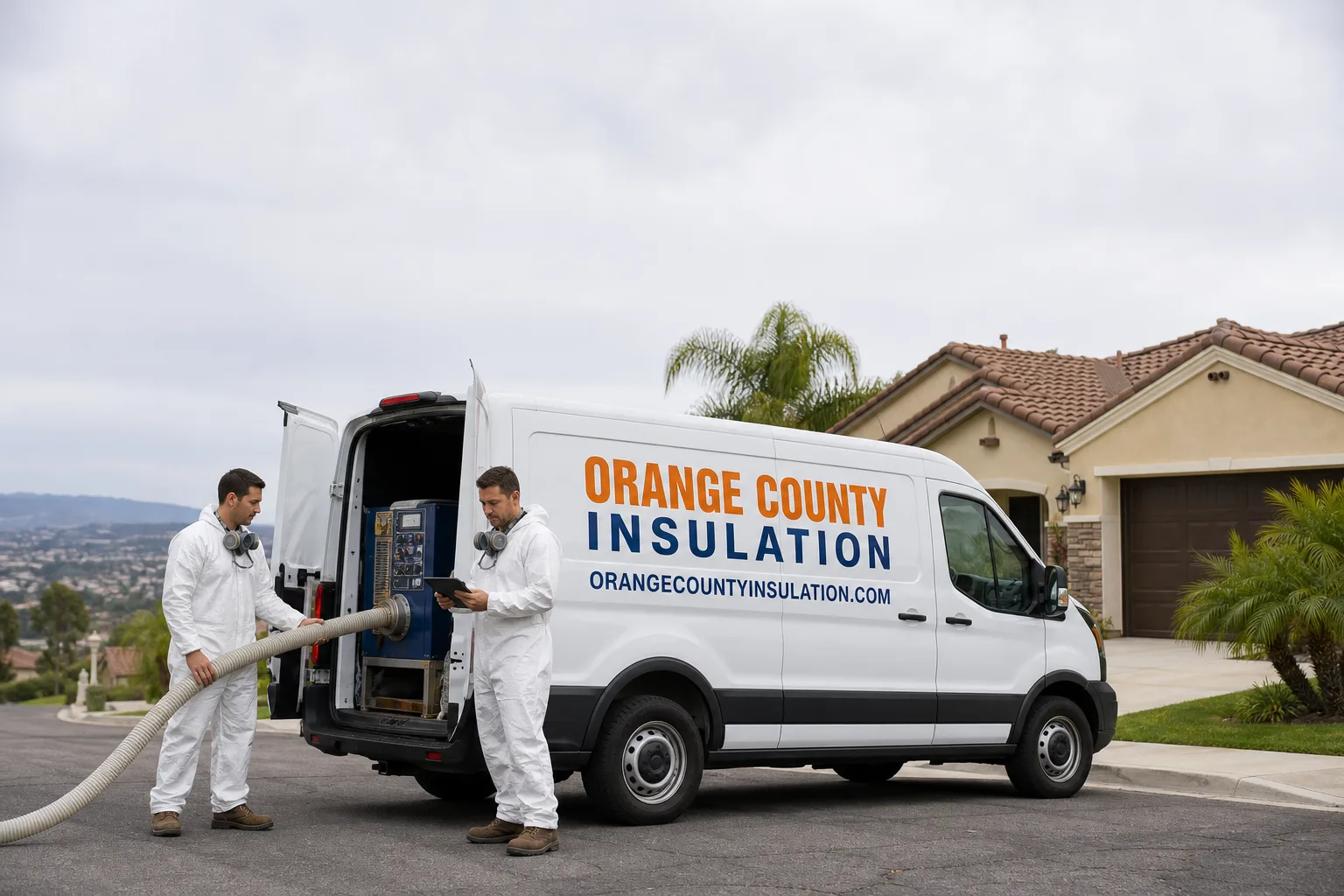
Fast, Reliable Spray Foam Insulation Across March Air Force Base
Spray foam insulation in March Air Force Base usually costs between $2.50 and $6.75 per board foot installed, with a full attic project in a typical 92551 home running $4,800 to $12,400 depending on open-cell versus closed-cell product and how much access clearance the roof structure allows. Most of our March Air Force Base jobs are finished in one to two days once we’re on site. If your rooms get hot by mid-afternoon in summer or you feel dust seeping in during Santa Ana wind events, call (877) 680-3557 and we’ll tell you exactly what’s going on in your attic and what it’d take to fix it.
We work both sides of the base line here. That means on-base military family housing with federal energy and AT/FP spec paperwork, and the 1980s – 2000s stucco tracts off the March corridor that fall under standard Title 24. Same crew, same foam, two completely different compliance worlds. Very few insulation contractors in this perimeter handle both cleanly. We do.
Why Orange County Insulation Is March Air Force Base’s Preferred Spray Foam Insulation Company
We’re an insulation-only shop. That’s not a marketing line; it’s the business model. Every estimate we write, every crew member we send into an attic, every warranty conversation we have is about insulation. No roofing side jobs, no HVAC crossover, no divided attention. When a March Air Force Base homeowner asks us why their upstairs bedrooms run 15 degrees hotter than the downstairs in August, we can answer that specific question because it’s the only kind of question we answer all day.
Noel Carrasco leads our crew, and he’s been the person homeowners call when their attic has been done wrong once already. We stock and install products from eight manufacturers: Owens Corning, Johns Manville, Knauf, Rockwool, CertainTeed, Icynene, Demilec, and GreenFiber. That matters for March Air Force Base specifically because the right foam for a base-era block-and-stucco house with knee walls is not automatically the right foam for a 1990s tract home with scissor trusses and a shallow attic. We spec the product to the structure, not to whatever one supplier happened to put on a pallet this month.
Response time to March Air Force Base from our Rancho Santa Margarita shop is typically same-week for estimates, and we coordinate base-access vetting paperwork before the crew arrives so an on-base job doesn’t stall mid-install. We know what the gate requires. We plan around it.
Spray Foam Insulation Contractors in March Air Force Base
Spray foam insulation contractors in March Air Force Base fall into two groups: the handful who are cleared and equipped to work on-base housing under federal energy/AT-FP compliance, and everybody else. We’re in the first group. The job itself is straightforward when the paperwork is handled up front: either open-cell foam for interior cavity and attic applications where cost and sound control matter, or closed-cell foam where you need higher R-value per inch or moisture resistance against the inland heat and Santa Ana dust. Most 92551 tract-home attics with tight clearance get open-cell; on-base retrofits often call for closed-cell to meet federal performance specs in thinner cavities. A typical spray foam job in March Air Force Base runs $2.50 to $6.75 per board foot, whole-attic work landing between $4,800 and $12,400.
On-Base Vetting and Federal Spec Work
We handle the access paperwork before our first truck pulls into queue. On-base housing at March ARB often carries federal energy and AT/FP requirements that an ordinary Riverside County attic job never sees. That means product data sheets, R-value documentation, and sometimes specific foam formulations. If your contractor has never done an on-base job before, you’ll learn that the hard way when everything stops at the gate. We’ve done it. We bring the paperwork with us.
Off-Base 92551 Title 24 Attics
Three miles off the base line, the compliance world changes completely. A 1990s stucco tract home in the March corridor with vaulted ceilings and scissor trusses typically has less than two feet of attic clearance, which rules out thick batt applications and makes spray foam the highest-R-value option per inch. We’ll check your current attic depth, air-seal the penetrations, and then foam to Title 24 minimums or above depending on how hot your upper rooms run in July. Two worlds, one crew.
Spray Foam Attic Insulation in March Air Force Base
Spray foam attic insulation in March Air Force Base is the single highest-impact job we perform in this market, because the inland Riverside County climate punishes under-insulated attics about eight months of the year. The attic in a 92551 home can reach 130°F on a July afternoon, and if your ceiling insulation has slumped or your ducts are pulling that heat, you’re paying to air-condition the roof line. A spray foam attic job in March Air Force Base typically runs $4,800 to $12,400 for a full attic, with ceiling-deck and knee-wall applications landing lower when the scope is tighter. The foam pays back fastest when you combine it with penetrations sealing: evaporative cooler cutouts, wall furnace flues, and duct runs all leak air that the foam can’t fix by itself.
Knee-Wall and Low-Slope Attics
The base-era housing around March ARB has a lot of low-slope and shallow-pitch roofs with knee-wall attics, and those are the hardest spaces to insulate properly with batts. Blown fiberglass slumps off the vertical knee walls within a season. Spray foam holds. In one base-era block-and-stucco house off the March ARB flightline corridor, our tech opened a knee-wall attic over a low-slope roof and found old blown fiberglass slumped to a few inches with evaporative-cooler penetrations leaking hot desert air straight in. We air-sealed those penetrations and flash-and-filled with Icynene in the rim and knee-wall band before sealing duct runs against solar gain, and the family’s triple-digit-afternoon attic temps dropped measurably. That’s the difference between adding insulation and fixing an attic.
Duct and Ventilation Sealing
In a tract home from the 1990s or 2000s, the attic ductwork is often the biggest leak after the ceiling itself. If your vents blow warm air for the first two minutes after the AC kicks on, you’re feeling duct gain. We seal ducts where they meet the plenum and boots, then foam the attic deck so the entire volume stops pulling heat into the house. This is standard practice on our March Air Force Base attic jobs. It should be standard practice on every attic job, but most crews skip it and just blow more fiberglass.
Trusted Brands We Service in March Air Force Base
We install Icynene for open-cell applications and Demilec for closed-cell, and those are the two brands we spec most in March Air Force Base because they cover the spread between on-base spec work and off-base Title 24 attics. For homes where spray foam isn’t the right call, we also stock and install fiberglass from Owens Corning and Johns Manville, mineral wool from Rockwool, and cellulose from GreenFiber. That’s the whole point of carrying eight brands: we’re not tied to one product line. When you call us about your attic, we’ll tell you which material fits your roof structure and your budget, and we can explain why in terms you can actually picture. If your March Air Force Base job needs a product the local supply house doesn’t stock, we order ahead so the crew doesn’t lose a day waiting at the counter.
Common Spray Foam Insulation Problems We See in March Air Force Base Homes
- Old evaporative-cooler and wall-furnace penetrations. Mid-century base-era housing in 92551 was built around evaporative coolers and wall furnaces, and when those got abandoned or converted, the cutouts were never sealed properly. Santa Ana winds push dust and 100°F+ air through those gaps straight past the spray-foam envelope. We air-seal before we foam; skipping that step wastes about a third of the foam’s performance.
- Knee-wall and low-slope attics with no room for proper foam thickness. Base-era construction often has tight knee-wall attics where a closed-cell foam needs less depth to hit the same R-value, but crews trained only on open-cell will under-apply and miss Title 24. We see this on a lot of retrofits where the first contractor didn’t actually check the roof pitch.
- On-base jobs stalling on paperwork. Federal energy and AT/FP spec documentation plus base-access vetting for the crew are required before foam hits the deck on March ARB housing. If that paperwork isn’t done, the job stops mid-install and the homeowner is left with half an envelope and a mess. We do the paperwork first. It’s part of the job.
- Ducts sealed against solar gain rather than simply foamed around. In the 1980s – 2000s stucco tracts off the March corridor, attic ducts sit in 130°F air. Foam on the ceiling deck helps, but if the duct joints and boots aren’t sealed first, the system still pulls heat. We treat duct sealing as step one, foam as step two. Most crews do it backwards or not at all.
Pricing for Spray Foam Insulation in March Air Force Base, CA
Open-cell spray foam in March Air Force Base runs $2.50 to $4.25 per board foot installed. Closed-cell runs $3.75 to $6.75 per board foot. A full attic in a 92551 tract home typically lands between $4,800 and $9,000 for open-cell and $6,500 to $12,400 for closed-cell. Rim joist work in a crawlspace or garage ceiling runs $1,200 to $3,200 depending on linear footage and access. What moves the number: roof pitch and attic clearance, whether we’re air-sealing old penetrations first, whether the job is on-base and needs federal spec documentation, and whether duct sealing is included. We give a written line-item estimate before any work starts, and estimates are free. To get an exact number for your house, call (877) 680-3557.
We Also Serve Cities Near March Air Force Base
Our crews cover March Air Force Base and the surrounding 92551 corridor, plus March Air Force Base adjacent communities. We run foam jobs in Moreno Valley, Woodcrest, Perris, and Good Hope on a regular basis. Same crew, same brand roster, same insulation-only focus. If you’re a few miles off the base line, the drive time doesn’t change the price sheet. For any project outside March Air Force Base proper, see our full Spray Foam Insulation service area or call us directly.
Serving March Air Force Base, CA — Our Local Coverage Area
We’re based in the March Air Force Base area and know this community well. Use the map below to see our service coverage — if you’re nearby, we can almost certainly help.
FAQs About Spray Foam Insulation in March Air Force Base
Yes, and it’s often the only insulation that stays in place on those surfaces. Low-slope roofs and knee-wall attics in base-era 92551 housing don’t hold blown fiberglass or batts well because gravity and heat slump them off vertical surfaces within a season. Spray foam adheres to the deck and knee walls and stops air movement in both directions. We spec closed-cell in tight knee-wall attics where you need higher R-value per inch, and open-cell where cost and sound control are the bigger concern. Call (877) 680-3557 and we’ll tell you which one your roof actually needs before we quote anything.
An on-base job needs base-access vetting for every crew member and federal energy/AT-FP spec documentation showing the foam product meets the installation’s performance and anti-terrorism/force-protection requirements. Off-base 92551 tract homes fall under standard Title 24, which is a different, simpler document set. Our office handles the on-base paperwork before the first truck rolls, and we bring the product data sheets and R-value documentation with us so the job doesn’t stall at the gate or mid-install. If you’re in on-base housing, ask any contractor you’re considering whether they’ve done a March ARB on-base job before. If they pause, call us.
Yes, you should seal those penetrations before or during any spray-foam job, and foam is the best material for the job. Old evaporative-cooler cutouts and wall-furnace flues in mid-century base-era housing leak hot desert air and Santa Ana wind dust straight into the conditioned envelope, and batts or caulk alone won’t stop the airflow. We air-seal those penetrations with foam and then insulate around them, which is the order that actually works. Skipping that step leaves a bypass that cancels out a big share of the foam’s R-value. Call (877) 680-3557 for a free estimate that includes penetration sealing; it should be in every quote you get.
No, it’s often the only insulation type that fits. Tract homes from that era in the March corridor frequently have vaulted ceilings, scissor trusses and less than two feet of attic clearance, which means thick batts can’t be installed properly and blown fiberglass compresses or slumps over time. Spray foam delivers the highest R-value per inch and doesn’t compress, so it’s the practical choice when roof geometry leaves no room for anything else. Whether it’s overkill depends on your attic depth, your current insulation level and how hot your upper rooms run in the summer; we’ll measure all three and tell you plainly. The number to call for a free inspection is (877) 680-3557.
We install Icynene open-cell and Demilec closed-cell spray foam in March Air Force Base attics, and we’ll choose between them based on your roof structure, R-value target and whether the job is on-base or off-base. Icynene handles open-cell applications with good sound control and lower cost per board foot. Demilec covers closed-cell work where you need higher R-value per inch, moisture resistance or federal spec compliance. Both are manufacturer-backed, and we have the technical reps on speed dial if a March ARB on-base job needs a specific data sheet. Call (877) 680-3557 for a recommendation specific to your attic.
If your March Air Force Base attic is hot enough to cook a roofing nail in August, that’s a fixable problem. Call (877) 680-3557 and we’ll send someone out to actually look at the roof, the knee walls, the ducts and the old penetrations, then tell you what needs foam and what doesn’t. Estimates are free and the paperwork is on us.
Written by Noel Carrasco, Owner at Orange County Insulation, serving March Air Force Base and the 92551 corridor.