
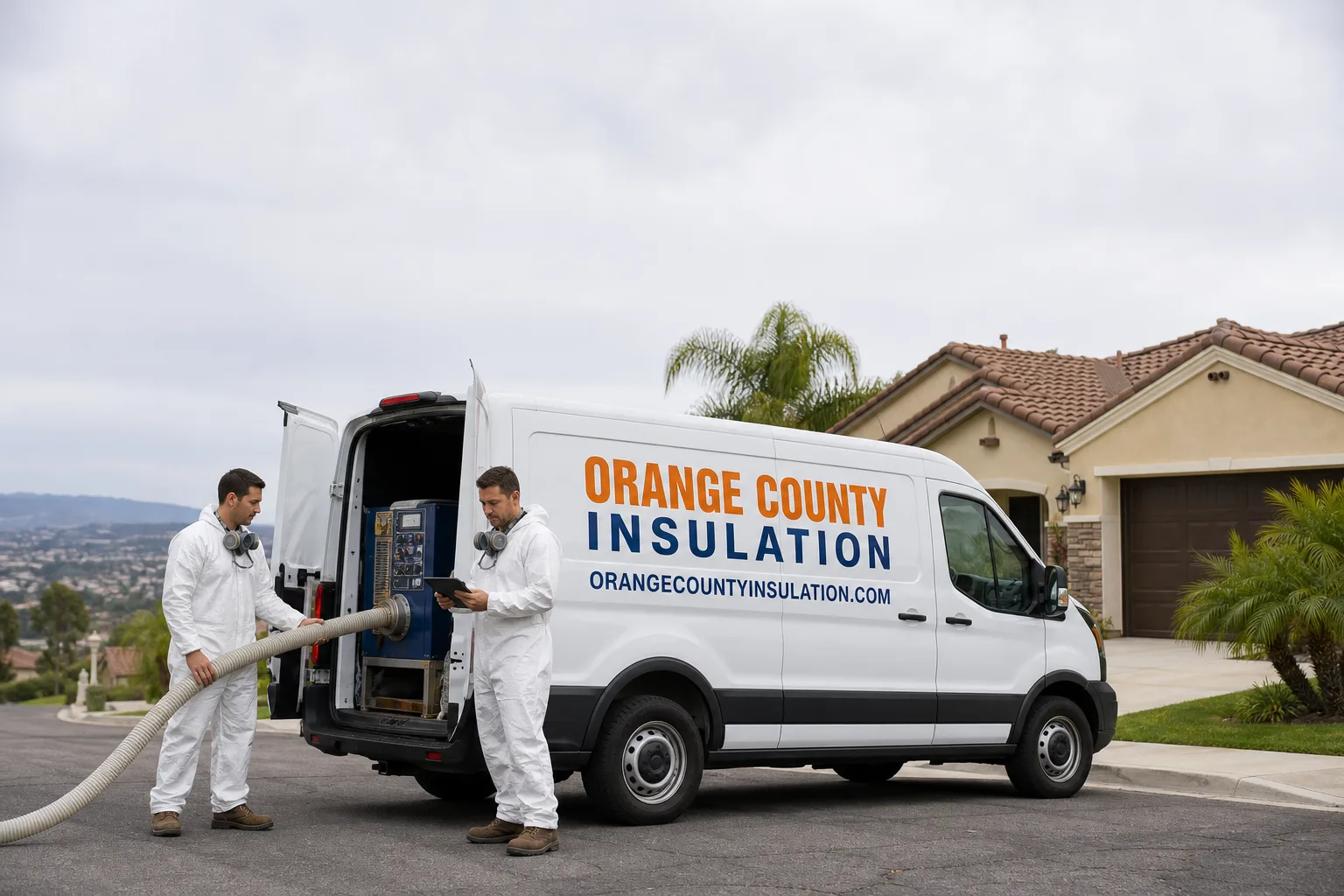
Fast, Reliable Spray Foam Insulation Across Topanga
Spray foam insulation in Topanga typically runs $2.50 – $6.50 per board foot installed, with closed-cell foam (Icynene or Demilec) landing on the higher end because it adds structural rigidity and a built-in vapor barrier. Most Topanga projects take one to three days once we’re on site, depending on how irregular the framing is. Call (877) 680-3557 to talk through your specific attic, wall, or rim joist job with someone who’s worked the canyon roads up here before.
Why Orange County Insulation Is Topanga’s Preferred Spray Foam Insulation Company
We only do insulation. That matters in Topanga because the homes here weren’t built to any standard envelope spec – they were built by hand, over decades, often by the original owners. When we pull up a private drive off Old Topanga Canyon Road or Saddle Peak Road, we already know the framing is going to be uneven, the rafter spacing weird, the attic access tighter than anything in a tract subdivision. Our crews have done this work enough times in the 90290 to expect surprises and solve them without stalling the job.
Homeowners here tell us the same thing: previous contractors quoted them a generic blow-in job and never mentioned that their add-on room had no air barrier at all. That’s the difference between a generalist and a team that installs Spray Foam Insulation every day. We stock open-cell and closed-cell products from Icynene and Demilec, plus mineral wool from Rockwool for fire-hardening details, so we don’t steer you toward whatever one supplier happens to carry. Noel Carrasco runs our team with a simple rule: if the assembly doesn’t stop air movement, it doesn’t matter what R-value you bought.
Spray Foam Attic Insulation in Topanga
Spray Foam Attic Insulation in Topanga is rarely a straightforward blow-and-go job, because most attics up here belong to hand-built canyon cabins from the 1920s through the 1970s. The roof decks are irregular, the framing is exposed, and add-on rooms create thermal breaks that a standard fiberglass batt was never going to seal. Closed-cell foam against the roof deck solves two things at once: it stops convection through the old batt seams, and it gives the assembly a continuous vapor barrier that was never there in the first place.
Unvented Attic Air Sealing
In a hot, dry canyon like Topanga, summer sun hammers the roof deck and winter cold snaps pull heat straight out of the living space below. An unvented closed-cell assembly flips that. We spray the underside of the roof deck and gable ends, which turns the attic into conditioned space and stops the stack effect that carries hot air up and out through every gap in the ceiling plane.
Ember-Resistant Vent Screening
Topanga sits in a high-fire-severity wildland-urban interface zone. An insulated attic with unscreened vents is still a fire risk – embers don’t care about R-value. We screen gable and eave vents with ember-resistant mesh as part of any attic job here. It’s not an add-on, it’s the price of doing the job correctly in this canyon.
Spray Foam Wall Insulation in Topanga
Spray Foam Wall Insulation in Topanga works differently than anywhere else we serve, because the walls themselves were often framed by hand. Irregular stud spacing, exposed beams, and a mix of materials from multiple renovation eras make batting a wall nearly impossible to do well. Open-cell foam expands into those irregular cavities, fills the gaps, and air-seals as it cures. For an old Topanga add-on room that loses heat through the wall assembly, that’s the difference between a fix and a patch.
Closed-Cell for Rim Joists and Crawlspace Walls
Closed-cell foam on rim joists and crawlspace walls stops the biggest air leak most Topanga homeowners have never looked at. The rim joist where the floor framing meets the foundation is a direct path for outside air – and in a canyon that swings from 100-degree summer days to cold winter nights, that leak costs real money. Closed-cell Demilec foam seals it permanently and adds vapor control where the crawlspace meets the house.
Wall Cavity Retrofit for Add-On Rooms
Topanga’s owner-built additions rarely have a continuous air barrier. That’s why we use closed-cell foam as both insulation and air-sealing when the walls are open during a remodel. The vapor barrier comes with the foam, not as a separate detail someone forgets to install. Builders working in Topanga call us specifically for this because we understand that a canyon wall needs to do more than hold heat – it needs to hold back air.
Trusted Brands We Service in Topanga
We carry Icynene open-cell and Demilec closed-cell spray foam on our trucks, so the material is there when the crew pulls onto your property. For Topanga homeowners asking about fire resistance, we also stock Rockwool mineral wool, which is non-combustible and fits the WUI conversation naturally. GreenFiber cellulose rounds out the options for people who want recycled-content material in their attic. We don’t push one brand. We pick the product that matches the assembly in front of us – and in Topanga, that’s usually a closed-cell foam paired with Rockwool details around ember-exposed areas.
Common Spray Foam Insulation Problems We See in Topanga Homes
- Sagging batt insulation in hand-built add-on rooms. The original fiberglass or rock wool was installed decades ago, often by the homeowner, and it’s pulled away from irregular, exposed-beam framing. Santa Ana wind events then move outside air straight through those convection gaps.
- No continuous air or vapor barrier over owner-built additions. Summer sun bakes the attic, winter cold snaps chill the living space, and the house never had a proper envelope to begin with.
- Unscreened or degraded attic vents as ember entry points. In Topanga’s high-fire-severity zones, a well-insulated attic with open gable vents is still a fire liability. We see this constantly.
- DIY spray foam attempts that cured poorly or missed the air-sealing step entirely. Foam that’s shaved back too far or applied over dirty surfaces won’t bond, and the homeowner is left with a mess that performs no better than the batt it replaced.
Pricing for Spray Foam Insulation in Topanga, CA
Open-cell spray foam in Topanga typically runs $2.50 – $3.50 per board foot installed. Closed-cell runs $4.00 – $6.50 per board foot, and that’s the product most canyon homes need for the vapor barrier and structural benefits. A typical attic retrofit in the 90290 runs $6,000 – $14,000 depending on square footage and access. Rim joist sealing is usually $1,200 – $2,800. The irregular framing and narrow private drives in Topanga mean crew time runs a little higher than a flat-lot tract home, but the material cost is the same. Call (877) 680-3557 and we’ll walk the job with you, measure the actual surfaces, and give you a written number before any work starts. Estimates are free.
We Also Serve Cities Near Topanga
Our crews work up and down the canyon and into the surrounding valleys. We regularly run spray foam jobs in Encino, Santa Monica, Northridge, and Sherman Oaks, plus the smaller communities along the Santa Monica Mountains. If you’re outside the 90290 and want to talk about spray foam, call us – we know the terrain and we know how access affects the schedule. Learn more about our work across Spray Foam Insulation in Topanga and the surrounding area.
Serving Topanga, CA — Our Local Coverage Area
We’re based in the Topanga area and know this community well. Use the map below to see our service coverage — if you’re nearby, we can almost certainly help.
FAQs About Spray Foam Insulation in Topanga
Yes. Because most Topanga homes sit in high-fire-severity WUI zones, an attic job needs ember-resistant vent screening and non-combustible assembly details – spray foam is not fireproof, and open vents are an ember entry point no matter how well you insulate. Call (877) 680-3557 and we’ll specify the right screening and Rockwool details for your roof.
Yes, that’s most of what we do up here. Irregular framing, exposed beams, and add-on rooms are the norm in Topanga, not the exception, and closed-cell foam expands into odd cavities and seals gaps that batts can’t touch. If the attic has been DIY-insulated before, we’ll scope what’s salvageable and what needs to come out before we spray.
Yes. Spray foam doesn’t require any municipal utility hookup – it’s a material application, not an appliance. For off-grid Topanga homes, closed-cell foam actually helps by cutting heating and cooling loads, which means less generator or battery draw when you run a heat pump or mini-split. The work itself runs on our truck-mounted equipment, not your power.
Usually, yes. Topanga’s summer heat and winter cold snaps punish any envelope that isn’t airtight, and closed-cell foam gives you both thermal resistance and a continuous vapor barrier in one application. In an older canyon home with no air barrier at all, open-cell foam may be enough for interior walls, but the roof deck and rim joists should be closed-cell.
If the original batt insulation is sagging or pulling away from the framing, retrofitting with spray foam is the long-term fix – not another layer squeezed on top. For most Topanga homes, that means closed-cell foam on the roof deck or in wall cavities, plus air-sealing at the top plates. We’ll tell you honestly if the existing material is worth keeping, and if it isn’t, we’ll show you exactly why. Call (877) 680-3557 for a free estimate.
Written by Noel Carrasco, Owner of Orange County Insulation, serving Topanga’s canyon homes with spray foam, attic, and blown-in insulation since the company’s first day in business.