
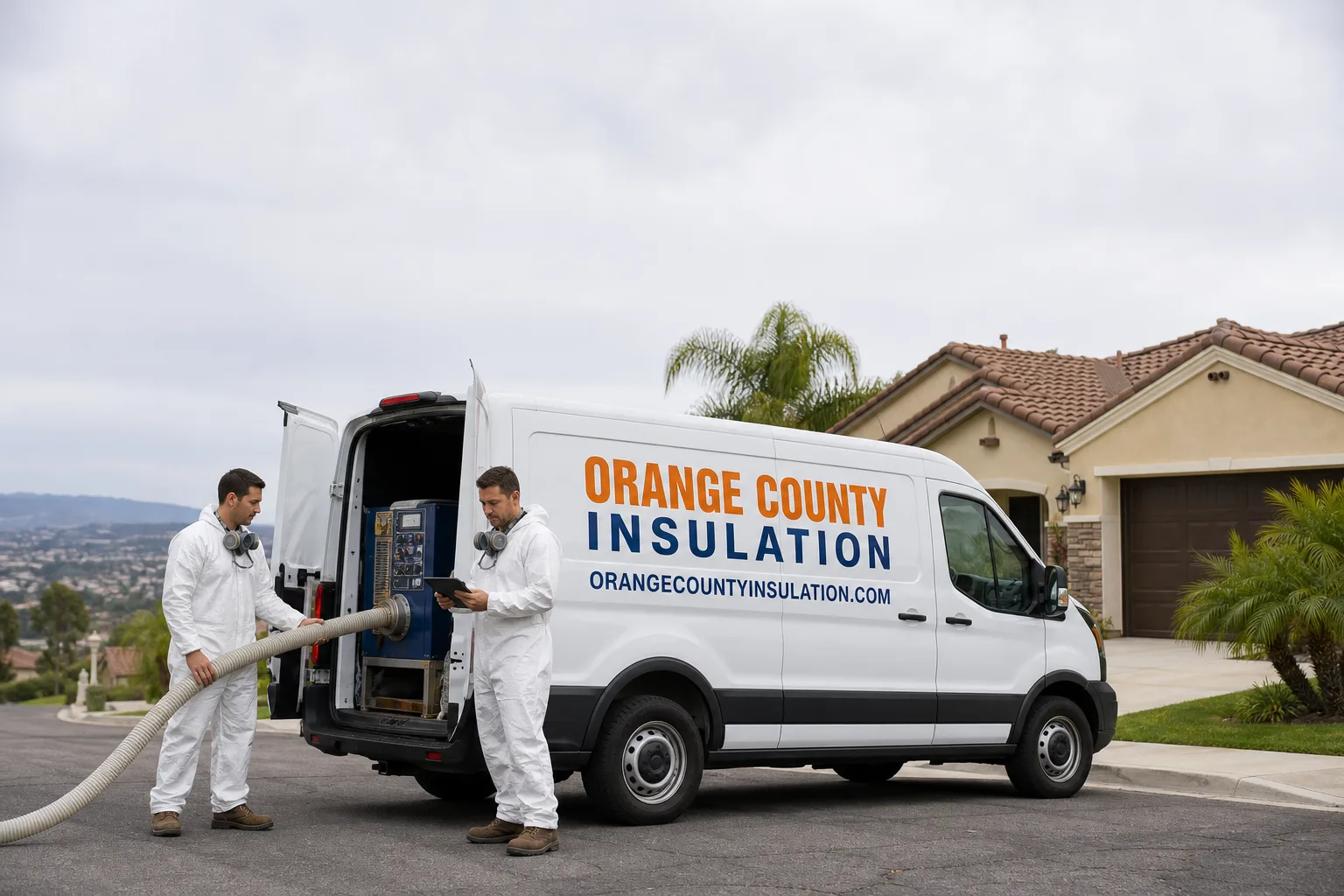
Fast, Reliable Spray Foam Insulation Across Encino
Spray foam insulation in Encino typically runs $2.50 to $6.50 per board foot installed, with most attic roof deck projects on mid-century ranches landing between $4,800 and $11,000 depending on square footage and whether old batts need removal first. We work throughout 91316, 91416, 91426, and 91436, and our crews know Encino’s housing stock well enough to spot the issues before they become change orders. If your ranch home’s back bedrooms won’t drop below 80°F in August, call (877) 680-3557 and we’ll tell you what’s actually happening in that attic.
This page is for Encino homeowners who want the definitive fix, not another patch job. Encino sits in the San Fernando Valley basin where summer attic temperatures routinely push past 140°F. Most of the homes we inspect here were built between the 1940s and 1980s with insulation that wouldn’t come close to passing today’s Title 24 requirements. The right spray foam, applied correctly, changes how the whole house feels. The wrong foam, or foam applied over old problems, makes things worse. We’ll show you which situation you’re in.
Why Orange County Insulation Is Encino’s Preferred Spray Foam Insulation Company
We’re an insulation-only contractor. That’s not a tagline; it’s the entire business model. Every estimate, every crew member, and every warranty conversation we have centers on one trade. Noel Carrasco built the company around a simple idea: when a contractor only does insulation, they know the material science behind each product well enough to tell you exactly why open-cell Icynene behaves differently than closed-cell Demilec in a 1950s Encino attic. That’s the conversation most Encino homeowners tell us they’ve never had with a general contractor.
We carry eight manufacturer brands: Owens Corning, Johns Manville, Knauf, Rockwool, CertainTeed, Icynene, Demilec, and GreenFiber. For spray foam specifically, we’re trained on both Icynene and Demilec systems, which means we can match open-cell or closed-cell to your roof geometry and wiring situation rather than selling you whatever single product we happen to stock. Encino’s housing mix demands that flexibility. A low-pitch ranch roof in the 91316 flats and a 1980s rebuild south of Ventura Boulevard call for different approaches sometimes.
Response time to Encino is typically 24 to 48 hours for an estimate, and scheduling for install runs one to two weeks out depending on season. We’ve been in Encino attics enough to know what we’ll find before we climb the ladder: sagging original R-11 batts, radiant-barrier-less roof decks, and in the older homes, knob-and-tube era wiring stapled across the joists. None of that surprises us, and all of it gets addressed before foam goes in.
Rim Joist Spray Foam in Encino
Rim joist spray foam is the single most overlooked air-sealing opportunity in Encino’s raised-floor ranch homes, and it’s often the reason an attic insulation upgrade doesn’t deliver the cooling savings the homeowner expected. The rim joist is the band of wood where your floor framing meets the foundation wall, sitting just above the crawl space. In a typical 1950s or 1960s Encino ranch, that band is sheathed with nothing but fiberboard or thin plywood, and every one of those seams leaks Valley heat into the house all summer. Sealing the rim joists with closed-cell foam closes the bypass path that undercuts your attic gains in August.
In Encino, a full rim joist sealing job on a standard 1,400 to 1,800 square foot ranch runs $1,800 to $3,400 depending on accessibility and how much old fiberglass has to come out of the joist bays first. We use closed-cell Demilec or Icynene for rim joists because the material’s rigidity and moisture resistance matter in Ventura-adjacent crawl spaces where humidity can accumulate against the foundation. Open-cell foam doesn’t belong here; it’s too vapor-permeable for that application and will absorb crawl space moisture over time.
When Encino Homes Need It Most
You’ll feel the problem before you see it. Floors over the crawl space stay warm well into the evening, your AC runs longer than your neighbors’, and in August the baseboards near exterior walls read five to ten degrees warmer than the middle of the room. That’s the rim joist leaking. Homes built before the 1980s in Encino rarely have any rim sealing at all, which means the hot exterior air moves freely into the floor assembly all day. Foaming the rim stops that movement at the source.
Why We Check the Crawl Space First
We won’t quote a rim joist job without looking at what’s under the house. In Encino, raised-floor ranches often have original vapor barriers that have long since shredded, plumbing penetrations that were never sealed, and the occasional rodent-damaged fiberglass batt hanging into the dirt. If we foam the rim while ignoring a failed vapor barrier, you’ll pay twice to fix moisture problems the foam masked. We’ll tell you what we found, show you photos, and tell you what has to happen before the spray rig comes out.
Crawl Space Spray Foam Insulation in Encino
Crawl space spray foam insulation addresses the underside of the floor assembly directly, and for Encino’s raised ranchers it’s sometimes the better first move than an attic job. Many of these homes were built with vented crawl spaces that pull in dry, superheated Valley air all summer, which the AC then has to fight from below while the attic cooks the house from above. Encapsulating the crawl space walls with closed-cell foam and sealing the vents changes the thermal boundary of the entire floor system, and homeowners consistently report the biggest comfort change in the rooms directly above the crawl.
A full crawl space encapsulation with spray foam on the perimeter walls in Encino usually runs $4,500 to $9,000, with the range driven by square footage, ceiling height, and whether the existing floor batts need removal and disposal first. Rim joist foam is almost always part of the same scope, since sealing the walls while leaving the rim bands open is like closing three doors and leaving the fourth wide open. We’ll give you one number for the combined job, not a series of surprise line items.
Open vs. Closed Cell Under the Floor
For crawl space walls, closed-cell Demilec or Icynene is the right call every time. Closed-cell acts as its own vapor barrier at roughly two inches, which matters in Encino because the soil under these older homes holds moisture that moves upward through the crawl space air. Open-cell would allow that moisture to reach the floor joists and eventually the subfloor, creating exactly the rot and mildew conditions Encino homeowners call us about after a wet winter.
When to Combine It With an Attic Job
If your Encino home has both a vented crawl space and an under-insulated attic, doing them together gives you the full thermal boundary and usually saves money on mobilization since the spray rig comes out once. We’ve seen 91316 ranches where the owner spent $6,000 on attic foam and got a two-degree improvement, then added crawl space encapsulation the following year and the AC runtime dropped 30 percent. Both sides of the house matter. We’ll show you the numbers for doing them together versus separately so you can decide with real data, not a sales pitch.
Trusted Brands We Service in Encino
For spray foam work in Encino, we install both Icynene and Demilec systems, which gives us genuine flexibility that single-brand contractors don’t have. Icynene’s open-cell foam is ideal for attic roof decks where you want the assembly to breathe slightly and the wood to remain inspectable. Demilec’s closed-cell line is the choice for crawl space walls, rim joists, and flat-roof decks where moisture resistance and structural rigidity matter. We stock both product lines in our Rancho Santa Margarita facility and run installs across Encino’s 91316 and 91436 ZIP codes on a regular schedule. If your job calls for fiberglass batts, mineral wool from Rockwool, or cellulose from GreenFiber instead, we have those too, and we’ll tell you honestly when spray foam isn’t the right answer.
Common Spray Foam Insulation Problems We See in Encino Homes
- Foam sprayed over sagging original R-11 batts. We see this constantly in Encino because some contractors will foam right over whatever’s already in the attic to save labor. The old batts sag against the ceiling, trapping heat between the foam and the drywall, and the real condition of the roof deck stays hidden until a leak forms and nobody can see it. We remove the old material first, every time.
- Closed-cell foam applied with knob-and-tube wiring still stapled to the joists. Encino’s 1940s and 1950s homes still carry live knob-and-tube runs in the attic more often than most people realize. Spraying closed-cell over active knob-and-tube traps heat against the cloth-insulated wires and creates a serious safety hazard. The wiring has to be re-routed or boxed before foam goes on. We do that work, and we won’t skip it.
- Rim joist and crawl space foam skipped on raised-floor ranches. A homeowner gets the attic done, sees a modest improvement, and wonders why the house still feels warm. In Encino’s raised-floor homes, the crawl space is a bypass path that lets the attic gains leak right back out. If your contractor quoted an attic foam job and never mentioned the rim joists, ask why.
- Flat and low-pitch roof decks foamed without checking the deck condition above. Encino’s flat-roof ranches hold rain differently than sloped roofs, and a deck that’s been leaking slowly for years often looks fine from below until foam seals the underside and the moisture has nowhere to go. We inspect the deck from the roof side before installing on flat-roof homes.
Pricing for Spray Foam Insulation in Encino, CA
A typical open-cell attic roof deck foam job in an Encino ranch runs $4,800 to $8,500 for a 1,200 to 1,800 square foot home, assuming existing batts are removed first. Closed-cell on the same deck runs $6,500 to $11,000 because the material cost is higher and you’re getting a vapor barrier plus structural rigidity in return. Rim joist spray foam in Encino runs $1,800 to $3,400. Crawl space encapsulation runs $4,500 to $9,000. The biggest cost drivers are flat roof access, existing insulation removal, and re-routing old wiring. We’ll give you a fixed price after a site visit, not a range that doubles by contract day. Call (877) 680-3557 for a free estimate and we’ll tell you what your specific house needs.
We Also Serve Cities Near Encino
Our crews run regular routes through the San Fernando Valley, so when we’re not in Encino we’re working right next door. We serve Encino and the surrounding communities including Sherman Oaks, Van Nuys, Valley Glen, and Northridge. If you’re in any of those neighborhoods and want the same insulation-only expertise, call (877) 680-3557 and we’ll get you on the schedule. Our full Spray Foam Insulation service area covers the entire Valley basin.
Serving Encino, CA — Our Local Coverage Area
We’re based in the Encino area and know this community well. Use the map below to see our service coverage — if you’re nearby, we can almost certainly help.
FAQs About Spray Foam Insulation in Encino
Yes, and it’s one of the most effective upgrades we do in Encino because flat and low-pitch roofs put the deck just inches above the ceiling plane, so the foam directly converts what was a 140-150°F solar oven into a semi-conditioned attic. The caveat is that we inspect the roof membrane from above first to rule out existing leaks, and we re-route any knob-and-tube wiring before the foam goes in. On a typical 1950s Encino ranch, expect the job to take one to two days and fall in the $6,500 to $11,000 range for closed-cell. Call (877) 680-3557 and we’ll inspect your specific roof deck.
In most Encino homes, the existing insulation is either original R-11 fiberglass batts from the 1950s or 1960s that have collapsed to about R-4, or blown-in fiberglass that has settled well below its rated depth, and neither product blocks radiant heat transfer from a 140°F roof deck. Fiberglass works by slowing conductive heat, but in an Encino August, the dominant heat gain is radiant, coming straight off the underside of the roof deck and radiating down through the living space. Spray foam, especially closed-cell applied directly to the deck underside, stops both conductive and radiant transfer at the source. That’s the difference between fighting the heat with AC and keeping it out of the house in the first place.
It doesn’t block the work, but it changes the order of operations. Encino’s 1940s and 1950s homes often still have live knob-and-tube wiring stapled across the attic joists, and spraying foam over active knob-and-tube creates a heat-trapping situation that the wire’s cloth insulation was never designed to handle. We re-route or box the old wiring before we spray, which adds some labor cost to the job but keeps the house safe and the work code-compliant. On newer Encino rebuilds from the 1970s and 1980s, this is rarely an issue because the wiring is Romex and can be foamed around without modification.
If your Encino home is a raised-floor ranch, you should at least get both quoted at the same time, because doing them together saves you the cost of a second spray rig mobilization and the results compound. We’ve measured Encino homes where the attic foam alone dropped afternoon indoor temperatures by three degrees, and the rim joist plus crawl space foam added another two to three degrees on top of that by closing the bypass path under the floor. The combined job usually runs $8,000 to $18,000 depending on home size, but doing them separately costs 15 to 20 percent more overall. We’ll give you both numbers and you decide which scope makes sense for your budget.
For most Encino ranch homes with attic heat gain as the main problem, yes, because blown-in fiberglass still can’t block radiant heat transfer from a deck that hits 140°F or more in August, no matter how deep you blow it. The fiberglass approach keeps the attic a hot box and asks your insulation to slow the heat down as it moves toward the living space. Spray foam on the roof deck removes the attic from the thermal equation entirely by moving the building envelope to the roofline. Fiberglass is cheaper upfront, usually $1,800 to $3,500 to re-blow an Encino attic, but it doesn’t solve what’s actually causing the problem. We’ll show you the performance difference and let you choose, with real numbers for both options.
If you’re ready to fix the actual problem, call Orange County Insulation at (877) 680-3557. We’ll schedule a site visit in Encino, inspect the attic and crawl space, and give you a written estimate with the scope, materials, and price before you commit to anything. No pressure, just the information you need to make the right call for your house.
Written by Noel Carrasco, Owner at Orange County Insulation, serving Encino and the San Fernando Valley.