
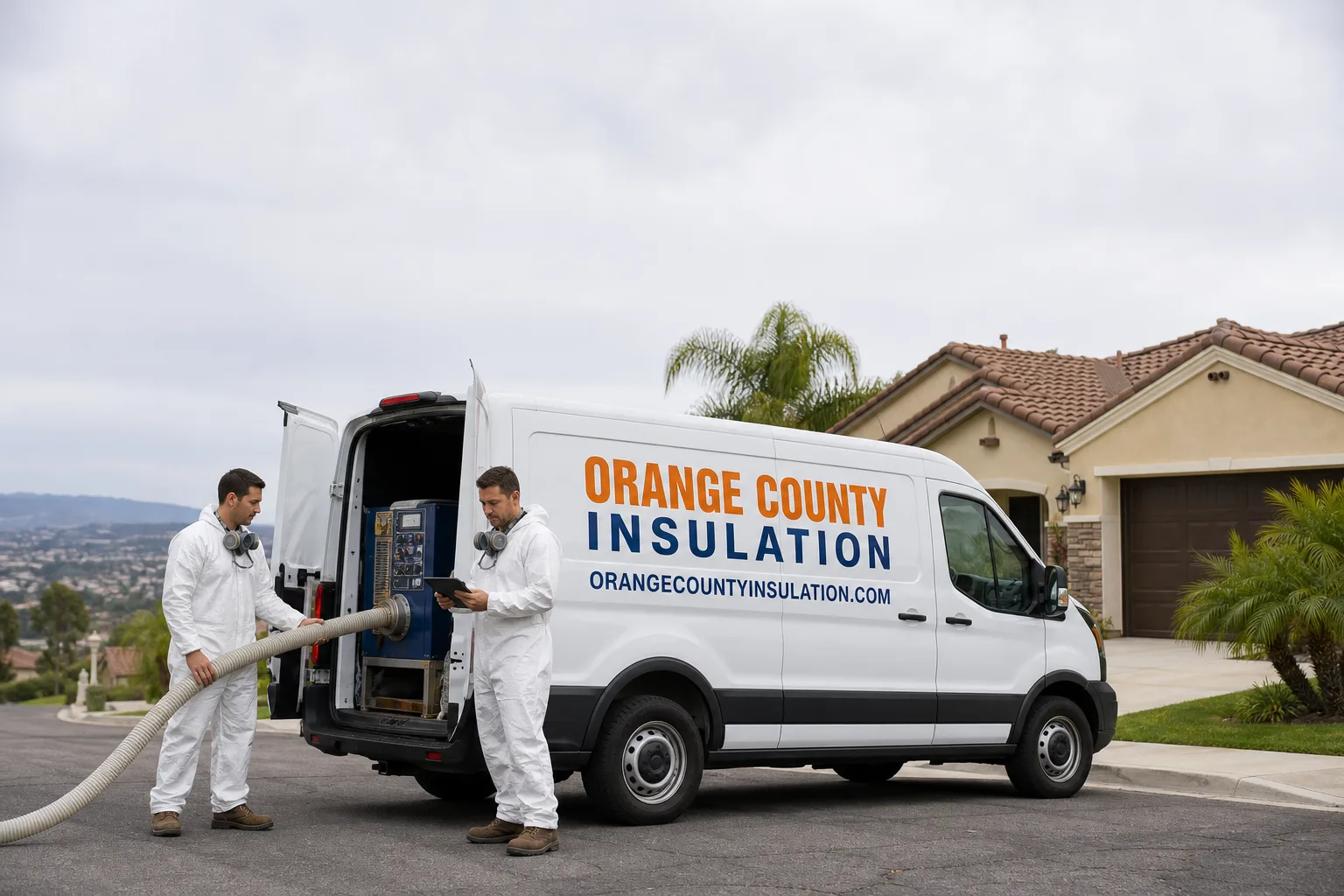
Fast, Reliable Spray Foam Insulation Across Whittier
Spray foam insulation in Whittier costs roughly $2,800 to $7,400 for a typical attic or rim joist project, with open-cell running $0.45 to $0.80 per board foot and closed-cell $0.90 to $1.60. The bigger number in Whittier is not the material line item. It is what a 1950s tract home with original sagging batts and a low-pitch roof costs you every summer when the attic hits 140° and your AC runs nonstop. We get called to those homes off Mar Vista, Uptown, and the College streets weekly, and we can usually be on-site within one to two business days. Call (877) 680-3557 and tell us what your ceiling feels like at 4 p.m. in August. That tells us more than any square footage number.
Why Orange County Insulation Is Whittier’s Preferred Spray Foam Insulation Company
We only do insulation. That is the whole reason Whittier homeowners and remodelers call us instead of a general contractor who carries insulation as a side item. Every estimate, every crew member, every warranty conversation centers on one trade. We carry eight manufacturer lines, but for the foam work that defines so much of Whittier’s older housing stock, we lean on two: Icynene for open-cell and Demilec for closed-cell. That dual-brand capability matters when a 90603 ranch addition needs a different assembly spec than the 1950s main house next to it.
Noel Carrasco leads our spray foam work, and he has walked enough Whittier attics to know exactly what he will find before he climbs the ladder: collapsed fiberglass, dusty knob-and-tube-era top plates, and roof decks with almost no vent path. That local pattern recognition means our estimates are more precise and our installs go faster. We do not guess at what a “normal” attic looks like. We know what a Whittier attic looks like.
Open Cell Spray Foam in Whittier
Open Cell Spray Foam is the workhorse for most Whittier ceiling-plane applications because it air-seals and insulates in one pass, and it performs well in vented attics that still have soffit and ridge airflow. In a 1950s tract home where the original batts have sagged to R-9 or worse, we remove or flatten the dead material, air-seal the top plates and electrical penetrations, then spray open-cell Icynene to the ceiling line. The material expands into gaps that fiberglass never touched, which is the entire point. Whittier’s summer heat does not sneak through the big open cavities. It sneaks through the half-inch cracks around can lights and partition walls.
Rim Joist and Band Board Sealing
Many Whittier homes sit on raised foundations with open rim joists that leak air from the crawl space into the living floor above. We spray open-cell foam into the rim joist bays, which stops that stack effect and keeps the floor noticeably warmer during those 40-degree foothill winter nights. It also cuts the dust and mustiness that crawl space air pushes up through the floorboards.
Garage Ceiling and Attic Hatch Areas
Attached garages in Whittier get punishing heat because they are usually uninsulated, and that heat bleeds into the bedrooms above. We spray the garage ceiling band, then insulate and weatherstrip the attic hatch, which is the most overlooked air leak in the entire house. An R-30 garage ceiling in Whittier is not luxury. It is the difference between a bedroom that cools down and one that never does.
Spray Foam Insulation Contractors in Whittier
Spray Foam Insulation Contractors in Whittier fall into two categories: general builders who offer foam as an add-on and specialists who only do the thermal envelope. We are the second, and it changes how the job gets quoted. We do not sell you the material we happen to stock. We spec the assembly your roof and wiring actually allow, then price it honestly. A typical open-cell attic in a 1,200 to 1,800 square-foot Whittier home runs $2,800 to $4,600. A closed-cell roof deck application on a flat-roof home near Turnbull Canyon runs higher, often $5,000 to $7,400, because the material is denser and the prep work around venting and framing is more involved.
Repair Versus Retrofitting Existing Foam
We get called to homes where a previous contractor sprayed foam directly over sagging batts without air-sealing first. The foam shell looks fine from the hatch, but the air leaks underneath are still active. We cut test plugs, inspect the original work, and tell you plainly whether a patch or a full re-spray is the right move. Sometimes the fix is two hours. Sometimes it is a full remove-and-redo. You deserve to know which one before money changes hands.
Builders and Remodelers in Whittier
We work with several Whittier remodelers who need a reliable insulation sub for additions and re-roofs. If you are adding a room or tearing off a flat roof, we can help you choose between a vented assembly and an unvented conditioned attic. That decision determines the foam type, the R-value, and the long-term moisture behavior. It should be made before the roof goes back on, not after.
Trusted Brands We Service in Whittier
We install and service Icynene open-cell foam and Demilec closed-cell foam, which covers the full performance range for Whittier’s mix of vented and unvented attics. We also stock and install GreenFiber cellulose, Owens Corning batts, and Johns Manville products for homes where foam is not the appropriate answer, which happens more than people expect. A flat-roof addition with tricky vintage framing sometimes wants damp-spray cellulose, not closed-cell. That is exactly why we keep the broader brand roster: so the recommendation comes from what the house needs, not what one distributor happens to stock this quarter.
Common Spray Foam Insulation Problems We See in Whittier Homes
- Foam sprayed over collapsed batt insulation without air-sealing first. The foam covers the visual problem, but the air leaks through top plates and can light penetrations continue. The attic still bakes, and the homeowner cannot figure out why their energy bill barely moved.
- Flat and low-pitch roofs near the Whittier Hills with no soffit or ridge vent path. A vented-assembly foam spec on these roof shapes can trap moisture between the foam and the roof deck. Without a designed ventilation or unvented-assembly plan, the foam creates a new problem instead of solving the old one.
- Knob-and-tube-era wiring and old recessed cans foamed in without proper clearance. This is a heat and code hazard. Foam must be kept off non-IC-rated cans and uninsulated knob-and-tube conductors. Older Whittier homes have plenty of both, so this check is part of every one of our pre-spray walkthroughs.
- Partial spray jobs that only hit the easy sections. Someone sprays the open attic floor around the hatch but never touches the kneewalls, the garage ceiling band, or the rim joists. The result is half a thermal envelope and a homeowner who assumes insulation “just doesn’t work in this old house.” It works when it is complete.
Pricing for Spray Foam Insulation in Whittier, CA
Open-cell attic insulation in Whittier runs $2,800 to $4,600 for a typical 1,200 to 1,800 square-foot home, which works out to $0.45 to $0.80 per board foot installed. Closed-cell roof deck work runs $0.90 to $1.60 per board foot, and a full flat-roof assembly on a smaller 1950s home near the foothills lands in the $5,000 to $7,400 range. Rim joist sealing in a raised-foundation Whittier home is usually $900 to $1,800. The variables are access, roof pitch, existing insulation removal, wiring conditions, and whether the assembly is vented or unvented. Call (877) 680-3557 for a free on-site estimate and we will give you a written number, not a phone guess.
We Also Serve Cities Near Whittier
Our crews work throughout the east San Gabriel Valley corridor, including South Whittier, West Whittier-Los Nietos, East La Mirada, and Santa Fe Springs. We schedule jobs across the full Whittier area so that smaller visits can be bundled with nearby work when it makes sense. If you are outside the immediate Whittier zip codes, ask about scheduling. You are still in our service territory.
Serving Whittier, CA — Our Local Coverage Area
We’re based in the Whittier area and know this community well. Use the map below to see our service coverage — if you’re nearby, we can almost certainly help.
FAQs About Spray Foam Insulation in Whittier
Yes, but only as part of a designed unvented assembly. We cannot responsibly spray closed-cell foam on the underside of a flat or low-pitch roof deck unless the roof is being converted to a conditioned attic or the existing vent path is being intentionally closed per assembly spec. Many of the flat-roof homes along the foothills near Turnbull Canyon were built with almost no ridge or soffit venting, so this is a common call for us. We evaluate the roof structure, the existing deck condition, and the framing before we recommend open-cell or closed-cell. Call (877) 680-3557 and we will walk the roof with you.
We remove or flatten the failed batt insulation and air-seal the ceiling plane before we spray. We do not spray foam directly over collapsed fiberglass, because the foam then hides the air leaks instead of stopping them. In most 1950s Whittier tract homes, the old R-9 to R-13 batts are doing almost nothing after sixty years of settling, so pulling them out and starting with a clean, sealed ceiling plane is the whole job. The spray foam then does the thermal work the batt was supposed to do.
For most vented Whittier attics, yes. Open-cell Icynene air-seals extremely well and performs fine in vented attics that still have soffit and ridge airflow. In the hot, dry San Gabriel Valley summers, the bigger issue is radiant heat gain through the roof deck, and open-cell on the ceiling plane combined with proper ventilation and radiant barrier where appropriate addresses that directly. For unvented assemblies or flat roofs, closed-cell Demilec is usually the better spec because it adds structural strength and creates its own vapor barrier. The answer changes based on your specific roof, and that is the conversation we want to have over the phone or at the house.
Parts of it can be, but knob-and-tube conductors and old non-IC-rated recessed cans must be kept clear of foam. That means we identify the wiring path during the estimate, flag any active knob-and-tube circuits, and mask or block foam around them. We do not foam over uninsulated conductors or non-IC cans, and we will tell you plainly if the wiring should be addressed by an electrician before we spray. This is common in the 1920s and 1930s homes near Uptown and Mar Vista, and we inspect for it on every pre-spray walkthrough.
Because the heat is entering above the ceiling plane, and your AC is cooling the air below it. An uninsulated or under-insulated attic in Whittier can reach 130 to 150 degrees on a 100-degree foothill afternoon, and that heat radiates down through the ceiling into your living space all evening. The AC never catches up because the problem is not the air temperature in the room. It is the radiant load from the attic above it. Air-sealing and spray foam on the ceiling plane stops that transfer at the source. Call (877) 680-3557 for a free attic assessment and we will tell you exactly what your ceiling assembly is doing right now.
Written by Noel Carrasco, Owner at Orange County Insulation, serving Whittier and the east San Gabriel Valley with insulation-only expertise.