
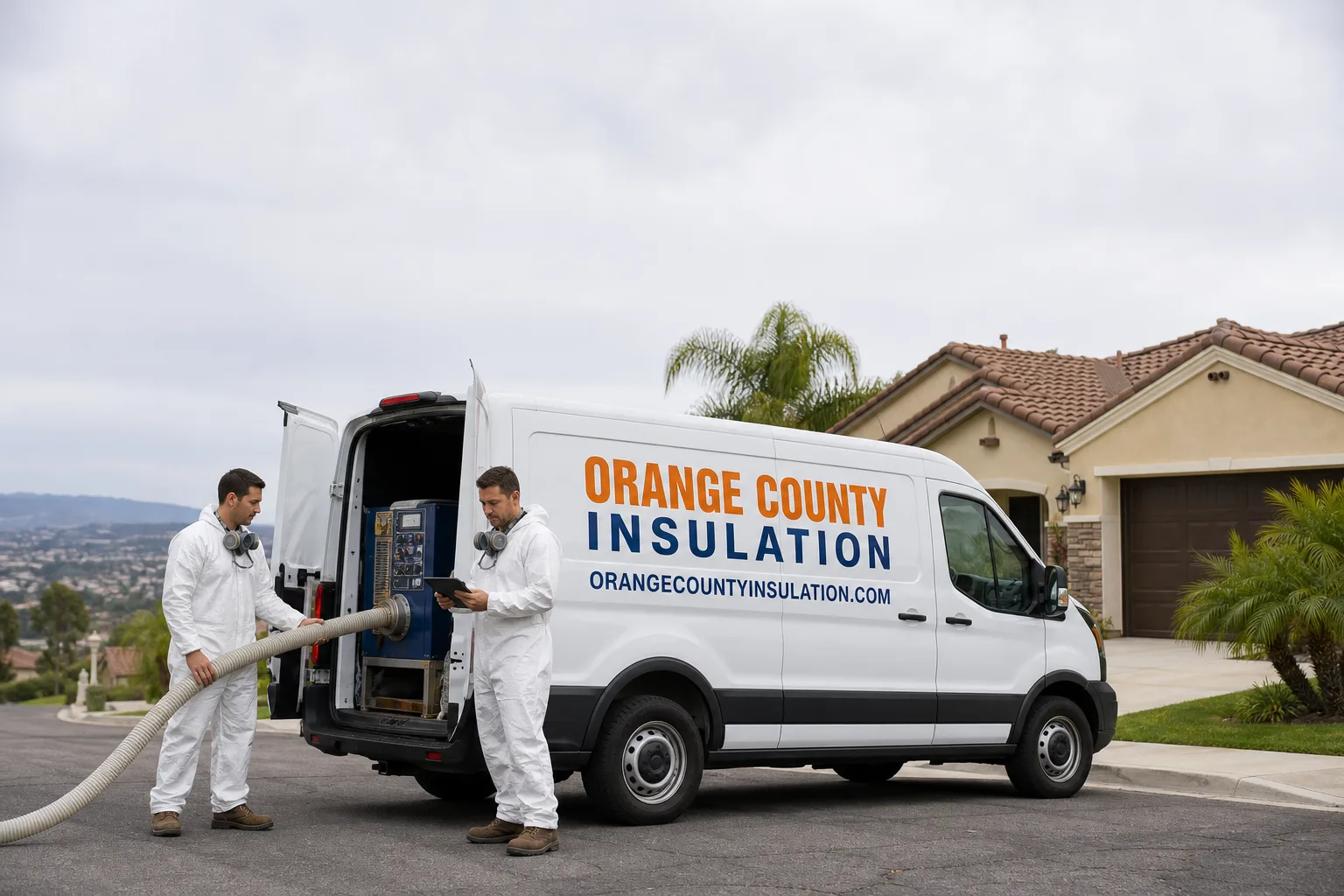
Spray Foam Insulation in Pomona: Cut Cooling Bills in a 140°F Attic Climate
Spray foam insulation in Pomona typically costs $2.50 – $6.50 per square foot installed, with a standard 1,200-sq-ft attic running $3,000 – $7,800 depending on open-cell vs. closed-cell and whether we’re sealing the roofline or the attic floor. In Pomona’s 91766 and 91767 neighborhoods, the real payoff isn’t just R-value: it’s keeping a 140°F attic from cooking your ducts and forcing your AC to work double shifts. Our Spray Foam Insulation crew works throughout Pomona weekly, and we’ll give you a straight answer on what your specific house needs. Call (877) 680-3557 for a free estimate.
Why Pomona Homeowners Call Orange County Insulation for Spray Foam
We only do insulation. That’s the whole business. Noel Carrasco built Orange County Insulation around one trade, which means every estimate, every crew member, and every warranty conversation centers on getting your building envelope right. There’s no roofing crew to schedule around, no HVAC side job pulling focus. When you call us about spray foam in Pomona, you’re talking to someone who spends their week thinking about foam, not someone fitting insulation between bathroom remodels.
We carry two dedicated spray foam lines: Icynene for open-cell applications and Demilec for closed-cell. That matters in Pomona because the right product depends on what you’re sealing. A postwar stucco house in 91767 with vented attic ducts wants open-cell at the roofline. A garage ceiling or rim joist in a newer 91768 build might justify closed-cell for its higher R-value per inch and moisture resistance. We’re not steered toward one brand or one product because it’s what we stock. We stock both, plus fiberglass, mineral wool, and cellulose, so we tell you exactly which material fits your situation.
Our response time to Pomona is typically 24 – 48 hours for an estimate, and we schedule installation on a timeline that works for your household. The Pomona housing stock runs from 1940s tract homes to mid-century ranches to newer east-side development, and we’ve seen what works (and what fails) across all of it.
Spray Foam Attic Insulation in Pomona
Spray Foam Attic Insulation in Pomona is the highest-impact upgrade for most homes here, and it’s the one we recommend most often in the 91766 and 91767 core. Here’s the local reality: attics in Pomona routinely hit 140°F or more on summer afternoons. Original mineral wool or fiberglass batts in these 1950s and 1960s houses have settled to a few thin inches, and the ducts running through that unconditioned space are baking. Sealing the ceiling plane with spray foam changes how the entire house behaves, not just the R-value number.
In Pomona’s older tract homes, spray foam is as much a duct-and-attic-temperature fix as an insulation upgrade. When we foam the attic ceiling plane, we air-seal top plates and penetrations first, then apply the foam, so the bond holds and the thermal barrier actually works. If your ducts sit in the attic, that sealing step makes a bigger difference to your July cooling bill than the foam thickness alone. A typical attic foam job in Pomona runs $2,800 – $7,500 depending on square footage and whether we’re doing open-cell or closed-cell.
Roofline vs. Attic Floor Sealing
If your HVAC ducts run through the attic, we almost always recommend foaming the roofline, not the attic floor. That brings the ducts inside the conditioned envelope, which matters enormously in Pomona’s 95°F-plus summers. The attic becomes a semi-conditioned space, and you stop losing cooled air through leaky duct joints in a 140°F oven.
Open-Cell for Pomona Attics
Open-cell spray foam (Icynene) is our go-to for unconditioned attics in Pomona’s older homes. It expands fully into 2×4 and 2×6 joist bays, air-seals as it cures, and costs less per board foot than closed-cell. For a vented attic that just needs the thermal boundary moved to the roofline, open-cell gets the job done without overpaying for closed-cell performance you don’t need.
Spray Foam Wall Insulation in Pomona
Spray Foam Wall Insulation in Pomona is a real decision point for homeowners in the 91767 and 91766 postwar housing stock. Many of these stucco-and-wood-frame houses were built with zero wall insulation. California Title 24 retrofit requirements have pushed a lot of Pomona homeowners to address walls during remodels, and spray foam is often the most practical way to get full cavity fill in existing walls. Expect wall foam installation in Pomona to run $2.75 – $4.50 per square foot of wall area for open-cell, and $3.50 – $6.50 for closed-cell, depending on cavity depth and access.
The wildcard in Pomona is wall drying. Stucco exteriors hold moisture differently than siding, and closed-cell foam on the interior can trap that moisture if the wall assembly isn’t detailed correctly. We always check for existing moisture issues before recommending closed-cell in a Pomona stucco wall. Open-cell allows vapor movement and is often the safer retrofit choice for older homes unless you’re specifically targeting a moisture or air-infiltration problem. We’ll tell you which one actually fits your wall type, not which one has a higher price tag.
Retrofit Wall Cavity Injection
For uninsulated walls in the 1940s – 1960s Pomona tract stock, we can inject foam from the exterior or interior with minimal disruption. This method fills existing cavities without tearing out drywall or stucco. It works best in walls with consistent stud spacing and no fire blocking obstructions.
Rim Joist and Garage Ceiling Applications
Rim joist spray foam seals a major air-leak point at the top of foundation walls, and it’s a smart add-on when you’re already doing a crawlspace or basement insulation project. Garage ceiling foam matters in Pomona too: attached garages with living space above them leak heat directly through the drywall ceiling, and an uninsulated garage door makes it worse. We typically use closed-cell here for the additional structural rigidity and moisture resistance.
Trusted Brands We Service in Pomona
We install and service Icynene open-cell and Demilec closed-cell spray foam, and we keep both product lines stocked for Pomona jobs, which means no waiting on a distributor order when your schedule is tight. We also carry Owens Corning, Johns Manville, Knauf, Rockwool, CertainTeed, and GreenFiber for hybrid jobs where foam isn’t the only right answer, like a Pomona attic that needs closed-cell at the roofline plus mineral wool in the walls for fire resistance. Eight brands, three installation methods, one trade. That’s the whole point: the right material for your house, not the easiest one for us to grab off the shelf.
Common Spray Foam Insulation Problems We See in Pomona Homes
After working in Pomona’s housing stock for years, these four issues come up constantly. All are fixable if caught before the foam goes in, and all are a lot more expensive to fix after.
- Foam peeling off dusty or chalky attic surfaces. In Pomona’s older stucco-and-frame houses, decades of dust, blown-in residue, and stucco chalk accumulate on top plates and sheathing. If the substrate isn’t cleaned and air-sealed first, the foam bond fails and thermal gaps reappear within months. We prep every surface before spraying.
- Closed-cell trapping heat in sun-baked roof decks. Pomona’s attic temperatures regularly exceed 140°F in July and August. Closed-cell foam applied directly to the underside of a hot roof deck without accounting for that thermal load can stress the roof assembly and shorten shingle life. We evaluate attic ventilation and roof deck condition before recommending closed-cell at the roofline.
- Ducts left unsealed while only the ceiling gets foamed. This is the big one in 91766 and 91767 homes. If your ducts run through unconditioned attic space and you foam only the attic floor, the ducts still sit in a 140°F oven and leak cooled air. The R-value added looks good on paper, but the July power bill barely moves. We map duct runs before foaming so we don’t bury a leaking joint that will haunt you later.
- Thin, settled mineral wool under a new foam layer. A 1950s Pomona attic might have two inches of compressed mineral wool between the joists. If foam is sprayed directly over that without addressing the settled material and the air leaks at the top plates, you get an uneven thermal boundary and trapped moisture. We remove or condition the old insulation before applying new foam.
Pricing for Spray Foam Insulation in Pomona, CA
Here are honest ranges for Pomona’s market. An open-cell attic foam job in 91766 or 91767 runs $2.50 – $3.75 per square foot of sprayed area, so a 1,500-sq-ft attic ceiling plane lands around $3,750 – $5,600. Closed-cell runs $3.75 – $6.50 per square foot, so that same attic comes in at $5,600 – $9,750, but you’re getting roughly double the R-value per inch and a moisture barrier. Rim joist foam typically runs $800 – $1,600 for an average Pomona crawlspace. Wall injection retrofit runs $2.75 – $6.50 per square foot of wall area depending on open-cell or closed-cell and cavity access. What changes the number: the size of the space, whether we’re sealing the roofline or the floor, how much old insulation needs removing, and whether ducts sit in the attic. Call (877) 680-3557 and we’ll give you a firm quote, not a ballpark that shifts after we walk the job.
We Also Serve Cities Near Pomona
Our crews work throughout the eastern San Gabriel Valley and Inland Empire. Beyond Pomona, we regularly handle spray foam projects in Spray Foam Insulation in Pomona and surrounding communities like La Verne, Walnut, Covina, and Claremont. If you’re in any of these cities and dealing with a hot attic or uninsulated walls, the same specialized crew and product lineup covers you.
Serving Pomona, CA — Our Local Coverage Area
We’re based in the Pomona area and know this community well. Use the map below to see our service coverage — if you’re nearby, we can almost certainly help.
FAQs About Spray Foam Insulation in Pomona
Yes, it’s the single most effective insulation upgrade for Pomona’s summer heat, because the problem isn’t just thin insulation. It’s hot air moving through gaps in your ceiling plane while your attic hits 140°F. Spray foam air-seals those gaps, and when applied at the roofline, it brings your ducts into a conditioned space. That combination drops your attic temperature swing dramatically and cuts the work your AC has to do. Call (877) 680-3557 for a free attic assessment and we’ll tell you exactly what your house needs.
We don’t recommend spraying directly over settled mineral wool in 1950s Pomona homes, and here’s why: the wool compresses unevenly, the top plates and penetrations still leak air underneath it, and the foam bond on dusty, settled material is unreliable. We remove or consolidate the old mineral wool, air-seal the top plates and penetrations, then apply foam. It’s more prep work, but it’s the difference between a thermal barrier that holds for 20 years and one that fails in two. (877) 680-3557 if you’d like us to take a look.
Foam the roofline. If your ducts run through the attic, which is the case in most 91766 and 91767 homes, the attic floor approach leaves those ducts in a 140°F space and you’ll keep paying to cool air that leaks out before it reaches your rooms. Moving the thermal boundary to the roofline brings the ducts inside the conditioned envelope. In our experience with Pomona tract homes, this is the single biggest difference-maker for July and August power bills. Call (877) 680-3557 for an exact quote.
Yes. Foam applied at the attic ceiling plane creates an air barrier, and that blocks the path that attic dust, insulation fibers, and that distinct “hot attic” smell use to get into your living space. Many 91768 homeowners notice the air inside the house feels cleaner and more stable within days of installation. It’s not an air purifier, but it closes the door on a lot of what tries to infiltrate from above. Free estimates: (877) 680-3557.
No, but you don’t always need closed-cell. Pomona’s winters are mild enough that heating-side wall insulation matters less than cooling-side attic and duct performance, but uninsulated walls in 1940s – 1960s tract homes still leak conditioned air year-round. Open-cell spray foam in walls is often the right balance: it air-seals, it insulates adequately for Pomona’s climate, and it costs less than closed-cell. We’ll tell you if closed-cell is worth the premium for your specific wall assembly, but it’s usually not. Call (877) 680-3557 and we’ll look at the house and give you a straight answer.
We foamed the attic ceiling plane of a 1950s stucco house off Pomona’s west side in 91766, where the original mineral wool had settled to about two inches between 2×4 joists and the ducts ran bare through a 140°F attic. We air-sealed the top plates and penetrations first, then sprayed Icynene to bring the roofline under control, which cut the attic temperature swing on the homeowner’s 95°F-plus afternoons. Before foaming we mapped the duct runs so the foam didn’t bury a leaking joint that still needed attention.
Written by Noel Carrasco, Owner at Orange County Insulation, serving Pomona and the San Gabriel Valley.