
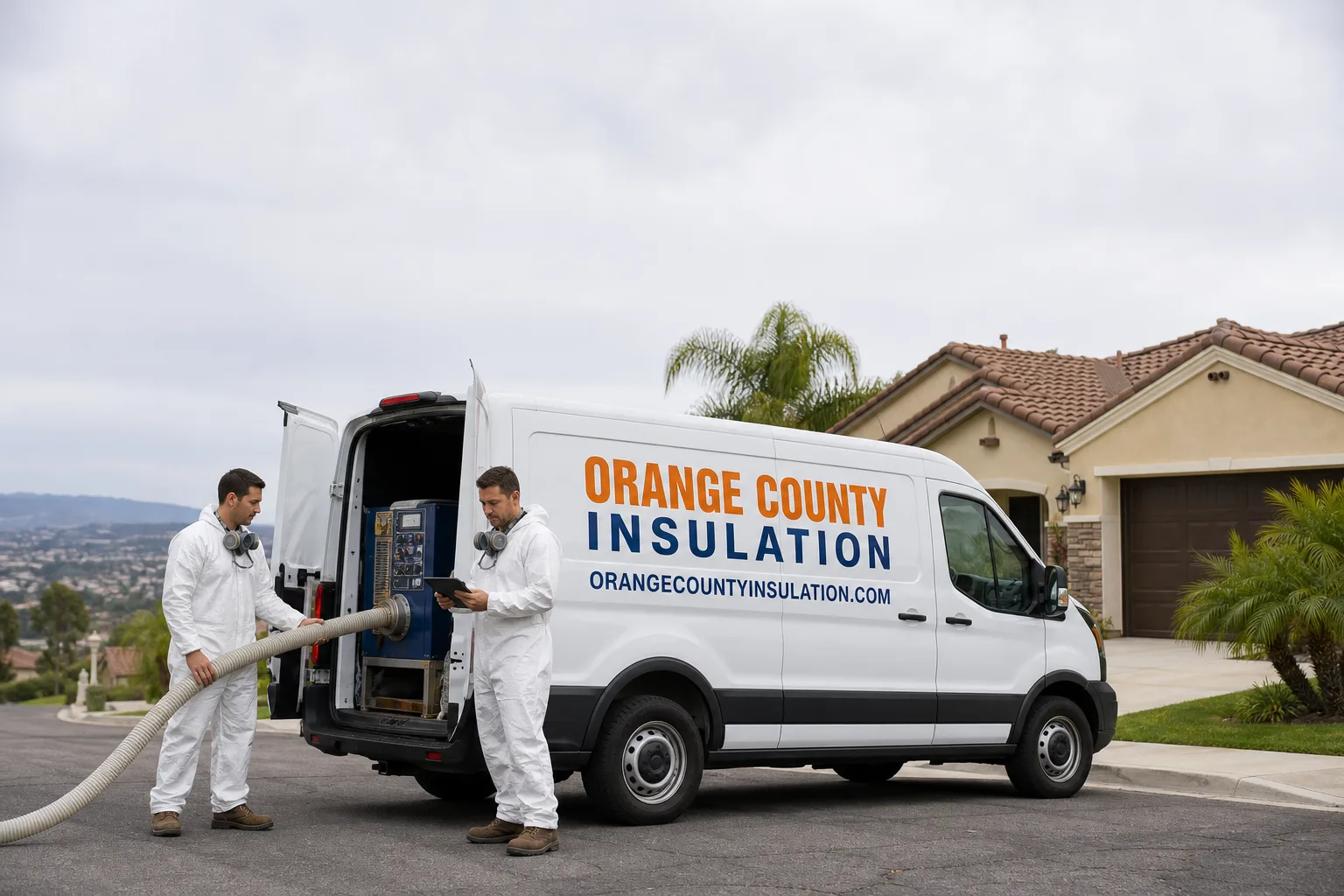
Fast, Reliable Spray Foam Insulation Across Eastvale
Spray foam insulation in Eastvale is a targeted fix, not a whole-house gut job. Because nearly every home here was built in the 1990s and 2000s by production builders, our crews spend most days in 92860 sealing the weak spots the original construction left behind: HVAC chases, recessed can lights, knee walls, and garage ceilings. We know exactly which two-story tracts off Hamner and Archibald run hot upstairs by 3 p.m. in August, because we’ve insulated enough of them to recognize the pattern. If your second floor won’t hold a setpoint or your garage door wall radiates heat into the hallway, call (877) 680-3557. We’ll show up, open the attic, and show you what’s actually happening.
Why Orange County Insulation Is Eastvale’s Preferred Spray Foam Insulation Company
We only do insulation. That means the crew we send to your Eastvale tract home isn’t splitting time between roofing, HVAC, and a remodel in Riverside. Every estimate, every warranty conversation, and every hour in your attic is spent on one trade. Homeowners around Roosevelt High School, the Eastvale Gateway side, and the newer sections east of the 15 have used us for open-cell and closed-cell Spray Foam Insulation because the product recommendation comes from what your envelope actually needs, not from whatever single brand a general contractor happens to stock.
This matters more in Eastvale than it does most places. The housing stock is so consistent across the city that a one-size-fits-all approach is tempting, but the truth is the east side’s wind-blown dust and the west side’s slightly older 1990s phases behave differently once you get into the attic. We treat every house as its own thermal envelope. That’s the only way to do this trade correctly.
Crawl Space Spray Foam Insulation in Eastvale
Crawl Space Spray Foam Insulation in Eastvale is most common in the handful of older phases where pier-and-beam or raised-floor construction exists, plus a growing number of two-story additions where the new floor overhang has never been air-sealed. The job involves cleaning the rim joist area, sealing penetrations, and spraying closed-cell foam against the band board and subfloor underside to stop the stack effect that draws hot attic air down through wall cavities. Eastvale homeowners typically notice the issue as cold tile floors in the family room or a persistent musty smell in a hallway closet. Typical pricing for a straight rim-joist encapsulation in an Eastvale home lands between $2,400 and $4,800 depending on linear footage and access clearance.
We use Demilec closed-cell for most Eastvale crawl spaces. It’s an air barrier and moisture barrier in one pass, which matters when the soil under your home sits above a high water table. Dust intrusion here is also a real problem: the open former dairy land on the east side blows fine particulates through foundation vents all year, and open-cell foam in a vented crawl space can become a dust filter rather than an insulator. Closed-cell foam doesn’t have that failure mode.
Rim Joist Sealing Under Two-Story Additions
Production-built 92860 homes that got a permitted addition twenty years after original construction often have a thermal seam at the floor transition. The builder sealed the addition to code at the time, but the rim joist under the new floor overhang almost never got a proper air barrier. Sealing that band board with closed-cell foam stops both heat loss and the dust that migrates up from the crawl space.
Encapsulating High-Moisture Crawl Spaces
When a crawl space in Eastvale holds humidity above 60 percent, the problem isn’t just comfort: it’s duct sweat and mold risk on floor joists. Spray foam on the rim joist and subfloor, combined with a vapor barrier on the soil, reduces latent heat transfer and cuts how hard your AC has to work. We inspect every crawl space before quoting so you’re not paying for foam where drainage or grading issues need to be fixed first.
Garage Spray Foam Insulation in Eastvale
Garage Spray Foam Insulation in Eastvale is, hands down, the most requested service we field from tract-home owners. In homes off Sumner, Citrus, and Schleisman, the garage shares a wall and ceiling with living space. The original builder rarely insulated that ceiling beyond a thin layer, and the door itself creates a thermal hole large enough to make the adjacent breakfast nook or hallway feel five degrees hotter. Spray foaming the garage ceiling and the wall between garage and house closes the largest unsealed thermal boundary in the structure. Typical Eastvale garage ceiling spray foam runs $1,800 to $3,600 for a standard two-car footprint.
We spray open-cell Icynene on interior garage ceilings where acoustic dampening matters, and Demilec closed-cell on walls that need fire-rated or moisture-resistive performance. The right call depends on whether your garage is attached, detached, or has a bonus room above. We’ll tell you exactly which one fits and why.
Attached Garage with Bedroom Above
When a bonus room or fourth bedroom sits directly over the garage, the floor assembly acts like a heat exchanger in Eastvale summers. The garage air bakes all day, and that energy transfers up through the joist bays into the bedroom floor. Spraying closed-cell foam onto the garage ceiling plane, rather than the bedroom floor, puts the thermal barrier on the unconditioned side where it belongs.
Garage Wall Shared with Living Space
That shared wall is often nothing more than drywall, a 2×4 cavity, and fiberglass batt that has slumped over time. Air sealing the garage side and spraying two inches of closed-cell foam dramatically cuts both thermal transfer and the fume and carbon monoxide penetration risk from a running car. It’s one of the highest-value spray foam applications we perform anywhere in Eastvale.
Trusted Brands We Service in Eastvale
We install spray foam from Demilec and Icynene, which means your Eastvale job gets whatever chemistry actually fits the application. Open-cell foam for interior sound control and cost-sensitive air sealing in attics; closed-cell foam for rim joists, garage walls, and anywhere moisture or fire rating is a factor. That’s the benefit of keeping eight manufacturers on the roster, including Owens Corning, Johns Manville, GreenFiber, and others. We’re not married to one product line, so your recommendation comes from the building science, not a sales quota.
Common Spray Foam Insulation Problems We See in Eastvale Homes
After years of working in 92860 specifically, certain patterns show up so often we can almost predict them from the street. Here’s what we regularly find and fix:
- Builder-grade attic baths that were never air-sealed. The original blow-in fiberglass looked fine on day one, but the recessed can housings and HVAC chases were left as open bypasses. Your insulation isn’t working at its rated R-value because conditioned air is pouring through those penetrations. We air-seal every can and chase before any foam goes in.
- Wind-blown dust fouling insulation around exhaust fans. The open former dairy land on the east side of Eastvale produces fine dust that gets pulled through attic vents and collects around bathroom fan housings and HVAC boots. It compresses the existing insulation and hides the real air leaks. We find this in almost every east-side attic we open.
- HOA fire-rated wall assemblies handled incorrectly. Many Eastvale HOA communities have fire-rated assemblies between attached units or around the garage. Spray foam is combustible and must respect fixture clearances and rating details. When a crew ignores those clearances, the “upgrade” becomes a code and warranty problem. We check the assembly type before we spray.
- Second-floor rooms that run hot all afternoon. Two-story tracts off Archibald and Hamner regularly see upper-floor temperatures 8 to 12 degrees above the thermostat setpoint from late May through September. The cause is almost always duct leakage in a hot attic, combined with the thermal bypass at the HVAC chase. Foam sealing the chase and garage ceiling changes the room’s behavior, not just the attic temperature.
Pricing for Spray Foam Insulation in Eastvale, CA
Eastvale spray foam pricing sits slightly below what you’d pay in older Corona or Norco stock because the homes are newer and the access is cleaner, but the labor hours are similar. Expect to budget $1,800 to $3,600 for a two-car garage ceiling, $2,400 to $4,800 for a rim joist and crawl space encapsulation, and $3,200 to $6,500 for targeted attic chase and knee wall sealing in a standard 2,800 sq ft two-story. What moves the number? Access height, how much recessed lighting needs to be sealed and boxed, whether you’re doing open-cell or closed-cell, and whether we’re doing the whole plane or just the high-loss seams. We’ll give you the actual quote after we open your attic, not from the curb. Call (877) 680-3557 for a free estimate.
We Also Serve Cities Near Eastvale
Our crews work the whole western Riverside corridor, so if you’re searching for Eastvale insulation you’ll see us in the adjacent communities too. We regularly run jobs in Norco, Home Gardens, Corona, and Jurupa Valley. Each has its own housing quirks, and we adjust our approach accordingly. Eastvale’s single-burst build-out is its own animal, and we’ve learned it well.
Serving Eastvale, CA — Our Local Coverage Area
We’re based in the Eastvale area and know this community well. Use the map below to see our service coverage — if you’re nearby, we can almost certainly help.
FAQs About Spray Foam Insulation in Eastvale
Because builders in Eastvale’s production subdivisions met code minimums, not performance targets. An attic with R-30 batts and unsealed recessed cans and HVAC chases loses a significant portion of its rated R-value to air movement. The home is new enough that you’re not replacing failed insulation; you’re correcting the original air sealing that was never done. On a 2000s tract off Archibald, this is the highest-return energy upgrade available. Call (877) 680-3557 and we’ll show you exactly where the air is moving.
Yes, and it’s usually the single best dollar-for-dollar improvement on a two-story tract home. The garage is the largest unconditioned space attached to your living area, and the original builder rarely insulated the ceiling plane before drywall. A two-inch lift of open-cell Icynene on the garage ceiling drops the temperature in the adjacent rooms and the floor above by enough that your AC cycles differently. For most Eastvale homeowners, this runs $1,800 to $3,600 and pays back in comfort long before the energy math catches up.
Fire-rated assemblies have clearance and installation rules that affect how spray foam is applied around recessed fixtures and shared walls. The spray foam itself is combustible, so the assembly’s rating must be maintained with proper clearances and, where required, intumescent or non-combustible covers. Crews that skip this step are leaving you with a code violation and a potential HOA problem. Our techs treat every Eastvale HOA job as a rated-assembly job until we verify the actual construction.
Eastvale’s position on the open former dairy land means wind-blown dust enters attic vents and settles on horizontal surfaces all year. That dust compresses existing insulation, fouls exhaust fan housings, and hides air bypasses. Before we spray foam anywhere, we inspect for dust-fouled insulation around vents and HVAC boots. The foam itself isn’t affected by dust, but spraying over a fouled penetration seals the problem in instead of fixing it.
If you only have budget for one, start with the attic and garage ceiling. That’s where the majority of your heat gain in Eastvale comes from, and the payback is fastest. But if you have a raised floor, a vented crawl space, or a two-story addition with an exposed rim joist, the crawl space may be the actual source of your discomfort. Our free estimate includes opening both spaces if you have them, so you can see the before-and-after picture before writing a check.
Written by Noel Carrasco, Owner at Orange County Insulation, serving Eastvale, CA with insulation-only expertise and eight major manufacturer brands.