
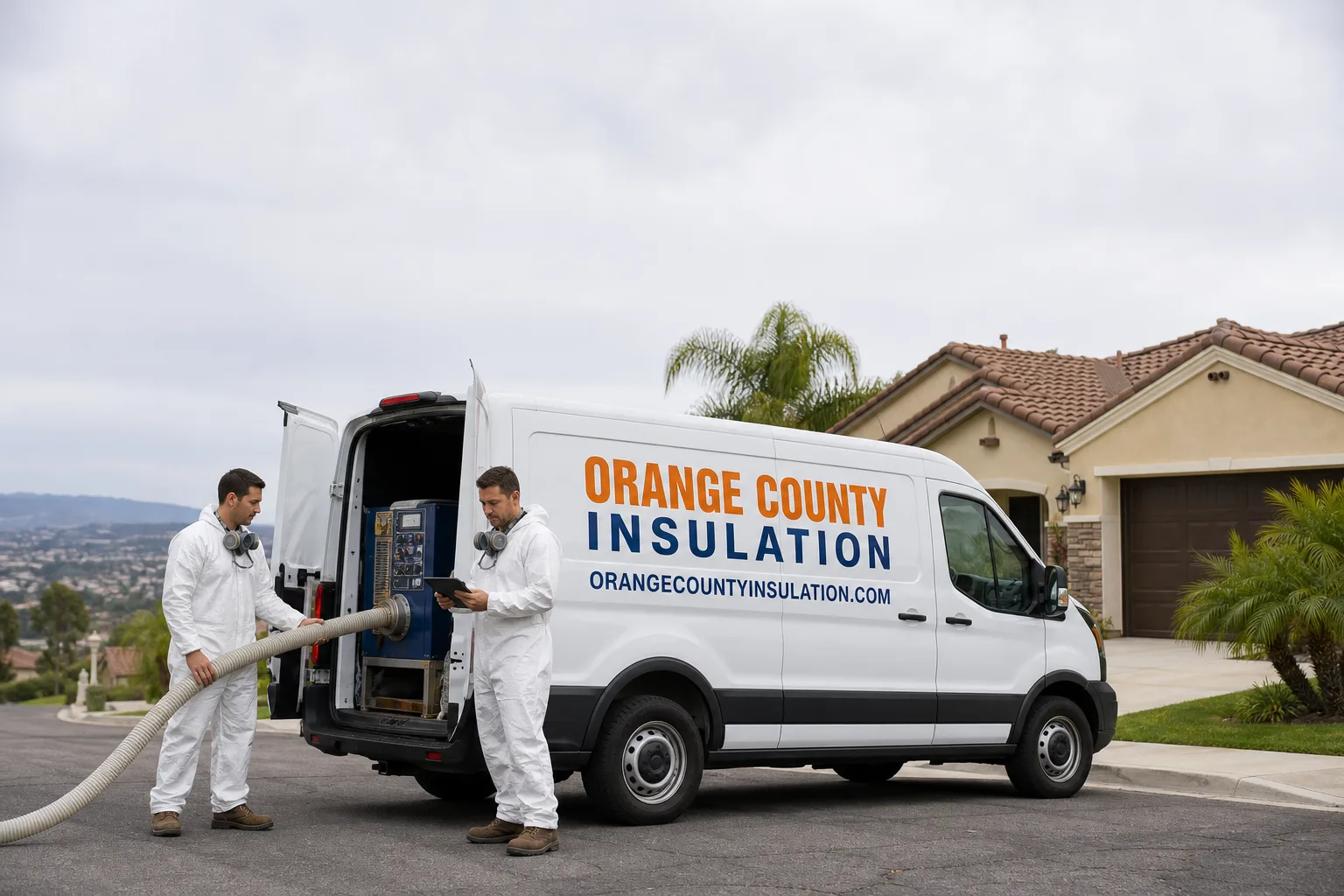
Fast, Reliable Spray Foam Insulation Across Desert Hot Springs
Spray foam insulation in Desert Hot Springs does something no other material can do here: it creates an air seal that stands up to San Gorgonio Pass wind, 105°F summer heat, and the mineral dust that blows through the pass every afternoon. We run crews into the 92240 and 92241 ZIP codes weekly, and we know what these homes need because we’ve been inside enough of them to see the same problems repeating. If you’re tired of rooms that never hold temperature, dust on every horizontal surface, or energy bills that spike from June through September, call us at (877) 680-3557 and we’ll tell you exactly what’s going on in your attic and walls. You won’t get a sales pitch. You’ll get a diagnosis and a number.
Why Orange County Insulation Is Desert Hot Springs’s Preferred Spray Foam Insulation Company
We only do insulation. That’s not a tagline; it’s the entire business. Noel Carrasco built Orange County Insulation as an insulation-only contractor, which means every crew member on your Desert Hot Springs job spends their whole week thinking about thermal envelopes, vapor drive, and air sealing. No one is rushing off to a roofing job or a remodel. When a homeowner in the older 92240 tracts asks us why their bedroom hits 90°F at 9 p.m., we know to check the attic first, because we’ve crawled through hundreds of those attics.
Desert Hot Springs homeowners tell us the same things after we finish: rooms finally hold temperature, the AC doesn’t run constantly, and the dust stopped coming through the walls. That last one matters here more than almost anywhere. The wind that funnels through the San Gorgonio Pass carries fine mineral dust that finds its way into every unsealed crack, and spray foam is the only material that stops it at the envelope.
We stock and install products from eight manufacturers: Owens Corning, Johns Manville, Knauf, Rockwool, CertainTeed, Icynene, Demilec, and GreenFiber. For spray foam specifically, we run both Icynene open-cell and Demilec closed-cell systems. Two specialized foam brands means we choose based on what your house actually needs, not what we happen to have on the truck.
Response time to Desert Hot Springs from our Rancho Santa Margarita base is typically one to three business days for estimates, with installations scheduled within a week or two depending on scope. We quote free, we quote specific, and we don’t charge for the visit.
Open Cell Spray Foam in Desert Hot Springs
Open Cell Spray Foam in Desert Hot Springs is our default recommendation for attics and interior walls in newer or well-sealed homes, especially those on the city’s municipal water grid where interior humidity stays predictable. Open-cell foam runs about $0.70 to $1.40 per board foot installed, and it expands to roughly 100 times its liquid volume, filling every cavity and sealing the thermal envelope. It’s half the cost of closed-cell, it deadens sound, and it handles the high-desert heat well when the home isn’t fighting internal moisture.
Where open-cell fits best here
Attics in newer 92240 tract homes and most wall cavities respond well to open-cell. The material is vapor-permeable, which means it lets moisture move through rather than trapping it, so it works in homes without geothermal or well-system humidity. We typically install it at 3.5 to 5.5 inches in attics, which puts most Desert Hot Springs homes at or above current code for the zone.
Why open-cell catches wind-driven dust
The pass wind doesn’t stop at the walls. It pushes fine dust through top plates, can light gaps, and any penetration that was never sealed. Open-cell foam, once fully expanded, glues itself to the framing and closes those gaps permanently. Homeowners in the mobile home parks around 92240 notice a difference in indoor dust within a week of the install.
Spray Foam Insulation Contractors in Desert Hot Springs
Spray Foam Insulation Contractors in Desert Hot Springs need to understand two things that don’t show up on a standard insulation bid: geothermal humidity and slab-on-grade air infiltration. Our crews do. We’ve worked on enough self-built 1960s and 1970s homes around Palm Drive and the surrounding tracts to know that a 92240 house on a private well or geothermal loop behaves differently than a municipal-water home four blocks away. The foam specification changes, and a contractor who doesn’t ask about your water system is guessing.
What a Desert Hot Springs install actually looks like
We start with a visual inspection of the attic, rim joists, and crawlspace or slab edges. We check for settled cellulose, roof-rat damage, can light gaps, and evidence of moisture around geothermal equipment rooms. Then we air-seal the penetrations first, because foam applied over unsealed penetrations still lets the pass wind through. After that, we spray the foam and verify depth and adhesion every six feet.
When closed-cell is the better call
For homes on private geothermal or well systems where interior humidity runs high, closed-cell Demilec is the right material at $1.50 to $2.80 per board foot for a typical 2-inch application. It’s a vapor barrier by itself, which means it stops the moist interior air from condensing inside the wall cavity. That matters in Desert Hot Springs more than any other high-desert city we serve, because the geothermal humidity problem is unique to this town.
Trusted Brands We Service in Desert Hot Springs
We install Icynene open-cell and Demilec closed-cell spray foam, and we carry GreenFiber cellulose and Owens Corning fiberglass for the jobs where foam isn’t the right fit. Eight brands on the roster means we’re never steering a Desert Hot Springs homeowner into a single material because that’s all we stock. It also means we can match the foam to the house: a 1970s self-built home on a geothermal loop off 92240 gets a different spec than a 2005 tract home in the same ZIP. We keep both foam systems on hand for the pass area, so turnaround doesn’t slow down waiting on a distributor.
Common Spray Foam Insulation Problems We See in Desert Hot Springs Homes
- Settled or rat-tunneled original insulation: In the older 92240 tracts and mobile home parks, the original blown-in cellulose or early open-cell foam has settled to half its original depth, and roof rats have tunneled through what’s left. R-values are often below R-19 where code wants R-38 or better.
- Geothermal humidity trapped in the wrong foam: Homes on private geothermal or well loops carry elevated interior moisture, and open-cell foam applied without a vapor strategy lets that moisture reach the sheathing and condense. Closed-cell on the humid side fixes it.
- Wind-driven dust through unsealed top plates: The San Gorgonio Pass wind pushes fine dust through every unsealed crack in the envelope. Homes that got fiberglass batts decades ago have essentially no air seal, and the dust shows up on window sills and furniture within days of cleaning.
- Unsealed slab edges and crawlspaces: Slab-on-grade construction is common in 92240, and the unsealed perimeter lets hot air and dust infiltrate at the floor line. Foam applied to the slab edge and rim joist area cuts that infiltration path off at the source.
Pricing for Spray Foam Insulation in Desert Hot Springs, CA
Open-cell spray foam in Desert Hot Springs typically runs $0.70 to $1.40 per board foot installed, and a standard 1,200-square-foot attic at 5.5 inches works out to $2,900 to $5,200. Closed-cell Demilec, which we use for geothermal-humidity homes and unvented roof decks, runs $1.50 to $2.80 per board foot; a 2-inch roof deck application on the same home falls around $4,800 to $8,400. Rim joist spray foam on a typical 92240 home runs $900 to $2,400 depending on the number of bays. Garage ceiling spray foam runs $1,100 to $2,800. Every quote is line-itemed by square footage, board feet, and material type, and we walk the house before we write anything down. Estimates are free. Call (877) 680-3557 to schedule a visit.
We Also Serve Cities Near Desert Hot Springs
Our crews cover the whole pass and the communities around it, including Desert Edge, Sky Valley, Garnet, and Thousand Palms. If you’re in any of those areas and want to know more, our Spray Foam Insulation page covers the methods and materials in depth, and our Spray Foam Insulation in Desert Hot Springs page goes deeper on this city’s unique housing conditions. Same crew, same standards, same eight brands.
Serving Desert Hot Springs, CA — Our Local Coverage Area
We’re based in the Desert Hot Springs area and know this community well. Use the map below to see our service coverage — if you’re nearby, we can almost certainly help.
FAQs About Spray Foam Insulation in Desert Hot Springs
Yes. Homes on private geothermal or well systems in Desert Hot Springs carry higher interior humidity than municipal-water homes, so the foam type and placement has to change. We typically spec closed-cell Demilec on the humid side of the envelope where it acts as a vapor barrier, rather than open-cell which would let moisture pass through and condense in the wall. If you’re not sure which system your home runs on, call (877) 680-3557 and we’ll help you figure it out during the walkthrough.
No, and you shouldn’t let anyone do that. The settled, rat-disturbed cellulose has to come out first. We vacuum the old material, air-seal the top plates and can light gaps, and only then apply fresh foam. Foaming over compacted cellulose traps the moisture and waste inside and leaves the air leaks untouched. In the 92240 mobile home parks we see this constantly, and the fix always starts with removal, not encapsulation.
Yes, and it’s the only insulation type that seals against both at once. Closed-cell foam resists heat gain through the roof deck and walls while blocking the wind-driven dust that the pass pushes through every unsealed penetration. Open-cell handles the heat well in homes without the geothermal humidity factor. The key is choosing the right foam for your specific home, and we make that call based on a walkthrough, not a formula. Call (877) 680-3557 for a free estimate and a straight answer.
For older self-built homes in 92240, the deciding factor is usually humidity. Open-cell is vapor-permeable and costs less, but it lets moisture pass through, which becomes a problem if the home runs on geothermal or well water with elevated interior humidity. Closed-cell is a vapor barrier and costs more, but it protects the wall cavity from condensation in exactly those homes. We walk the house, check the water system and the existing insulation, and tell you which one we’d put in our own home.
Yes, and it’s one of the fastest wins for comfort in these homes. The unsealed slab perimeter lets hot air and pass wind dust infiltrate at the floor line, and rim joist spray foam closes that path permanently. We foam the rim joist bays and the slab edge where accessible, and the difference in how the floors feel in summer is immediate. Most 92240 slab-on-grade homes see a noticeable change in indoor dust and floor temperature within days of the work.
Written by Noel Carrasco, Owner at Orange County Insulation, serving Desert Hot Springs and the surrounding Coachella Valley communities.
Ready to stop the dust and the heat at the envelope? Call (877) 680-3557 now and schedule a free insulation walkthrough for your Desert Hot Springs home. We’ll tell you what’s wrong, what it costs to fix, and which foam is right for your house. No guesswork, no pressure.