
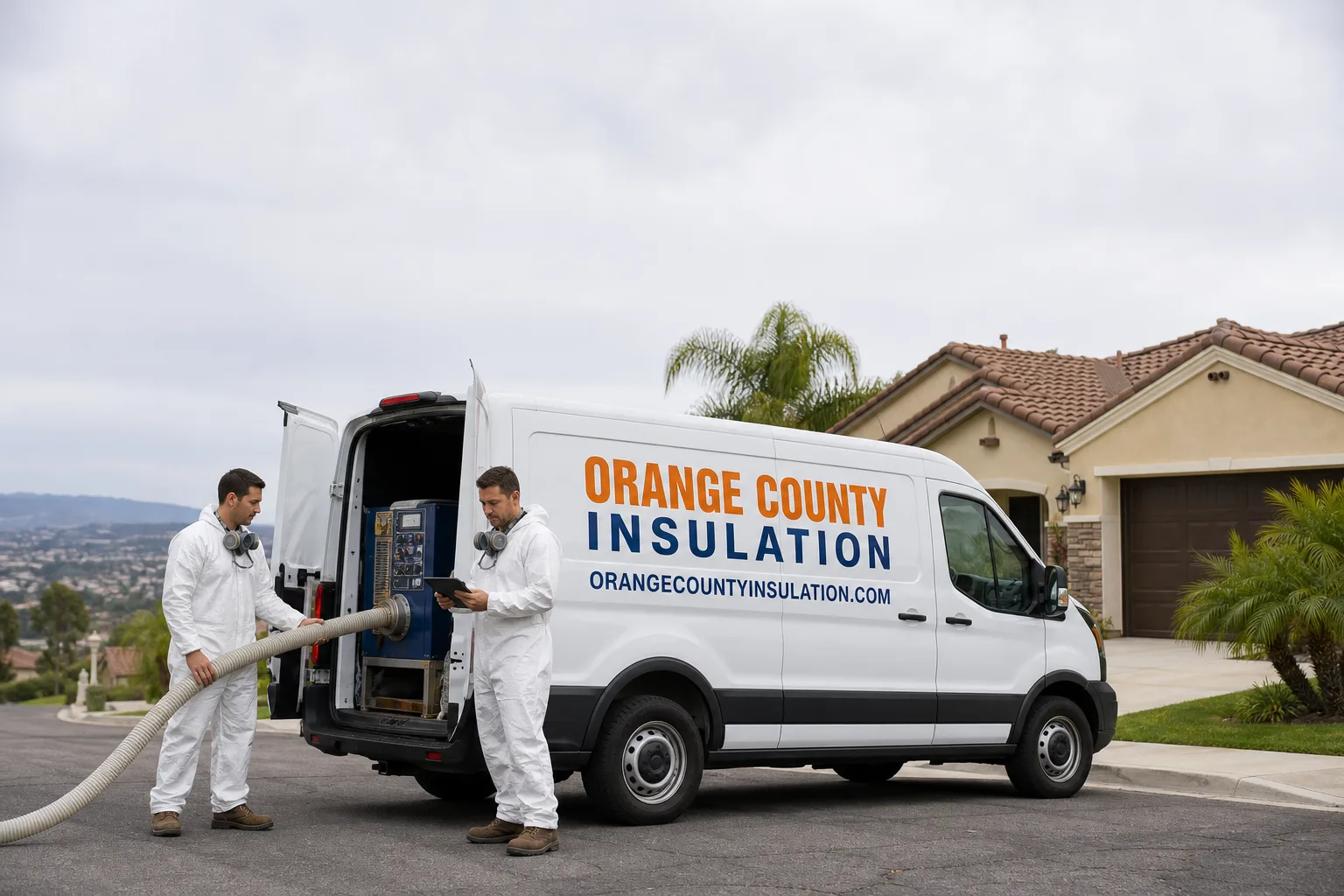
Fast, Reliable Spray Foam Insulation Across Culver City
Spray foam insulation in Culver City typically runs $2,800 – $7,500 for a full attic application and $4,500 – $12,000 for wall cavities, depending on whether you choose open-cell or closed-cell. Homes near the Ballona Creek corridor almost always need closed-cell, and we’ll explain exactly why below. If your Culver City home was built between the 1920s and 1950s, there’s a good chance it has little to no insulation in the walls and attic, which means every hot afternoon and every freeway hum passes straight through. We’re an insulation-only contractor, we carry both Icynene and Demilec spray foam, and we make the drive to Culver City from our Rancho Santa Margarita shop regularly. Call (877) 680-3557 for a free estimate.
Why Orange County Insulation Is Culver City’s Preferred Spray Foam Insulation Company
Culver City homeowners call us because we only do insulation. That’s the whole business. No roofing, no HVAC, no kitchen remodels competing for our attention. Every estimate we write and every crew we send focuses on one thing: getting the right material into the right cavity at the right thickness. We carry eight manufacturer brands including Icynene, Demilec, and Owens Corning, which means we’re not steering you toward whatever single product line we happen to stock. The right material for your home, not the easiest one for us to install.
Our Spray Foam Insulation team works in Culver City’s older single-family neighborhoods regularly, from the streets off Overland Avenue up to the homes climbing toward the Baldwin Hills overlook. We know what a 1940s balloon-framed house looks like behind its stucco, and we know what CALGreen demands when you pull a permit for an addition or a garage conversion. That local knowledge changes how we spec a job. It means we check for existing vapor barriers before recommending open-cell, and it means we flag moisture issues near the bluffs before they become mold problems.
Spray Foam Attic Insulation in Culver City
Spray foam attic insulation in Culver City addresses the two things that make older homes here uncomfortable: afternoon heat gain and moisture from the marine layer. Most 1920s through 1950s homes around Culver City have either no attic insulation or a thin layer of settled fiberglass that’s doing almost nothing. A typical spray foam attic job in Culver City runs $2,800 – $7,500 depending on square footage and whether you need open-cell or closed-cell. The marine layer doesn’t just cool the air; it pushes humidity into attics through soffit vents and gaps, and open-cell foam can absorb that moisture. Homes within a mile of the Ballona Creek corridor often do better with closed-cell Demilec foam and a proper vapor barrier.
We usually see the worst attic conditions in homes along the 405-facing side of Culver City and in the flat-roofed bungalows near downtown. Heat builds against the roof deck, and without insulation it radiates into the bedrooms below by late afternoon.
Roof Deck Application
Spraying the underside of the roof deck turns an attic into a conditioned space. That matters in Culver City because it keeps the temperature above the ceiling stable instead of letting it swing 40 degrees between morning and midafternoon. Closed-cell foam also seals the gaps where soot and brake dust from the 405 would otherwise filter through.
Garage Ceiling Spray Foam
Attached garages in Culver City are often directly below bedrooms, which means a hot garage ceiling becomes a hot bedroom floor by evening. Spray foam on the garage ceiling cuts that heat transfer immediately. It also helps block noise from Sepulveda Boulevard and the freeway, which is a complaint we hear constantly from homeowners in the 90230 and 90232 zip codes.
Spray Foam Wall Insulation in Culver City
Spray foam wall insulation in Culver City starts around $4,500 and runs up to $12,000 for full exterior wall coverage. Older homes here typically have empty wall cavities, and retrofitting them with spray foam is the most effective way to stop both heat gain and freeway noise without tearing out drywall completely. For additions and remodels, Culver City’s building department enforces CALGreen insulation values that generic fiberglass batts often cannot hit without careful air sealing. Spray foam meets those numbers because it insulates and air seals in one pass.
If your home sits near the bluffs above Ballona Creek, wall insulation is where we see the biggest difference between open-cell and closed-cell. The salt-laden air works its way into wall cavities through stucco cracks and rim joists, and open-cell foam acts like a sponge. Closed-cell foam doesn’t.
Rim Joist Spray Foam
The rim joist is the band of framing where your floor meets your foundation, and in Culver City’s older homes it’s almost never sealed. Spray foaming rim joists stops the stack effect that pulls hot air in and pushes cool air out, and it blocks the path rodents use to get from crawl spaces into walls. It’s a small job, usually a few hundred dollars, but it changes comfort in rooms above the crawl space immediately.
Home Additions and ADUs
Culver City has seen a wave of ADU and addition permits in recent years, and every one of those projects has to satisfy Title 24 and CALGreen. Closed-cell spray foam in walls and roof decks is one of the cleanest ways to hit the required R-values while also passing blower door and air sealing tests. Builders and remodelers call us because we can bring Demilec or Icynene to the site depending on the spec, and because we understand inspection requirements in Culver City specifically.
Trusted Brands We Service in Culver City
We install spray foam from Icynene and Demilec, and we stock products from Owens Corning, Johns Manville, Knauf, Rockwool, CertainTeed, and GreenFiber as well. Eight brands on the roster means we’re matching material to the job, not selling you whatever one supplier happened to have on the truck. For Culver City homes where soundproofing matters as much as thermal performance, Rockwool mineral wool is often the answer. For homeowners who want recycled content, GreenFiber cellulose delivers real R-value with lower embodied carbon. And for the coastal moisture problem along the Ballona Creek corridor, Demilec closed-cell is the workhorse. We’re not married to any single brand, which is exactly why Culver City homeowners and builders trust us to give a straight answer.
Common Spray Foam Insulation Problems We See in Culver City Homes
- Salt-air corrosion migrating from garage hardware into wall cavities. Culver City’s marine layer pushes humid salt air inland off the Ballona Creek corridor, and garages closest to the bluffs develop condensation on metal door tracks, hinges, and springs. That moisture wicks into garage ceiling and wall cavities, degrades insulation, and accelerates rust on fasteners.
- Open-cell foam losing R-value in bluff-adjacent garages. Open-cell spray foam absorbs marine-layer humidity, especially in garages near the bluffs below the Baldwin Hills. Once saturated, it loses thermal performance and can hold moisture against framing. Closed-cell foam with a vapor barrier is the fix.
- Zero insulation in 1920s – 1950s wall cavities. Many Culver City prewar and postwar homes were built with empty walls, and thin blown-in applications don’t hit CALGreen values for permitted work. We regularly strip out failing material and reapply closed-cell to meet current code.
- Freeway noise through garage-adjacent walls. Older homes near the 405 and Sepulveda Boulevard have walls that act like soundboards. Spray foam, especially closed-cell, reduces that transmission far better than fiberglass batts, and it’s the first thing we recommend for bedrooms over garages in 90230 and 90232.
The Salt-Air Problem: Why Culver City Garages Fail Differently
Culver City’s marine layer doesn’t just make mornings gray. It pushes humid, salt-laden air inland along the Ballona Creek corridor, and garages closest to the bluffs develop condensation on the underside of metal door tracks and hinges that inland garages a few miles east never see. We’ve seen it dozens of times: torsion springs pitted with rust, steel hinges frozen tight, track fasteners corroded to the point they snap. The same moisture migrates into garage ceiling and wall cavities, which is exactly where your insulation lives. That’s why closed-cell spray foam, not open-cell, is the right specification for those homes. Closed-cell doesn’t absorb water, it adds structural rigidity, and it creates a vapor barrier in the same application.
On a 1940s single-family home near the Ballona Creek bike path, our crew found the garage door’s original torsion springs pitted and the steel hinges rusted tight, with corrosion creeping into the ceiling cavity above. We pulled the failing open-cell batts, applied closed-cell spray foam to the garage ceiling and the shared wall with the living space, and walked the homeowner through what to ask for in replacement hardware: galvanized springs and stainless fasteners. The foam stops the moisture from getting into the house, and the hardware upgrade stops the salt air from eating the door assembly. If you live along the bluffs, that’s the kind of thinking your insulation contractor should be doing. Most don’t.
Pricing for Spray Foam Insulation in Culver City, CA
Spray foam attic insulation in Culver City runs $2,800 – $7,500. Wall applications run $4,500 – $12,000 depending on cavity depth and accessibility. Garage ceiling spray foam typically lands between $900 and $2,200. Rim joist work starts around $600. Closed-cell runs roughly 50 – 80% more per board foot than open-cell, but in bluff-adjacent homes it’s not optional; it’s the difference between insulation that lasts 20 years and insulation that starts failing in five. Square footage, roof pitch, existing insulation removal, and CALGreen verification all move the number. We give free estimates with line-item pricing, no vague ranges without a site visit. Call (877) 680-3557 and we’ll tell you exactly what your Culver City home needs and what it costs.
We Also Serve Cities Near Culver City
Our Culver City work often brings us to neighboring communities. We serve Ladera Heights, Century City, Venice, and Beverly Hills with the same insulation-only focus and the same eight-brand lineup. If you’re just outside Culver City, call (877) 680-3557 and we’ll confirm coverage for your street.
Serving Culver City, CA — Our Local Coverage Area
We’re based in the Culver City area and know this community well. Use the map below to see our service coverage — if you’re nearby, we can almost certainly help.
FAQs About Spray Foam Insulation in Culver City
Culver City’s marine layer carries salt-laden air inland along the Ballona Creek corridor, and garages near the bluffs get condensation on metal surfaces that inland neighborhoods never experience. Torsion springs, hinges, rollers, and track fasteners corrode years faster, and that same moisture migrates into ceiling and wall cavities. The fix starts with closed-cell spray foam to stop moisture penetration, plus galvanized or stainless hardware on the door assembly. Call (877) 680-3557 and we’ll assess the full picture.
Closed-cell. Open-cell absorbs marine-layer humidity and loses R-value, especially in garages within a mile of the Ballona Creek corridor. Closed-cell creates a vapor barrier, adds structural strength, and doesn’t hold moisture against framing. We specify closed-cell Demilec or equivalent for nearly every bluff-adjacent Culver City garage we insulate.
Yes, significantly. Closed-cell spray foam is one of the most effective materials for blocking airborne noise from the 405 and Sepulveda Boulevard. It seals the gaps that let sound travel through wall cavities while adding mass and density to the assembly. For bedrooms over garages or walls facing the freeway, we typically recommend closed-cell plus Rockwool for the best noise reduction we can deliver. Call (877) 680-3557 for a free assessment of your noisiest rooms.
Yes, and in most cases closed-cell spray foam exceeds the mandatory minimums while also helping you pass air sealing and blower door tests. Culver City enforces CALGreen more strictly than some neighboring cities, so the insulation values and verification requirements for permitted additions, ADUs, and remodels are not optional. We spec every job to the current code and know what inspectors here look for.
The marine layer pushes humid air into attic cavities through soffit vents and gaps, and open-cell foam absorbs that moisture. In homes near the bluffs or the Ballona Creek bike path, we recommend closed-cell on the underside of the roof deck with proper ventilation detailing to keep humidity from condensing on framing. It’s a Culver City-specific issue that inland neighborhoods simply don’t face.
Written by Noel Carrasco, Owner at Orange County Insulation, serving Culver City with insulation-only expertise across eight manufacturer brands and three installation methods.