
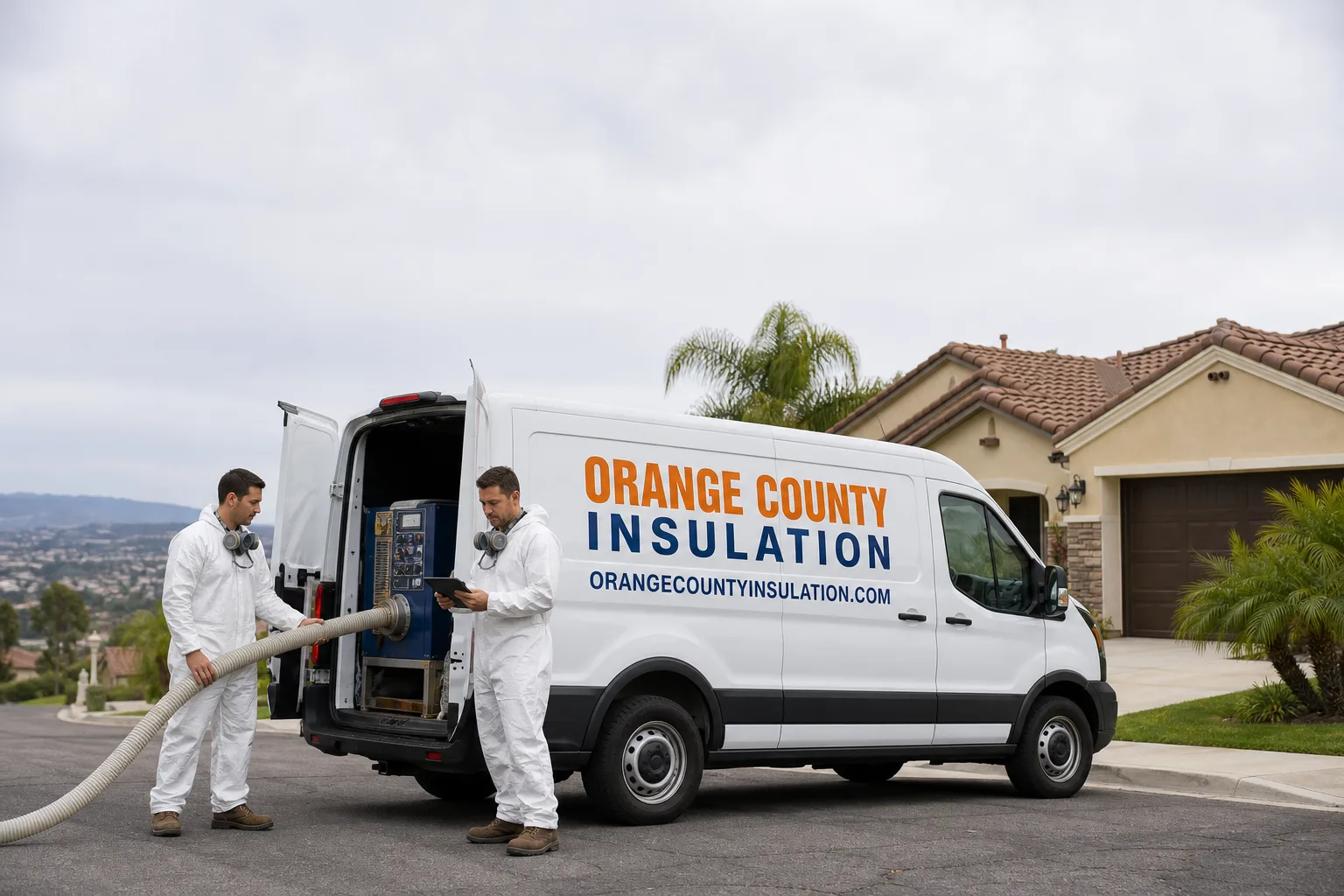
Fast, Reliable Spray Foam Insulation Across Covina
Spray foam insulation in Covina is a retrofit job most of the time, not new construction. The city’s post-war tract homes – stucco over wood frame, shallow vented attics, thin original wall cavities – let triple-digit San Gabriel Valley heat pour straight into living space. Sealing and insulating those cavities with open or closed cell foam changes how a Covina house behaves in August. If you’re tired of back bedrooms that run ten degrees hotter than the rest of the house, call us at (877) 680-3557. We work in Covina every week, and we know exactly what’s behind the drywall in these homes before we ever open an attic hatch.
Why Orange County Insulation Is Covina’s Preferred Spray Foam Insulation Company
We only do insulation. That’s the whole business. No roofing, no HVAC side jobs, no remodeling crews that dabble in foam on slow days. Every truck we send to Covina carries equipment operated by a crew that has done nothing but insulation work for years, and that focus shows up in how we handle the tricky stuff – old wiring, shallow rafter bays, stucco wall cavities that don’t forgive mistakes.
Covina homeowners call us because we explain the tradeoff between Spray Foam Insulation materials honestly. Open cell Icynene costs less and quiets the house. Closed cell Demilec adds structural rigidity and a vapor barrier. Both have a place here. We stock both, along with six other manufacturer lines, so the recommendation you get is based on your house, not on what we happen to have on the truck. Noel Carrasco built this company around that principle: the right material for the home, not the easiest one for us to install.
Response time to Covina from our Rancho Santa Margarita base is typically one to two business days for estimates. We work in the 91722, 91723, and 91724 zip codes regularly and know the difference between a 1955 rancher off Badillo Street and a 1970s two-story near Charter Oak. That local familiarity means fewer surprises once the work starts.
Open Cell Spray Foam in Covina
Open Cell Spray Foam in Covina is most often the right call for attic rooflines and interior walls in these mid-century tract homes. It expands aggressively, fills shallow rafter bays completely, and air-seals every gap where the original fiberglass or settled cellulose left a path for 100°F attic air to reach the ceiling below. Open cell Icynene is semi-permeable, so it lets the roof assembly breathe – useful in older Covina homes where the original venting design wasn’t meant to handle a fully sealed assembly without adjustments.
For a typical 1,200-to-1,600 square foot single-story in Covina, open cell attic foam runs $3,200 to $5,800 depending on rafter depth, access, and how much prep work the wiring and existing insulation require. It is the most common foam job we quote in the 91723 area because it delivers the biggest comfort change per dollar when the problem is heat gain through the ceiling.
Roofline Sealing for Shallow Attics
Covina’s older homes have rafter bays that are often six inches deep or less. That’s not enough space for meaningful batt insulation, and loose-fill settles to almost nothing after fifty years. Open cell foam applied directly to the roofline turns that shallow, superheated attic into a conditioned space instead of an oven sitting on top of your ceiling. We install baffles and close off soffit vents only when they’re part of the problem, not by default.
Interior Wall Cavity Filling
Many original Covina homes were built with empty wall cavities or a single layer of foil-backed fiberboard. Open cell foam injected through small access holes fills those stucco-over-frame cavities and stops the slow radiant heat transfer that makes west-facing bedrooms miserable by four in the afternoon. We do this work from the exterior when possible to avoid disturbing interior finishes in older homes.
Spray Foam Insulation Contractors in Covina
Spray Foam Insulation Contractors in Covina have to deal with what previous decades left behind. We open attic hatches on houses built in 1957 and find bare rafters, wiring stapled where foam needs to go, and loose-fill settled to two inches. That’s the job. The question is whether the contractor knows how to prep around those conditions without creating a moisture trap or burying electrical wire against a hot roof deck. Our crews are trained to probe first, document what’s in the cavity, and only then apply foam.
Closed cell foam in Covina typically runs $4,800 to $8,900 for a full attic roofline on a mid-century tract home, and $6,500 to $12,000 when walls are included. It costs more than open cell because it uses more material per board foot and requires careful proportioning on site. For a garage ceiling or rim joist band, smaller jobs run $900 to $2,500. Every quote includes the prep work: re-clipping wiring where needed, shielding any legacy electrical, and making sure the foam bonds to something that will hold it.
Legacy Wiring and Foam Application
Knob-and-tube shows up more often than you’d think in Covina homes built before 1960, and early Romex is everywhere in the 1960s and 70s stock. Foam applied over energized wiring creates a heat retention problem and a code violation in shallow attics. We check every joist bay before the foam gun comes out, and we flag anything that needs an electrician’s review before we proceed.
Retrofit Walls in Stucco Homes
Stucco over wood frame is the dominant Covina construction. The stucco itself holds heat well into the evening, and without an air barrier behind it, that heat migrates inward. Closed cell Demilec applied to the back of the sheathing from the inside, or injected into the cavity, breaks that path. It’s more invasive than attic work, but it’s the definitive fix for rooms that never cool down.
Trusted Brands We Service in Covina
We carry Icynene and Demilec specifically because they cover the open-cell and closed-cell ends of the spray foam spectrum with proven formulations. Covina customers also ask us about CertainTeed and GreenFiber when they’re comparing spray foam against batts or blown-in options, and we know those product lines just as well. We stock injection foam, sealants, baffles, and the consumables needed for foam work at our shop, so when a Covina job needs a specific product, we’re not waiting on a distributor. Eight brands. Three methods. One specialty. That’s the entire business.
Common Spray Foam Insulation Problems We See in Covina Homes
- Foam over settled loose-fill without probing first. A 1960s Covina attic that still has the original rock wool or cellulose is a moisture trap waiting to happen if closed cell goes down on top of it. We remove or contain the old material before any foam touches the cavity.
- Soffit vents sealed shut by accident. Mid-century attics were designed to pull intake air through soffits. Foam that blocks them kills the roof’s airflow, bakes the shingles, and pushes heat into the house. We baffle vents before foaming the roofline.
- Wiring buried against a hot roofline. Early Romex stapled to the underside of the rafters ends up inside the foam envelope. That’s a heat concern and a code problem. We re-clip or shield it, and we call in an electrician when the wiring is too fragile to touch safely.
- Santa Ana dust inside wall cavities. Dry autumn winds push fine dust through inattentively sealed exterior penetrations and into open cavities in these stucco homes. Foam applied over a dusty substrate won’t bond properly. We clean and prep every cavity before spraying.
Pricing for Spray Foam Insulation in Covina, CA
Open cell attic roofline work on a typical Covina single-story runs $3,200 to $5,800. Closed cell runs $4,800 to $8,900 for the same footprint. Interior wall injection runs $2,000 to $4,500 depending on how many walls and how much wiring is in them. Rim joist and garage ceiling work is the smallest ticket, typically $900 to $2,500. What moves the number: square footage, rafter depth, how much old insulation has to come out first, and whether we’re working around knob-and-tube or early Romex. Estimates are free. Call (877) 680-3557 and we’ll walk the property with you and give you a number that accounts for what’s actually in your walls and attic, not a per-square-foot guess from a brochure.
Key Takeaways
- Covina spray foam work is retrofit-driven: sealing shallow attics and empty wall cavities in 1950s-70s tract homes.
- Open cell Icynene fits most attic rooflines; closed cell Demilec adds rigidity and moisture control where walls are involved.
- Legacy wiring and settled old insulation have to be addressed before foam goes in. We check both on every job.
- Real Covina pricing runs $3,200 to $12,000 depending on scope. Free on-site estimates, no brochure pricing.
We Also Serve Cities Near Covina
Our crews work throughout the San Gabriel Valley for Covina homeowners and the surrounding communities. We handle spray foam and full insulation work in Irwindale, Azusa, Citrus, and West Covina on a regular basis. If you’re in one of those cities and dealing with the same heat, the same stucco walls, and the same shallow attic, the fix is the same. Call (877) 680-3557 and we’ll get you on the schedule.
Serving Covina, CA — Our Local Coverage Area
We’re based in the Covina area and know this community well. Use the map below to see our service coverage — if you’re nearby, we can almost certainly help.
FAQs About Spray Foam Insulation in Covina
No. We remove or contain the settled loose-fill first. Foam applied over old rock wool or cellulose won’t bond properly to the substrate, and closed cell foam over settled fiber can trap moisture against the attic floor or wall cavity. In Covina’s stucco homes, that trapped moisture becomes a mold and dust-adhesion problem during the dry, windy season. We probe the cavity, document what’s there, and only apply foam to a clean, dry surface. Call (877) 680-3557 for an inspection.
Yes. Open cell foam applied to the roofline of a shallow Covina attic brings that space inside the conditioned envelope, so the attic stops acting as a heat sink that radiates into the ceiling below. Homeowners we’ve worked with in the 91723 and 91724 zip codes consistently report back bedrooms holding their setpoint through triple-digit stretches after the foam goes in. The change is most dramatic in single-story homes where the attic covers the entire living area.
We inspect every joist bay first, then re-clip or shield any legacy wiring so it doesn’t end up buried in foam against a hot surface. Knob-and-tube, when we find it, gets flagged for an electrician’s review before any foam is applied. Early Romex stapled to the underside of the rafters is common in Covina homes from the late 1950s through the 1970s. We work around it carefully. This is one of the biggest reasons to use an insulation-only contractor who sees these attics every week.
For most Covina tract homes with settled loose-fill and empty wall cavities, retrofitting with spray foam is the better long-term fix. Repairing the old insulation means adding more material to a cavity that was never sealed in the first place. Spray foam air-seals and insulates in one pass, and it doesn’t settle or sag in the shallow rafter bays these houses were built with. If the budget is tight, we’ll tell you exactly which rooms need foam first and which can wait. Get a straight answer at (877) 680-3557.
They need to be clean and dry, and we need to know what’s behind the stucco before we spray. In older Covina homes, that’s often wood frame with empty cavities and foil-backed fiberboard. We probe from the exterior when possible, clean out any dust that Santa Ana winds have pushed into the cavity, and only then apply foam. Closed cell Demilec is usually the right product for wall cavities because it adds a vapor barrier and structural rigidity to walls that never had either.
Written by Noel Carrasco, Owner at Orange County Insulation, serving Covina and the San Gabriel Valley.