
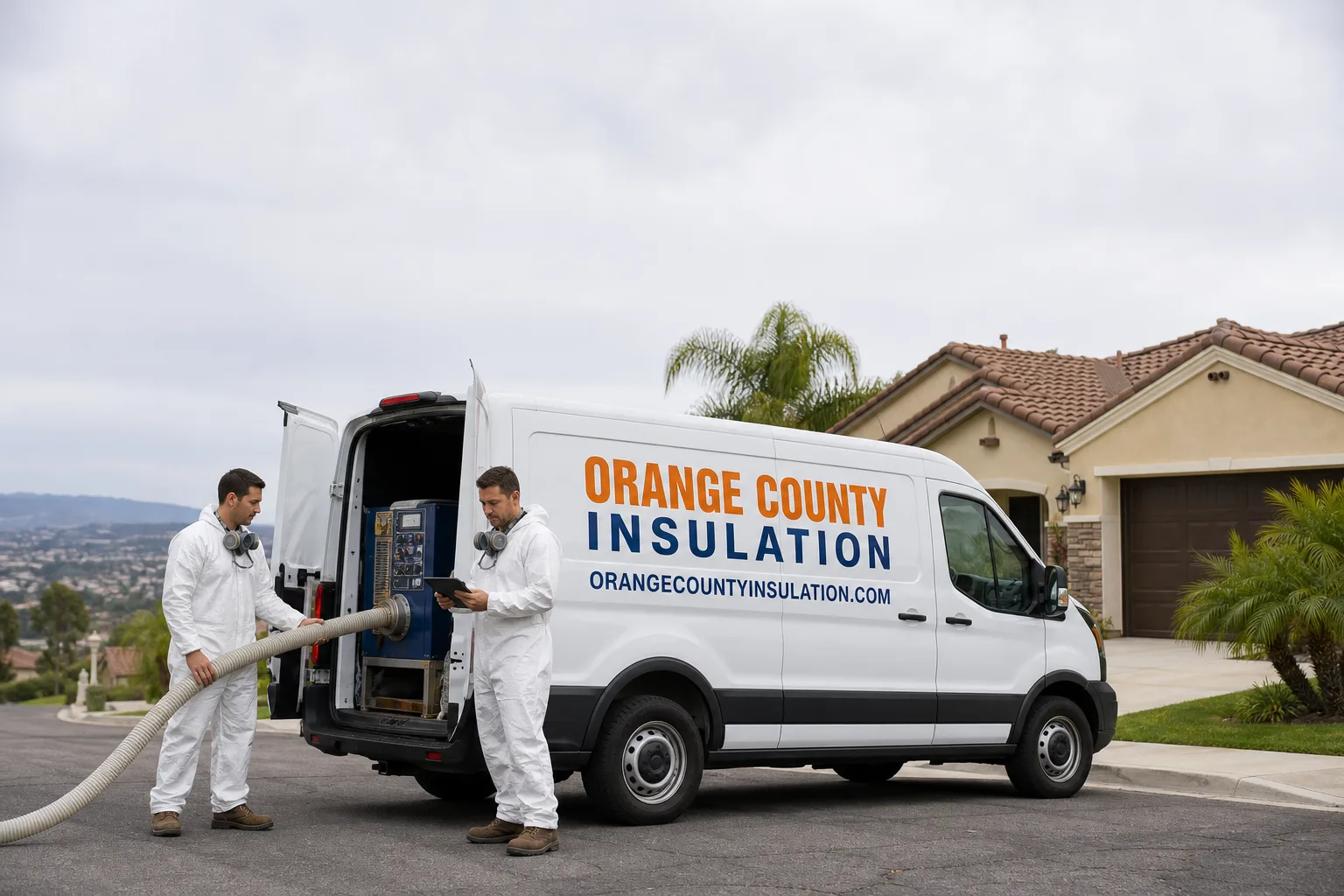
Fast, Reliable Spray Foam Insulation Across Brea
Spray foam insulation in Brea typically costs $2.50 to $6.50 per square foot installed, depending on whether you choose open-cell or closed-cell foam, and most attic jobs run $3,800 to $9,200 for a standard mid-century ranch. We work in Brea’s older tract neighborhoods every week, from the 92821 homes near downtown to the newer planned communities up in 92823. Our crews know exactly what they’ll find when they open an attic in this city: original 1960s batts that have sagged, settled, or simply failed. If your back bedrooms stay hot long after sunset, call us at (877) 680-3557 for a free estimate and a straight answer about what’s happening up there.
Why Orange County Insulation Is Brea’s Preferred Spray Foam Insulation Company
We’re an insulation-only contractor. That’s not a marketing line, it’s the whole business model. Every estimate we write, every crew we send, and every warranty conversation we have is about one trade: insulation. There’s no roofing division pulling our attention away, no HVAC crew waiting in the driveway. When we show up in Brea, the person on the ladder knows spray foam the way a specialist should.
Noel Carrasco set the company up this way on purpose. By stocking and installing products from Demilec, Icynene, Owens Corning, and Johns Manville, we’re not tied to whatever one supplier happens to have in the warehouse. The right material for a 1965 ranch off Imperial Highway is not automatically the right material for a 2005 build up in the 92823 foothills. We carry both open-cell and closed-cell spray foam, and we’ll tell you which one fits your attic, your walls, and your budget, with the reasoning behind it.
Response time to Brea matters. We’re based in Rancho Santa Margarita, but Brea is a regular stop for our crews. Most estimates happen within a few days, and we schedule installs around your availability, not the other way around. When a homeowner in the 92821 ZIP code calls about a bedroom that won’t cool down, we don’t read them a script. We ask about the house: year built, roof pitch, attic access, where the hot rooms sit. That’s how we know what we’re dealing with before we even open the hatch.
Spray Foam Attic Insulation in Brea
Spray foam attic insulation in Brea involves removing or bypassing the failed existing insulation and applying foam directly to the underside of the roof deck, creating an air-sealed thermal barrier at the roofline. In Brea’s stock of 1960s and 1970s ranch homes, this matters more than in most places. The original R-11 batts in these houses have had five or six decades to sag, compress, and pull away from the roof deck. The result is bare gaps exactly where inland summer heat loads the attic hardest, and homeowners only find out when a back bedroom stays at 82 degrees at 10 p.m.
What we do in a typical Brea attic: remove the failed batts or blown-in material, air-seal penetrations like can lights and top plates, then spray open-cell foam to the roofline at the right depth for this climate zone. In Brea’s warm-dry inland conditions, open-cell foam at 5 to 6 inches is usually the right call for a vented attic conversion. It air-seals the ceiling plane and cuts the radiant heat transfer that keeps bedrooms hot after dark.
Roofline Application for Vented Attics
Most Brea ranches have low-pitch vented attics with ridge and soffit vents. When we spray the roofline, we’re converting that attic from a ventilated space to a semi-conditioned space. The foam stops the sun’s heat from baking down through the roof deck into the living area. For a standard 1,200 to 1,600 square foot ranch in Brea, roofline spray foam runs $4,500 to $8,000 in most cases, including removal of the old material.
Garage Ceiling and Rim Joist Sealing
Attached garages in Brea ranches are a common source of air leakage into the house. We spray the garage ceiling with open-cell foam where living space sits above, and we seal rim joists with closed-cell foam where the foundation meets the framing. Rim joist sealing in a typical Brea home runs $1,200 to $2,800. It’s the kind of detail work that pays off year-round, not just in August.
Spray Foam Wall Insulation in Brea
Spray foam wall insulation in Brea is most common during remodels, room additions, and garage conversions. The city’s mid-century wood-frame construction means exterior walls in many homes still have original fiberglass batts, or in some cases, nothing at all. We see this in the older neighborhoods off Imperial Highway and around downtown, where wall cavities were either under-insulated from the start or the original material has slumped and left voids. Open-cell foam in a standard 2×4 wall cavity runs $1.80 to $3.20 per square foot of wall area in Brea. Closed-cell runs $2.80 to $5.00 per square foot and adds structural rigidity plus a higher R-value per inch.
For Brea homeowners planning a room addition or opening up walls anyway, spray foam gives you an air seal that batts physically cannot match. The foam expands into every corner, around electrical boxes, and behind pipes. In Brea’s dry climate, that air seal matters in summer when outdoor temperatures regularly pass 95 degrees and your AC is fighting both radiant heat and air infiltration.
Closed-Cell for Exterior Wall Cavities
When we insulate exterior walls in Brea, closed-cell foam from Demilec is a common recommendation. It delivers roughly R-6.5 per inch, which means a 2×4 wall gets close to R-25 in a single pass. In the 92822 and 92823 ZIP codes where some homes face full western exposure against the Puente Hills, that extra R-value per inch makes a measurable difference in afternoon heat gain.
Open-Cell for Interior Partition Walls
Interior walls don’t need the same thermal performance, but they do benefit from sound control. Open-cell foam in the interior walls between bedrooms and living spaces cuts noise transfer noticeably, which matters in older tract homes where wall assemblies were built light. We also use open-cell behind knee walls and in bonus rooms where drywall is already down.
Trusted Brands We Service in Brea
We stock and install spray foam from Demilec and Icynene, two manufacturer brands that specialize in exactly this product category. Demilec closed-cell foam is our go-to for exterior walls and rim joists where we need maximum R-value per inch. Icynene open-cell foam is the workhorse for attic rooflines and interior cavities. We also carry Owens Corning and Johns Manville products for homes where a hybrid approach makes more sense, typically batt insulation in combination with foam air-sealing. For Brea customers, this means we’re not married to one product line. We pick the foam that matches your house, your attic configuration, and your budget, and we explain the trade-offs in plain language.
Common Spray Foam Insulation Problems We See in Brea Homes
- Sagging original batts creating bare roof-deck gaps. In the 1960s ranches around downtown Brea, we routinely find R-11 batts that have pulled away from the roof deck by two or three inches. That gap lets radiant heat pour straight into the attic and then into whatever room sits below, which is why one bedroom can be ten degrees hotter than the rest of the house.
- Degraded cellulose settling well below modern R-values. Loose-fill cellulose installed in the 1970s and 1980s has often settled to half its original depth in Brea homes. The dry inland air accelerates breakdown of the material, and the settled layer leaves the ceiling plane with far less insulation than the homeowner assumes is there.
- Low-pitch attics trapping heat and making old insulation worse. Many Brea ranches have roof pitches shallow enough that attic space is tight, and ventilation is weak. Heat builds up, materials degrade faster, and any existing batt insulation bakes in place. Spray foam applied to the roofline bypasses this problem entirely.
- Off-gassing and adhesion issues over dirty or damp substrates. Spray foam needs a clean, dry surface to adhere properly. In older Brea homes with decades of dust, rodent activity, or past roof leaks, the substrate has to be prepped first. We inspect and prep every surface before spraying, because foam that doesn’t bond correctly creates more problems than it solves.
Pricing for Spray Foam Insulation in Brea, CA
Here are the numbers we quote for Brea work. Open-cell attic roofline foam runs $2.50 to $4.00 per square foot of roof area. A standard 1,400 square foot ranch attic typically lands between $4,200 and $7,500 including removal of old material. Closed-cell wall insulation runs $2.80 to $5.00 per square foot of wall area. Rim joist sealing for a full perimeter runs $1,200 to $2,800. Garage ceiling spray foam runs $1,800 to $4,200 depending on size and access. These are honest ranges for Brea’s market in 2025. The final number depends on attic access, substrate condition, and how much old material needs to come out first. Call (877) 680-3557 and we’ll give you a written estimate based on your actual house, not a square-footage guess over the phone.
We Also Serve Cities Near Brea
Our crews work throughout north Orange County and into the adjacent San Gabriel Valley communities. If you’re in Placentia, Rowland Heights, Fullerton, or Yorba Linda, the same Spray Foam Insulation team that handles Brea attics is available for your project. We schedule by route, which means shorter wait times for homes in all five cities. You can also see our Brea service area details for ZIP codes 92821, 92822, and 92823.
Serving Brea, CA — Our Local Coverage Area
We’re based in the Brea area and know this community well. Use the map below to see our service coverage — if you’re nearby, we can almost certainly help.
FAQs About Spray Foam Insulation in Brea
Adding new batts over old, sagging batts in a Brea ranch doesn’t fix the problem, because the original material is still pulled away from the roof deck and the attic still leaks air at every penetration. The bare gaps that let August heat into your back bedroom remain. Spray foam applied to the roofline air-seals the entire ceiling plane in one pass, filling the gaps batts physically cannot reach. For most older Brea tract homes, foam is the difference between patching and actually solving the problem. Call (877) 680-3557 and we’ll tell you honestly which approach fits your house.
Brea’s inland summer heat doesn’t degrade spray foam, it’s exactly the condition foam handles best. Unlike batt insulation, which loses effectiveness when hot air moves through it, closed-cell and open-cell foam stop air movement entirely. In Brea, where summer afternoons routinely pass 95 degrees and attic temperatures can exceed 140 degrees, the air-sealing property of foam prevents that heat from ever reaching your living space. The dry climate also means foam won’t absorb moisture the way fiberglass and cellulose can, so its R-value stays consistent year after year.
No, and we won’t do it. Spray foam requires direct contact with the roof deck or wall sheathing to adhere properly. Over old batts, the foam would create a poor bond and trap the degraded material underneath. In a 1960s Brea ranch off Imperial Highway, we remove the failed batts first, clean the deck surface, and then spray. The removal adds labor cost, but it’s the difference between a foam application that lasts 30 years and one that delaminates within a few seasons. This is exactly the kind of corner a general contractor might cut, and it’s why we don’t.
Open-cell foam is the right choice for most low-pitch vented attics in Brea. It carries an R-value around R-3.5 per inch, which means 5 to 6 inches delivers roughly R-20 to R-22 at the roofline, appropriate for Brea’s warm-dry climate zone. Open-cell foam is also more forgiving in tight attic spaces because it’s lighter and easier to apply uniformly on shallow-pitch decks. We use Icynene open-cell for most Brea attic conversions. Closed-cell is the better option only when the attic will be used for storage or living space and needs a moisture barrier, or when maximum R-value per inch is required.
Spray foam insulation lasts the life of the house in Brea’s dry climate, which is to say indefinitely under normal conditions. It doesn’t settle, sag, or absorb moisture the way fiberglass and cellulose do, and the arid inland air works in its favor by preventing mold and material breakdown. The foam’s R-value stays stable decades after installation. The only threat is physical damage from roof work or rodent activity, and proper application by a trained crew eliminates the adhesion failures that shorten foam’s lifespan. We warranty our installs and stand behind the manufacturer’s product warranty as well.
If you live in Brea and your upstairs or back bedrooms stay hot long after sunset, the problem is probably not your AC. It’s what’s between your ceiling and the roof. We recently sprayed open-cell foam in a 1965 ranch off Imperial Highway near downtown Brea. The homeowner complained their back bedroom stayed hot until midnight. We found original R-11 batts sagging away from the roof deck, leaving bare gaps exactly over that room. After removing the failed batts and applying 6 inches of Icynene open-cell foam to the roofline, the attic temperature dropped 15°F and the bedroom cooled within an hour of sunset. That’s the kind of result spray foam delivers in Brea’s specific housing stock, and it’s why we never recommend just piling more insulation on top of a problem. Call (877) 680-3557 for a free estimate. We’ll open the hatch, take a look, and tell you what’s actually going on up there.
Written by Noel Carrasco, Owner at Orange County Insulation, serving Brea and north Orange County.