
Insulation Company in Running Springs, CA
Blown in insulation is the workhorse fix for Running Springs homes, and it’s the service we get called about most often up here. At 6,000 feet, the problem isn’t just thin walls. It’s that mid-century mountain cabins and 1960s to 1980s second homes were built with minimal wall cavities, pier-and-beam foundations, and insulation that’s either gone, compressed, or was never there to begin with. We only do insulation, so when we tell you your rim joists are the problem or your attic has R-11 where it needs R-38, that’s a measurement, not a guess. Call us at (877) 680-3557 and we’ll walk the house with you.
Why Running Springs Homes Are Different
Running Springs sits at 6,000 feet in the San Bernardino Mountains, and the insulation assumptions that work in Orange County or the low desert fall apart up here. This is freeze-thaw country. Snow sits on roofs for weeks. Nights drop below freezing well into spring. The real enemies aren’t summer heat. They’re ice dams forming at the eaves, moisture working its way into wall cavities as snow melts and refreezes, and cold air pouring up through vented crawlspaces under pier-and-beam floors.
Much of the housing stock along the ridgelines and off Highway 18 is mid-century cabin construction: 2×4 walls with no sheathing in places, single-pane windows, and attics that were insulated decades ago, if at all. We regularly open attics in Running Springs and find fiberglass batts compressed to half their original thickness by snow load and rodent traffic. Below the floor, the crawlspace is often vented to the mountain air, which means the subfloor becomes a cold plate all winter. None of this gets fixed by blowing in some cellulose and calling it done. Air sealing comes first, then the right material at the right density, then verification.
Wildfire risk changes the conversation too. Running Springs sits in the wildland-urban interface, and ember intrusion is a real concern. That’s why we’ll often recommend mineral wool or fire-rated closed-cell foam in vulnerable assembly points, even when the thermal math says something cheaper would work. Most contractors coming up from the valley don’t factor that in. We’ve been serving Running Springs since 2013, and this elevation is its own trade.
Our Main Running Springs Services
Most Running Springs homeowners call us about one of two things: what’s happening above the ceiling and what’s happening inside the walls. Here’s how each one plays out up here.
Attic Insulation in Running Springs
Attics in Running Springs are where the money leaks out. Heat rises, and at 6,000 feet with snow on the roof, a poorly insulated attic doesn’t just waste heat, it creates the conditions for ice dams that damage roofing and gutters. In older cabins along the ridgelines we often find attics with R-11 or R-19 where code now calls for R-38 or more, or insulation that’s been flattened by decades of snow load and animal traffic. The fix usually starts with air sealing every penetration, then bringing the attic to the right R-value with the material that fits the framing, not whatever’s cheapest to blow in. Read the full breakdown at Attic Insulation in Running Springs.
Spray Foam Insulation in Running Springs
Spray foam solves a specific Running Springs problem: air movement. Older mountain homes leak air through rim joists, around windows, and through the gaps between framing and sheathing that nobody ever sealed. Closed-cell foam, in particular, does double duty up here. It insulates and it acts as an air and moisture barrier, which matters in freeze-thaw conditions. It also stiffens the structure, which some of these 1960s cabins can use. Open-cell foam is the right call for interior walls and sound control between rooms. Both have their place here, and we’ll tell you which one makes sense for your specific framing and budget. Details are at Spray Foam Insulation in Running Springs.
What happens when you call
- 1
A real person answersNo phone trees — you reach a local pro.
- 2
You get an upfront price rangeHonest numbers before anyone is dispatched.
- 3
A background-checked tech heads outLicensed & insured, dispatched right away.
- 4
You approve before work beginsNothing starts until you say go.
Blown In Insulation in Running Springs
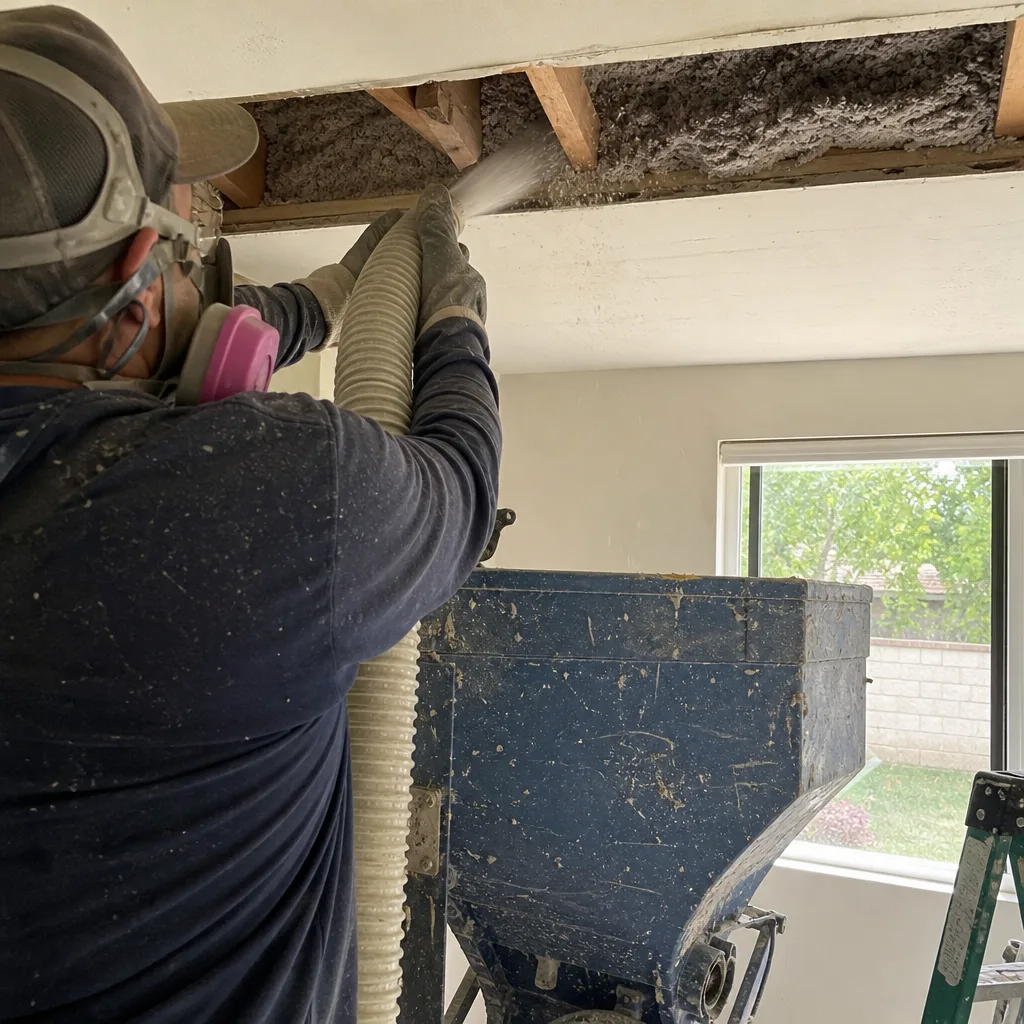
Blown in insulation in Running Springs is the most versatile option for older mountain homes because it works around existing framing, odd cavity sizes, and the quirks of mid-century construction without tearing walls apart. Whether it’s dense-packed into closed walls, blown across an attic floor, or installed in a crawlspace ceiling, blown in material gets into the spaces batts can’t, and it does it at a price that makes sense for a second home or a full-time mountain residence. Blown In Insulation is one of our three core installation methods, and in Running Springs it’s often the most practical path to a warmer floor and a dry attic.
Cellulose Insulation
Signs you need it
You can feel cold drafts rising through floor boards in winter, or your heating system runs constantly yet rooms never hold temperature.
What it costs in Running Springs
Cellulose insulation in Running Springs typically runs $1.00 to $1.50 per square foot installed, depending on density and access.
How we do it
We air seal the cavity first, then dense-pack or loose-fill cellulose to the specified depth using a calibrated blower, checking coverage as we go.
Blown In Attic Insulation
Signs you need it
Snow melts unevenly on your roof while your heater runs nonstop, or you can see bare framing between batts when you look into the attic.
What it costs in Running Springs
Blown in attic insulation in Running Springs typically runs $1.00 to $1.50 per square foot for cellulose and $1.50 to $2.50 per square foot for fiberglass, installed.
How we do it
We seal all attic penetrations, install baffles where needed, then blow insulation to a consistent verified depth across the entire attic floor.
Blown In Fiberglass Insulation
Signs you need it
Your attic has old, compressed batts and you want a fresh, even layer that will hold its R-value at 6,000 feet.
What it costs in Running Springs
Blown in fiberglass in Running Springs typically runs $1.50 to $2.50 per square foot installed, including air sealing and depth verification.
How we do it
We remove or level any compromised existing material, air seal, then blow fiberglass to the target R-value using consistent, measured passes.
What Blown In Insulation Costs in Running Springs
| Item | Typical range in Running Springs |
|---|---|
| Cellulose, loose-fill attic | $1.00 – $1.50 per sq ft |
| Fiberglass, blown in attic | $1.50 – $2.50 per sq ft |
| Dense-pack cellulose in walls | $1.00 – $1.50 per sq ft |
Two things push price up in Running Springs specifically: access. Steep lots, low-pitch attics, and tight crawlspaces all add labor time. And prep work: when existing insulation is compromised by rodents or moisture, removal and cleanup are part of the job before any new material goes in. Every estimate is line-itemed, and our pricing is upfront, never adjusted after the fact.
How long does blown in insulation last in Running Springs?
Cellulose and fiberglass last 20 to 30 years or more if the attic stays dry and rodent-free. In Running Springs, the bigger threat is compression from snow load over time, which reduces R-value long before the material breaks down. An inspection will tell you what you actually have.
Can you blow insulation into existing walls in a Running Springs cabin?
Yes, and it’s one of the most common jobs we do up here. Dense-pack cellulose can be installed through small holes in the siding or drywall, filling the cavity completely without demolition. It’s the most practical retrofit for uninsulated 1960s-era walls.
Brands We Service in Running Springs
We stock and install products from Owens Corning, Johns Manville, Knauf, Rockwool, CertainTeed, Icynene, Demilec, and GreenFiber. In Running Springs, we carry GreenFiber cellulose, Owens Corning and Johns Manville fiberglass, and Demilec closed-cell foam for the fire-conscious applications common in the wildland-urban interface. See our brands for the full roster. We choose the material for the job, not the other way around.
Pricing for Insulation Company in Running Springs, CA
| Service | Typical range in Running Springs |
|---|---|
| Attic insulation, full service | $1,200 – $2,600 |
| Spray foam, closed-cell, per board foot | $1.00 – $2.50 |
| Spray foam, open-cell, per board foot | $0.50 – $1.50 |
| Blown in attic insulation (cellulose) | $1.00 – $1.50 per sq ft |
| Blown in attic insulation (fiberglass) | $1.50 – $2.50 per sq ft |
| Dense-pack wall insulation | $1.00 – $1.50 per sq ft |
| Air sealing package | $400 – $1,000 |
| Crawlspace insulation | $1,200 – $2,800 |
In Running Springs, the biggest price drivers are access and the condition of what’s already there. Steep driveways and tight low attics cost more in labor, and if we have to remove rodent-damaged or water-compromised insulation before starting, that’s prep work, not an add-on surprise. We deliver line-item pricing before any work begins, and that number is the number.
Neighborhoods We Serve in Running Springs
We work all over Running Springs and the 92382 ZIP, from the ridgeline cabins off Live Oak Drive to the older homes near Hilltop and the flatter lots around Rimwood and Smiley Park. The terrain varies a lot, but the insulation challenges don’t: cold floors, drafty walls, and attics that were under-insulated from day one.
- Hilltop
- Rimwood
- Smiley Park
- Live Oak Drive area
- Highway 18 corridor
For most Running Springs jobs, we’re on site within one week of the estimate, which works out well up here since the pass on Highway 330 or 18 is part of every trip.
Service Area – Cities Near Running Springs
We also serve the surrounding San Bernardino Mountain communities and the foothill towns below. Homeowners in Lake Arrowhead, CA deal with the same freeze-thaw cycles at slightly higher elevation. Down the hill, Crestline, CA has similar cabin-era housing stock. And in the valley, Highland, CA and Mentone, CA see big temperature swings that make air sealing and attic work matter just as much.
Serving Running Springs, CA — Our Local Coverage Area
We’re based in the Running Springs area and know this community well. Use the map below to see our service coverage — if you’re nearby, we can almost certainly help.
FAQs About Insulation Company in Running Springs
We schedule Running Springs estimates within a few business days and come prepared to look at attics, walls, and crawlspaces in one visit. The drive from our Orange County base is part of the day, so we batch Running Springs appointments to be efficient. Call (877) 680-3557 and we’ll get you on the schedule.
Most insulation retrofits don’t require a permit in San Bernardino County, though anything involving structural changes or significant spray foam volume may trigger a review. We handle the details and will tell you upfront if your project needs paperwork. The building department up here is familiar with mountain-specific energy code requirements.
Yes, a large share of our Running Springs work is on second homes and rental cabins, many of them vacant for long stretches. That’s actually a good time to insulate, since access is easier and the work won’t disrupt anyone. We coordinate lockbox access and send photos and measurements throughout the job.
If your Running Springs home is cold, drafty, or expensive to heat, let’s find out exactly where the heat is going. Call Orange County Insulation at (877) 680-3557 for a free estimate, and we’ll give you a straight answer about what your house needs and what it will cost.
What happens when you call
- 1A real person answersNo phone trees — talk to a local insulation pro.
- 2You get an upfront price rangeHonest numbers before anyone is dispatched. No surprises.
- 3A background-checked tech heads outLicensed & insured, typically within the hour.
- 4You approve before work beginsNothing starts until you say go.
What Running Springs Customers Say
"He did a blower door test before and after and gave me the numbers. I like being able to see the difference rather than being told about it."
— Nia Robinson"Installed baffles at the soffits so the new insulation didn't block the ventilation, which the previous contractor apparently never considered."
— Mark Schaefer"Found and sealed a gap around the chimney chase that was basically an open chimney to the attic."
— Beatriz Vargas