
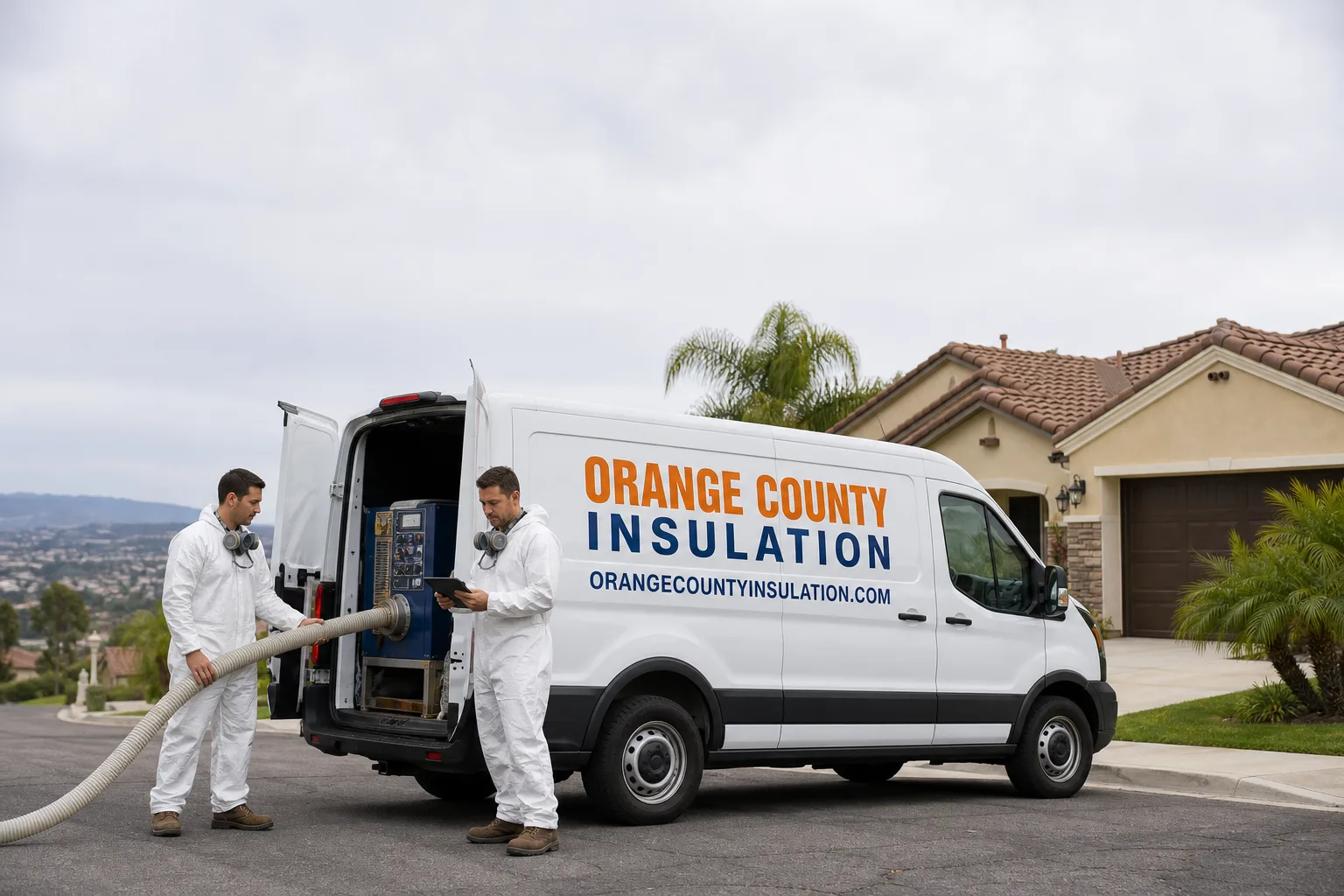
Fast, Reliable Attic Insulation Across Spring Valley Lake
Most attic insulation jobs in Spring Valley Lake come down to one thing: heat that won’t stay out. Summer attic temps here routinely hit 140°F or more, and when your ceiling insulation is sagging, compressed, or full of gaps from decades of HVAC and re-roof work, that heat pours straight into your living space. We fix that. Orange County Insulation works in Spring Valley Lake regularly, and we know the HOA review process, the lakefront microclimate, and the housing stock inside this community better than any general contractor from down the hill. Call (877) 680-3557 and we’ll walk your attic, check your vents, and give you a straight answer on what needs to happen and what it costs.
Why Orange County Insulation Is Spring Valley Lake’s Preferred Attic Insulation Company
The homes around the Spring Valley Lake golf course and marina are not like the tract housing in Victorville. You’re working with 1970s and 1980s wood-frame stucco construction, cathedral ceilings in a lot of lakefront properties, and an Architectural Review Board that has to sign off on anything visible from the street. We know that process. We’ve submitted vent-color samples and low-profile styles to the ARB before a single piece of insulation went in, and we’ve kept jobs moving because we anticipated the review instead of reacting to it. That’s not something you learn from a YouTube video. That’s what comes from doing attic work inside a private HOA community year after year.
Our crews are insulation-only. Everyone who shows up at your door in Spring Valley Lake works on insulation every single day, not roofing on Monday and HVAC on Wednesday. When you call us, you’re talking to someone who can explain why Rockwool holds its R-value in wind-driven dust better than fiberglass in certain spots, or why a radiant barrier makes sense on a west-facing roof line near the lake but maybe not on a shaded north slope. The right material for your home, not the easiest one for us to install.
Spring Valley Lake homeowners call us because the first question we ask is “what’s your attic actually doing right now?” – not “which package do you want?” We’ll climb up, measure, check your baffles and vent flow, and then tell you what’s wrong and what it’ll take to fix it. That’s the difference a specialist brings.
Attic Ventilation in Spring Valley Lake
Attic Ventilation in Spring Valley Lake is a balancing act between moving enough air to keep summer attic temps down and not adding exterior penetrations that trigger HOA review. A properly vented attic in this climate should push hot air out through upper vents while pulling cooler air in through soffit or eave vents. When that airflow is blocked – usually by blown-in insulation covering soffit vents, or by someone sealing gaps without adding intake – the attic turns into an oven that cooks your insulation and radiates heat into your bedrooms all night. A standard attic ventilation upgrade in Spring Valley Lake, including baffles, runs $450 to $950 depending on attic size and how many vents need attention. Adding new roof vents runs $180 to $320 per vent installed.
Baffle installation and airflow correction
We see a lot of Spring Valley Lake attics where blown-in cellulose or loose fiberglass has drifted over the soffit vents, choking off intake air. We install baffles that hold insulation back and restore the air channel from eave to ridge. On a typical two-thousand-square-foot home, that’s a half-day job and it makes an immediate difference in how fast the attic cools down after sunset.
Vent replacement inside HOA guidelines
If your existing vents are rusted, dented, or the wrong color because a previous owner cut a corner, we’ll match the exact color and profile the ARB has on file for your home. We’ve done enough vent replacements in Spring Valley Lake to know which styles pass review and which ones get flagged. One call to (877) 680-3557 gets you a vent assessment and a quote the same week.
Radiant Barrier in Spring Valley Lake
Radiant Barrier in Spring Valley Lake works because this is one of the highest solar-gain spots in the Victor Valley. A radiant barrier is a reflective foil material stapled to the underside of your roof rafters. In the summer, when the roof deck is baking at 150°F, the barrier reflects that radiant heat back out instead of letting it radiate down into the attic. It’s not insulation in the traditional sense – it doesn’t add R-value – but it cuts attic temps by 15 to 25 degrees when installed correctly. We typically charge $1,400 to $2,800 for a full radiant barrier install in Spring Valley Lake, depending on roof geometry and attic accessibility. Homes with low-slope or cathedral sections cost more because access is tighter.
Best candidates for radiant barrier
Lakefront homes along Spring Valley Lake’s western shore and golf-course properties with unshaded roof lines benefit most. If your attic floor already has decent batt or blown-in insulation but your upstairs rooms still won’t hold a setpoint in July, the roof deck is the problem, not the floor. We’ll check your existing insulation first and tell you straight if a radiant barrier is worth the money or if your dollars are better spent upgrading R-value.
Radiant barrier plus ventilation
A radiant barrier only reaches its potential if the attic has enough airflow to flush the heat it rejects. In a lot of Spring Valley Lake homes, the best result comes from pairing a barrier with improved soffit-to-ridge ventilation. We’ll spec both together when it makes sense and keep your total below what you’d pay for closed-cell foam across the same attic.
Trusted Brands We Service in Spring Valley Lake
We stock and install insulation from Owens Corning, Johns Manville, and GreenFiber for most Spring Valley Lake attics, plus we carry Demilec closed-cell foam for lakefront rim joists and crawl spaces that need a moisture-resistant barrier. Having eight manufacturer brands on the roster means we’re never stuck telling you that one product fits every situation. Blown-in GreenFiber cellulose makes sense in a lot of the 1980s tract homes around Spring Valley Lake where attic access is tight. Owens Corning R-38 batts are a workhorse for flat ceiling attics. And Demilec closed-cell spray foam is the answer when lake humidity is pushing moisture into wood framing. We pick the right one, and we stock enough local inventory to keep most Spring Valley Lake jobs on schedule without waiting on a distributor truck from the Inland Empire.
Common Attic Insulation Problems We See in Spring Valley Lake Homes
- Wind-driven dust infiltration through gaps. High desert wind finds every opening around vent pipes, recessed lights, and top plates. When insulation has been disturbed by re-roof or HVAC work, those gaps open up and fine Mojave dust coats everything in the attic. We air-seal before we insulate, which is the step most crews skip.
- Lakefront humidity attacking rim joists and crawl spaces. Homes within a few hundred feet of the water see moisture levels that dry desert lots a mile away never experience. Batt insulation against a damp rim joist loses R-value fast and invites mold. Closed-cell spray foam is usually the right fix here.
- Sagging 1970s batt insulation in cathedral ceilings. The original fiberglass in a lot of the older Spring Valley Lake homes around the golf course has slumped, compressed, and left the top of the ceiling exposed in spots. You can’t just lay more on top – we remove the dead material and re-insulate properly.
- HOA-triggering vent replacements from past handyman work. We regularly find non-approved vent colors or styles that a previous contractor slapped on without ARB review. The fix costs more than doing it right the first time because you’re paying twice. We handle the compliance paperwork from the start.
Pricing for Attic Insulation in Spring Valley Lake, CA
Blown-in attic insulation to bring a typical Spring Valley Lake home up to R-38 runs $1,800 to $3,200 depending on square footage and how much old material has to come out first. Attic batt insulation for a standard 1,500 to 2,500 square foot home lands between $1,400 and $2,600. An attic insulation top-up over existing loose-fill runs $900 to $1,700. Full attic insulation replacement, including removal of old compressed material, runs $2,200 to $3,800. Radiant barrier adds $1,400 to $2,800. Attic ventilation upgrades run $450 to $950 as a standalone job. These are the real numbers for this market, not a national average. We give free estimates, and we’ll show you exactly where every dollar goes. Call (877) 680-3557 and we’ll come measure your attic, no charge, no obligation.
We Also Serve Cities Near Spring Valley Lake
Our crews cover Spring Valley Lake and the surrounding Victor Valley communities including Mountain View Acres, Victorville, Apple Valley, and Hesperia. The HOA rules are different across each of those areas, but the August heat isn’t. If you’re in any of these nearby communities, you can learn more on our Spring Valley Lake page or call us directly. Our Attic Insulation team covers the whole corridor from the 15 freeway to the lake.
Serving Spring Valley Lake, CA — Our Local Coverage Area
We’re based in the Spring Valley Lake area and know this community well. Use the map below to see our service coverage — if you’re nearby, we can almost certainly help.
FAQs About Attic Insulation in Spring Valley Lake
Yes. Any change to exterior vent style, vent color, roof sheathing color, or new penetrations in Spring Valley Lake must go through the Architectural Review Board before work starts. Radiant barrier installed inside the attic does not require ARB review because nothing visible from the street changes. Vents always do. We prepare and submit the ARB package for you, including vent-color samples and profile specs, so the job doesn’t stall or earn you a violation notice. Call (877) 680-3557 and we’ll tell you exactly which parts of your project trigger review and which don’t.
Lakefront and near-water homes in Spring Valley Lake deal with humidity that inland Victorville tract homes never see. Moisture works its way into rim joists, crawl spaces, and sometimes the lower attic framing near soffit vents. Fiberglass batts lose R-value when damp, and they hold moisture against wood framing, which invites mold. Closed-cell spray foam is often the right answer for these lake-adjacent spots because it blocks moisture while insulating. Homes a quarter mile from the water have the opposite problem: dry heat and wind-driven dust. We spec the material to the microclimate, not the zip code.
Yes. We carry vent profiles and finish options that match most original Spring Valley Lake exterior color schemes, and we’ve matched enough of them to know what the ARB expects. Before any vent replacement, we pull the color and style against whatever the community has on file and submit samples for review. If a previous contractor installed something non-approved, we’ll fix it and handle the compliance paperwork in one pass. Estimates are free, so call (877) 680-3557 and we’ll take a look.
Passive ridge and soffit vents are the quietest option because there are no moving parts. Powered attic fans move more air but add a low hum that some lakefront homeowners find intrusive, especially at night when the desert goes quiet. For most Spring Valley Lake attics, a well-designed passive system with baffles and balanced intake does the job without any noise. We’ll calculate your attic’s ventilation needs and tell you honestly whether a powered fan buys you anything or just adds noise and maintenance.
We see this constantly: a roofing crew shifts batts out of the way, an HVAC tech steps through loose-fill, and nobody puts it back. The gaps that result let hot air pour into the ceiling assembly and wind-driven dust pile up around recessed lights. We come in after the other trade is done, assess what moved, what compressed, and what’s too dirty to save, then restore the attic to a continuous thermal boundary. The fix usually runs $400 to $1,200 depending on how much area was disturbed. Call (877) 680-3557 for a repair assessment.
Written by Noel Carrasco, Owner at Orange County Insulation, serving Spring Valley Lake and the Victor Valley since our first lakefront job.