
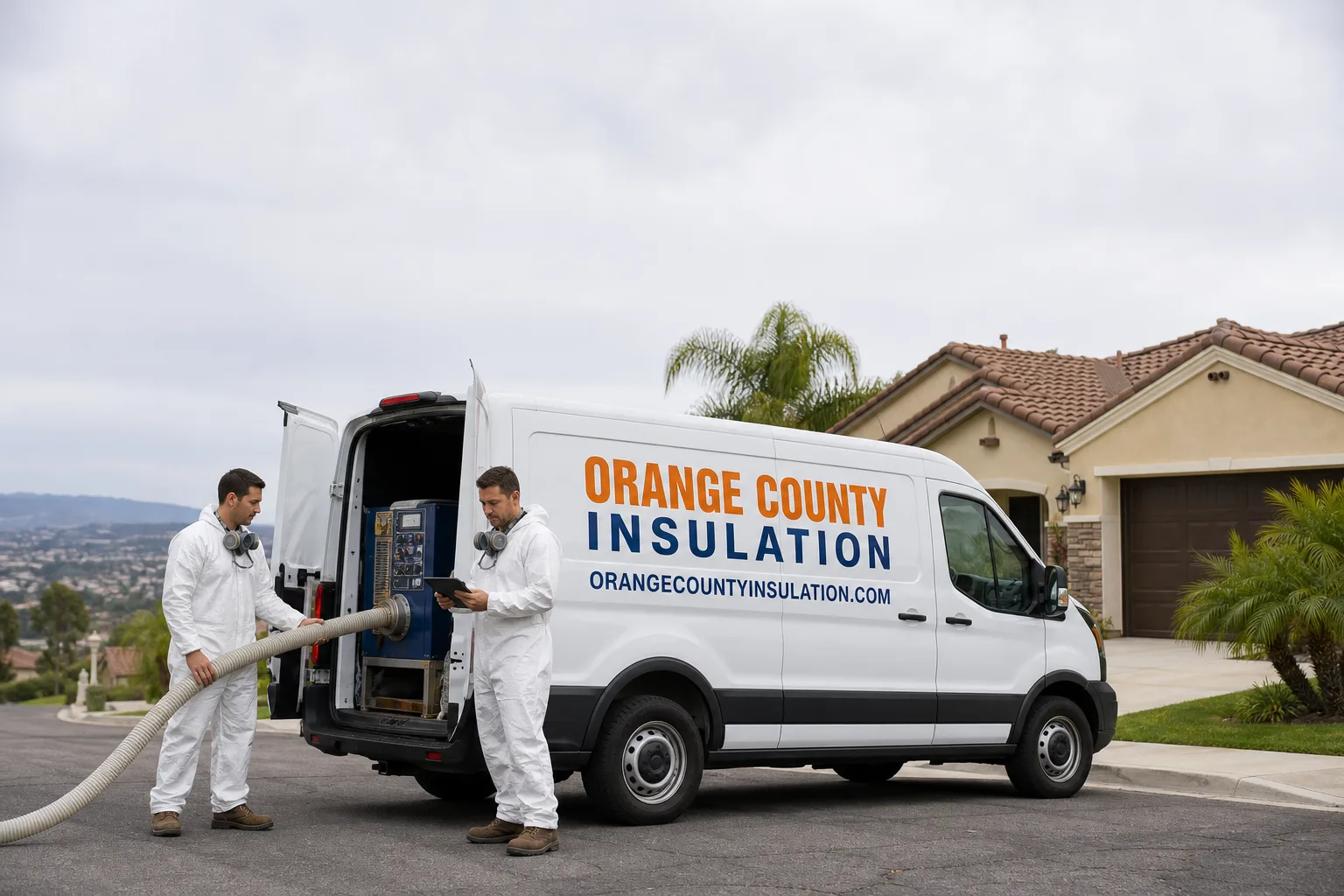
Fast, Reliable Attic Insulation Across March Air Force Base
Attic insulation in March Air Force Base typically runs $1,450 to $3,800 for a full attic, with removal of old settled material adding $600 to $1,400 on top. Most jobs in the 92551 corridor take one day once we’re on site. If you’re in base-era housing or a 1980s tract home near Arnold Heights or along Van Buren Boulevard, call (877) 680-3557 and we’ll give you a straight answer on what your attic actually needs.
We work both sides of the March ARB line. That matters more than you’d think. On-base military family housing runs on federal energy and AT/FP spec with access control and paperwork. Off-base 92551 tract homes are standard Title 24 jobs. Same crew, same week, two completely different compliance worlds within a few miles. You want a contractor who already knows which one applies to your house before the truck rolls up.
Why Orange County Insulation Is March Air Force Base’s Preferred Attic Insulation Company
We only do insulation. That’s the whole story. No roofing, no HVAC, no general contracting to split our attention. Every estimate we write, every crew member we send, and every warranty conversation we have centers on one thing: getting your attic right. That focus means we can tell you exactly why open-cell foam makes sense in a scissor-truss vaulted ceiling and why blown-in fiberglass is the smarter play in a shallow-pitch base-era attic floor. The right material for your home, not the easiest one for us to install.
Working around March Air Force Base means we see the full range of housing stock in a single day. Morning might be a mid-century block-and-stucco unit in the base housing area with wall-furnace penetrations and settled loose fill. Afternoon might be a 2005 stucco tract house off Alessandro Boulevard with vaulted ceilings and almost no attic clearance. That daily reality means our recommendations are grounded in what actually works here, not what a product catalog says should work.
Noel Carrasco started Orange County Insulation as an insulation-only contractor, and that single-trade focus shapes how we operate in March Air Force Base. We carry eight manufacturer brands including Owens Corning, GreenFiber, Icynene, and Demilec. That breadth means we’re not steering you toward whatever one supplier happens to stock. We choose the material that fits your attic, your budget, and your energy goals.
Attic Insulation Removal in March Air Force Base
Attic Insulation Removal in March Air Force Base is the first step on most of the older homes we service here. The base-era military family housing around the ARB was built with loose fill that’s now settled thin and clogged with decades of dust and wind-blown debris. You can’t just blow new insulation over that. The old material has to come out, the attic floor and top plates need air-sealing, and then fresh insulation goes in at the correct depth.
When Removal Is the Right Call
If your attic has original loose fill that’s flattened to less than half its original depth, or if you’ve had rodents, or if a wall-furnace penetration has been leaking dust for thirty years, removal beats top-up. A top-up over compromised material just buries the problem. We find this constantly in the 92551 corridor, especially in the smaller base-era homes where the shallow-pitch roof leaves little room to work.
What Removal Costs Here
In March Air Force Base, attic insulation removal and cleanup typically runs $600 to $1,400 depending on attic size, access, and how much material is up there. Removing old insulation from a small base-era attic with a low-slope roof might sit near the bottom of that range. A larger 1980s tract home with vaulted truss sections and poor access will run higher. Call (877) 680-3557 and we’ll give you a firm quote.
Insulation Contractors in March Air Force Base
Insulation Contractors in March Air Force Base fall into two camps: general contractors who install insulation as one line item among many, and specialists who do nothing else. We’re the second kind. That distinction shows up fast when you ask a general contractor which R-value makes sense for a low-slope roof under inland Riverside County’s triple-digit summer afternoons, or whether a radiant barrier actually pays off in a vaulted-ceiling tract home. The answer matters, and it’s specific to this corridor.
On-Base Work and Access
Jobs on March ARB itself can require installation access, contractor vetting, and federal energy and AT/FP spec documentation. We’ve done that paperwork and we’re comfortable working under those requirements. It’s a different workflow from a standard Title 24 attic job in the surrounding Riverside subdivisions, and very few insulation contractors handle both. If you’re in base housing or attached to the installation, tell us up front so we bring the right documentation.
Off-Base 92551 Housing
The tract homes off Van Buren Boulevard and around the Arnold Heights area were mostly built between the 1980s and the early 2000s. Their attics often have scissor trusses, vaulted ceilings, and very little clearance. That changes the work. Crews that skip duct sealing and radiant barrier work leave those vaulted rooms baking under solar gain, because the heat load doesn’t sit where the insulation is. We address that on every off-base job.
Common Attic Insulation Problems We See in March Air Force Base Homes
- Settled original loose fill in base-era housing. The mid-century military family homes around March ARB were insulated to the standards of their day. That loose fill has since settled thin and gone dusty, so the R-value at the shallow-pitch attic floor sits far below current Title 24 minimums by the time triple-digit afternoons roll through.
- Wall-furnace and evaporative-cooler penetrations leaking air. Older base-era homes often still carry wall-furnace chimneys and cooler chases that pull hot inland air and Santa Ana wind dust straight into the attic. Insulation over those leaks does almost nothing until the chases and top plates are air-sealed.
- Near-zero attic clearance in 1980s – 2000s tract homes. The 92551 stucco tracts have scissor trusses and vaulted ceilings that leave very little working room. This pushes crews toward blown-in application and makes radiant barrier and duct sealing the real performance levers, not wall retrofit.
- Radiation and solar gain through low-slope roofs. Inland Riverside County delivers strong afternoon UV and long summer heat spells. A low-slope roof deck facing a shallow attic acts like a radiator, heating whatever insulation is underneath. A radiant barrier facing that deck cuts a measurable share of that load.
Pricing for Attic Insulation in March Air Force Base, CA
A full attic insulation install in March Air Force Base runs $1,450 to $3,800 depending on attic size, depth, and material choice. Blown-in fiberglass or cellulose sits at the more affordable end. Closed-cell spray foam runs higher but performs differently in tight, shallow attics. Attic insulation removal adds $600 to $1,400 when it’s needed. Duct sealing and radiant barrier work on a vaulted 92551 tract attic usually adds $800 to $2,200 depending on square footage and duct accessibility.
What moves the number most is attic geometry and which material actually fits your roof. A small, shallow-pitch base-era attic is a different job from a 2,500-square-foot tract home with vaulted sections. We’ll walk the attic, show you what’s there, and give you a line-item quote. Estimates are free. Call (877) 680-3557.
Trusted Brands We Service in March Air Force Base
We stock and install products from eight major manufacturers, and we pick the one that matches your attic rather than whatever a single supplier pushes. For March Air Force Base homes, that often means Owens Corning fiberglass on blown-in jobs where the attic floor needs to reach a specific R-value per inch, or GreenFiber cellulose when a homeowner wants recycled content. For air-sealing and closed-cell performance in tight scissor-truss sections, we lean on Demilec. Attic Insulation is all we do, so the brand choice is a technical decision, not a habit.
Field Note: What We Found in a Base-Era Home Near March ARB
On a mid-century block-and-stucco base-era home in the March ARB housing area, our crew found the original wall-furnace penetration and shallow-pitch attic knee walls packed with settled, dust-clogged loose fill, plus an evaporative-cooler chase bleeding Santa Ana dust straight into the envelope. We air-sealed the chase and top plates first, then blew Owens Corning fiberglass to bring the attic above Title 24 minimum, with a radiant barrier facing the low-slope roof deck. That’s the order that matters: seal first, then insulate. Blow new material over those leaks and you’re paying to heat the sky.
That’s the dual reality of working around March ARB. One job requires federal spec and access paperwork. The next is a tract home off Alessandro Boulevard where the real problem is clearance and solar gain through the vault. Attic Insulation in March Air Force Base isn’t a one-size job, and the company that treats it like one is guessing.
We Also Serve Cities Near March Air Force Base
From our base in Rancho Santa Margarita we cover the full March corridor and the surrounding Riverside County communities. Homeowners in Moreno Valley, Woodcrest, Perris, and Good Hope call us for the same reason people in the 92551 do: they want an insulation-only contractor who can explain the material choice. If you’re in any of those areas and your attic isn’t holding temperature, call (877) 680-3557.
Serving March Air Force Base, CA — Our Local Coverage Area
We’re based in the March Air Force Base area and know this community well. Use the map below to see our service coverage — if you’re nearby, we can almost certainly help.
FAQs About Attic Insulation in March Air Force Base
Yes, we can coordinate on-base work at March ARB. Installation access, contractor vetting, and federal energy or AT/FP spec paperwork may be required depending on the specific building and its current status, and we’re familiar with those requirements. If you’re in base housing or managing a building on the installation, let us know as early as possible so we bring the right documentation and plan the right material spec. Call (877) 680-3557 before you schedule so we can confirm the access requirements for your specific location.
The original loose fill in those mid-century homes has settled thin, gone dusty, and often absorbed decades of air leakage from wall-furnace and cooler penetrations. Blowing new insulation over that material buries the problem instead of fixing it. Removal, air-sealing, and fresh insulation is a bigger job up front, but it’s the only approach that actually changes the R-value at the attic floor and stops the dust infiltration. Removing old attic insulation in March Air Force Base runs $600 to $1,400, and on most base-era homes it’s the difference between a real fix and a cosmetic one.
Yes, in most cases a radiant barrier facing the roof deck delivers meaningful value in the 92551 tract attics. Those homes have scissor trusses and vaulted ceilings, so the attic floor area where insulation sits is limited. A radiant barrier reflects a share of the solar radiation that would otherwise heat the roof deck and radiate into the living space below. In inland Riverside County’s triple-digit afternoons, that’s a real load reduction. Give us a call at (877) 680-3557 and we’ll take a look at your specific roof pitch and deck orientation.
For the March corridor and the broader 92551 area, we typically recommend R-38 to R-49 at the attic floor depending on the specific attic geometry and the home’s heating and cooling setup. That’s above California’s Title 24 minimum, because inland Riverside County’s summer heat means the attic is the single biggest energy-loss zone in most homes. Some shallow-pitch base-era attics will struggle to reach R-49 without compressed material, and that’s exactly where a radiant barrier and air-sealing do the heavy lifting.
We install products from eight major manufacturers and choose the right one for the job, not the one we happen to stock. Around March Air Force Base that frequently means Owens Corning fiberglass for blown-in work where R-value per inch matters, GreenFiber cellulose when a homeowner wants recycled content, and Demilec closed-cell spray foam when air-sealing and high R-value in a tight attic are the priorities. We also work with Icynene for open-cell applications on larger vaulted areas. If you want to know which material fits your attic, call (877) 680-3557 and we’ll explain the trade-offs in plain terms.
Contact Orange County Insulation
If your attic in March Air Force Base isn’t holding temperature, or your energy bills climb every summer, or you’ve got base-era loose fill that’s seen better decades, we’ll walk the attic and tell you exactly what’s going on. No guesses, no upselling, no attempt to fit your house into one material because that’s all we stock. We carry eight brands because your attic deserves the right one. Call (877) 680-3557 for a free estimate. Noel and the crew at Orange County Insulation work the March corridor every week, on both sides of the gate.
Written by Noel Carrasco, Owner at Orange County Insulation, serving March Air Force Base and surrounding Riverside County communities.