
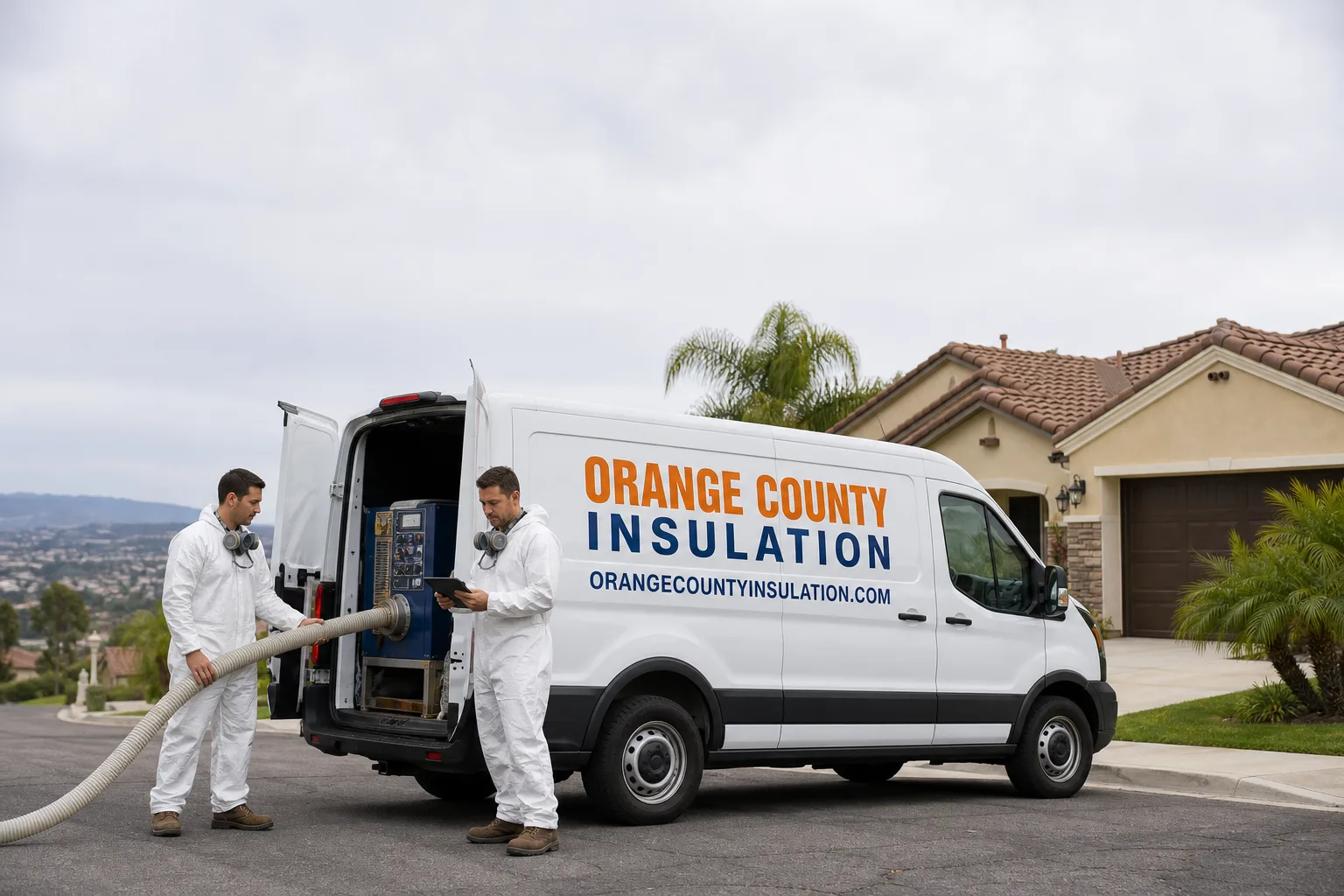
Spray Foam Insulation in Portola Hills: What It Costs and What to Expect
Spray foam insulation in Portola Hills typically runs $2,200 – $6,800 for a full attic application and $1,100 – $3,400 for a garage ceiling or rim joist job, depending on square footage and whether you choose open-cell or closed-cell foam. Most Portola Hills homes we work on are 1980s – 90s two-story stucco builds with tile roofs, so we’re usually correcting settled builder-grade batts and air-sealing wind-exposed top plates at the same time. Call (877) 680-3557 for a free estimate, and we’ll tell you exactly which foam fits your home and your budget.
Fast, Reliable Spray Foam Insulation Across Portola Hills
Portola Hills isn’t a flat, sheltered subdivision. It’s a master-planned hillside community cut into the foothills above Santiago Canyon, and the homes here work differently than they do ten minutes down the hill in Lake Forest. Our crews are in the 92610 zip code regularly, and we know the tracts: the ridge-facing lots along Saddleback Ranch Road, the two-story stucco plans near Glenn Ranch Road, the older sections off Ridgeline that catch the worst of the afternoon sun. When you call us, you’re not explaining Portola Hills to someone who’s never been here. We already know that your west-facing upstairs rooms cook by 3 p.m. and that your original builder batts stopped doing their job a decade ago. If you need spray foam in Portola Hills today, call (877) 680-3557.
Key Takeaways
- Attic spray foam in Portola Hills runs about $2,200 – $6,800; garage ceiling spray foam $1,100 – $3,400.
- Most Portola Hills attics have original 1980s – 90s batts that are compressed, displaced, and underperforming.
- Canyon-wind infiltration on west- and ridge-facing walls makes air sealing just as important as adding R-value here.
- We’re an insulation-only contractor. Spray foam, blown-in, or batts: we’ll tell you exactly which one fits your situation and why.
- Free estimates. Call (877) 680-3557.
Why Orange County Insulation Is Portola Hills’s Preferred Spray Foam Insulation Company
We only do insulation. Not roofing, not HVAC, not remodeling. Every estimate, every crew member, and every warranty conversation centers on one trade, which means when a Portola Hills homeowner asks us about open-cell versus closed-cell Icynene for a ridge-facing attic, we’re not guessing. We install spray foam from two specialized brands, Icynene and Demilec, and we stock materials from eight manufacturers total including Owens Corning, Johns Manville, and GreenFiber. That breadth matters here specifically. A home on a graded slope above Santiago Canyon has different needs than a flat-lot house in Mission Viejo, and having multiple product lines means we choose the right material for your exposure, not whatever one supplier happens to have on the truck.
Noel Carrasco runs the company with a simple rule: insulation decisions get made on evidence, not convenience. Homeowners in Portola Hills call us because the fix we recommend is the one their house actually needs. The right material for your home, not the easiest one for us to install.
Crawl Space Spray Foam Insulation in Portola Hills
Crawl Space Spray Foam Insulation in Portola Hills is a targeted fix for hillside homes where the floor system sits above a vented crawl space and canyon air moves freely underneath the house. In these 1980s – 90s stucco-on-frame builds, the crawl space is often vented to the outside, which means wind-driven air from the Santiago Canyon corridor gets drawn up through floor penetrations and into living space. A typical crawl space spray foam job in Portola Hills runs $1,800 – $4,200 depending on access, square footage, and whether we’re doing rim joists, floor decking, or the full encapsulation. We usually recommend closed-cell Demilec for this application because it adds structural rigidity and an air barrier in one pass, which matters when you’re sealing against wind pressure rather than just cold ground.
Rim Joist and Air Penetration Sealing
The rim joist is where the floor framing meets the foundation wall, and on a hillside lot it’s a prime entry point for air movement. Foaming the rim joist band with closed-cell spray foam stops the chimney effect that pulls hot canyon air up through the walls in summer.
What You’ll Notice After Sealing
Floors stop feeling drafty in the winter, the house holds temperature longer, and dust intrusion from the crawl space drops noticeably. For Portola Hills homeowners with allergy sensitivities, that reduced dust is often the first thing they mention.
Garage Spray Foam Insulation in Portola Hills
Garage Spray Foam Insulation in Portola Hills is one of the most cost-effective upgrades you can make to a Mediterranean stucco plan where the garage shares a wall or ceiling with living space. In these two-story floor plans, the attached garage bakes in the afternoon sun, and that heat transfers directly into the adjacent bonus room or master suite. A garage ceiling and shared-wall foam job in Portola Hills typically runs $1,100 – $3,400, with most jobs falling around $1,800 for a standard two-car garage. We use open-cell Icynene on the shared wall for sound and thermal control, and closed-cell Demilec on the ceiling when the garage sits under a finished room and needs a vapor barrier. The garage door assembly itself is the last piece, and we’ll talk you through that below because foaming the garage without addressing the door leaves the single biggest heat bridge untouched.
The Shared-Wall and Ceiling Cavity Problem
Most Portola Hills garages were built with zero insulation in the shared wall. That’s not neglect, it’s 1980s building practice. But it means the garage acts like an oven that cooks the rooms next to and above it every afternoon. Foam seals the cavity and cuts that transfer almost completely.
Fumes and Air Quality
Cars, paint cans, gas cans, lawn chemicals. Whatever you store in the garage off-gasses into the house through the shared wall. Air sealing that cavity with spray foam stops fume migration and noticeably improves indoor air quality in the adjoining rooms.
Trusted Brands We Service in Portola Hills
We install and service spray foam from two specialized brands, Icynene and Demilec, and we carry a full material roster spanning Owens Corning, Johns Manville, Knauf, Rockwool, CertainTeed, and GreenFiber. That matters for Portola Hills specifically because wildfire-zone venting requirements and canyon-wind exposure sometimes call for a specific product spec, not whatever’s in the warehouse. Eight brands. Three methods. One specialty. For Portola Hills homeowners, the practical upside is simple: when we show up in 92610, the right product is on the truck, the material is matched to your roof deck and wall assembly, and we don’t have to come back and redo a guess. Our Spray Foam Insulation team stocks the products your home needs, and if a specific product has to be ordered for a wildfire-zone vent spec, we’ll tell you the timeline before you commit to anything.
Common Spray Foam Insulation Problems We See in Portola Hills Homes
- Compressed builder batts near the ridge vents. Nearly every 1980s – 90s attic in Portola Hills has original fiberglass batts that have settled, compressed, and blown back from the ridge. The hottest part of the roof deck, right at the peak, is often bare or nearly bare, and no amount of attic fan will fix that.
- Canyon-wind infiltration at top plates. West- and ridge-facing wall cavities pull outside air through gaps the original batts never sealed. On windy days, you can feel the difference; on hot days, that air carries heat straight into the wall cavity.
- Attached garage bridging heat and fumes into the house. The shared wall and ceiling between garage and living space was usually left uninsulated in these original plans. The garage bakes, the bonus room cooks, and fumes migrate through the cavity.
- Wildfire-zone venting conflicts with generic foam applications. Portola Hills sits in a high-fire-risk area. Ember-resistant venting and foam choices need to be matched, and a generic open-cell attic application can conflict with what the Wildland-Urban Interface code requires on these hillside lots.
Pricing for Spray Foam Insulation in Portola Hills, CA
Here’s where Portola Hills pricing actually lands. Open-cell attic spray foam runs $2,200 – $4,800 for a standard two-story stucco home with an accessible vented attic. Closed-cell Icynene or Demilec runs higher, typically $3,200 – $6,800 for a full attic, because the material cost per board foot is higher and the installation requires more prep on the top plates and can lights. Garage ceiling and shared-wall jobs are the most affordable entry point at $1,100 – $3,400, and rim joist or crawl space work usually lands at $1,800 – $4,200 depending on access. What moves your number: square footage, foam type, whether we’re removing old batts first, and whether the job requires air sealing at the top plates and around recessed cans. Nobody in Portola Hills should pay for foam without that air sealing step included. Stop guessing why your energy bills are high. Start here. Call (877) 680-3557 and we’ll give you a real number, not a vague range.
We Also Serve Cities Near Portola Hills
Orange County Insulation works throughout the foothill communities around Portola Hills, including Foothill Ranch, Lake Forest, Mission Viejo, and Trabuco Canyon. If you’re in one of those areas and wondering whether your attic or garage needs spray foam, same answer applies: call us, and we’ll diagnose it honestly.
Serving Portola Hills, CA — Our Local Coverage Area
We’re based in the Portola Hills area and know this community well. Use the map below to see our service coverage — if you’re nearby, we can almost certainly help.
FAQs About Spray Foam Insulation in Portola Hills
Your garage feels hotter because it was built with no insulation in the ceiling or shared wall, and the afternoon sun hitting the stucco and tile roof turns that cavity into a heat sink. In Portola Hills, where summer afternoons run hot and garages sit on the sun-facing side of the floor plan, that trapped heat bleeds straight into the rooms next to and above the garage. Foaming the ceiling and shared wall cuts that transfer dramatically. Call (877) 680-3557 for a free garage assessment.
No. Old batts should be removed before foam is applied, especially in Portola Hills where the original 1980s material has compressed, settled, and often blown back from the ridge vents. Foam sprayed over dead batts won’t adhere properly and traps the old material’s gaps underneath. We remove, air-seal, then foam. That’s the only sequence that actually solves the problem.
Yes, and it’s measurable. Wind moving through the Santiago Canyon corridor pushes air against west- and ridge-facing walls and forces it through gaps at the top plates, around windows, and into the wall cavities. That wind-driven infiltration makes a house feel drafty in winter and hotter in summer, and it carries dust from the canyon into living space. Air sealing and foam together are the fix. A fiberglass batt alone won’t stop wind.
Yes, but the product and venting choices have to be ember-aware. Portola Hills sits in a Wildland-Urban Interface zone, and attic vents need to resist ember intrusion. Closed-cell Demilec on the roof deck can help create a tighter, more ember-resistant attic assembly, and we coordinate foam placement with the vent specs your home needs. Open-cell on walls and garage cavities is fine in most cases. We’ll walk you through the trade-offs during the estimate.
If your opener is original to the house, yes. A 1980s chain-drive opener is loud, slow, and dumps heat into an already hot garage. Upgrading to a belt-drive smart opener while we’re foaming the ceiling and shared wall means the garage stops being the hottest, loudest room in the house in one pass. Ask during the estimate and we’ll coordinate.
Why Portola Hills Homes Need a Different Insulation Approach
Portola Hills was built out almost entirely in the 1980s and 1990s as a single master-planned hillside community. That’s not architectural trivia. It means nearly every attic here carries the same generation of original builder batts, now 25 – 35 years compressed and displaced near the ridge vents, rather than the mixed-vintage housing you’d find in older south Orange County towns. It also means the construction methods are consistent: two-story stucco frame, tile roof, wood-frame walls with stucco exterior, vented and accessible attic. That consistency is actually useful for diagnostics. When we walk into a Portola Hills attic, we know what we’re going to find before we open the hatch.
But here’s what makes the insulation work different from flat inland subdivisions: the tracts sit on graded slopes above Santiago Canyon, so west- and ridge-facing walls take wind-driven infiltration that sheltered neighborhoods never experience. Air sealing isn’t an add-on here. It’s the core of the work. A spray foam job in Portola Hills that ignores the top plates, can lights, and windward wall cavities will underperform no matter how many inches of foam go in. That’s why our estimates always include a walkthrough of the windward exposures and an honest read on what your home actually needs. On a ridge-facing two-story stucco home in the tracts above Santiago Canyon, our crew found the original 1980s batts compressed flat and blown back from the ridge vents, with daylight visible at the top plates on the west-facing wall. We air-sealed the top plates and can lights, then applied closed-cell Icynene spray foam to the west wall cavities and garage ceiling, and the homeowner reported the upstairs bonus room no longer cooking by mid-afternoon. We also foamed the attached garage’s shared wall and ceiling, which had been the biggest single heat and fume leak into the house.
If your Portola Hills home still has its builder insulation, you don’t need a patch job. You need the gaps found, sealed, and then insulated with the right material for your exposure. That’s the only way this actually gets fixed. Call (877) 680-3557 and we’ll give you a straight answer about your attic, your garage, and your crawl space.
Written by Noel Carrasco, Owner at Orange County Insulation, serving Portola Hills and the surrounding foothill communities with spray foam, blown-in, and batt insulation.