
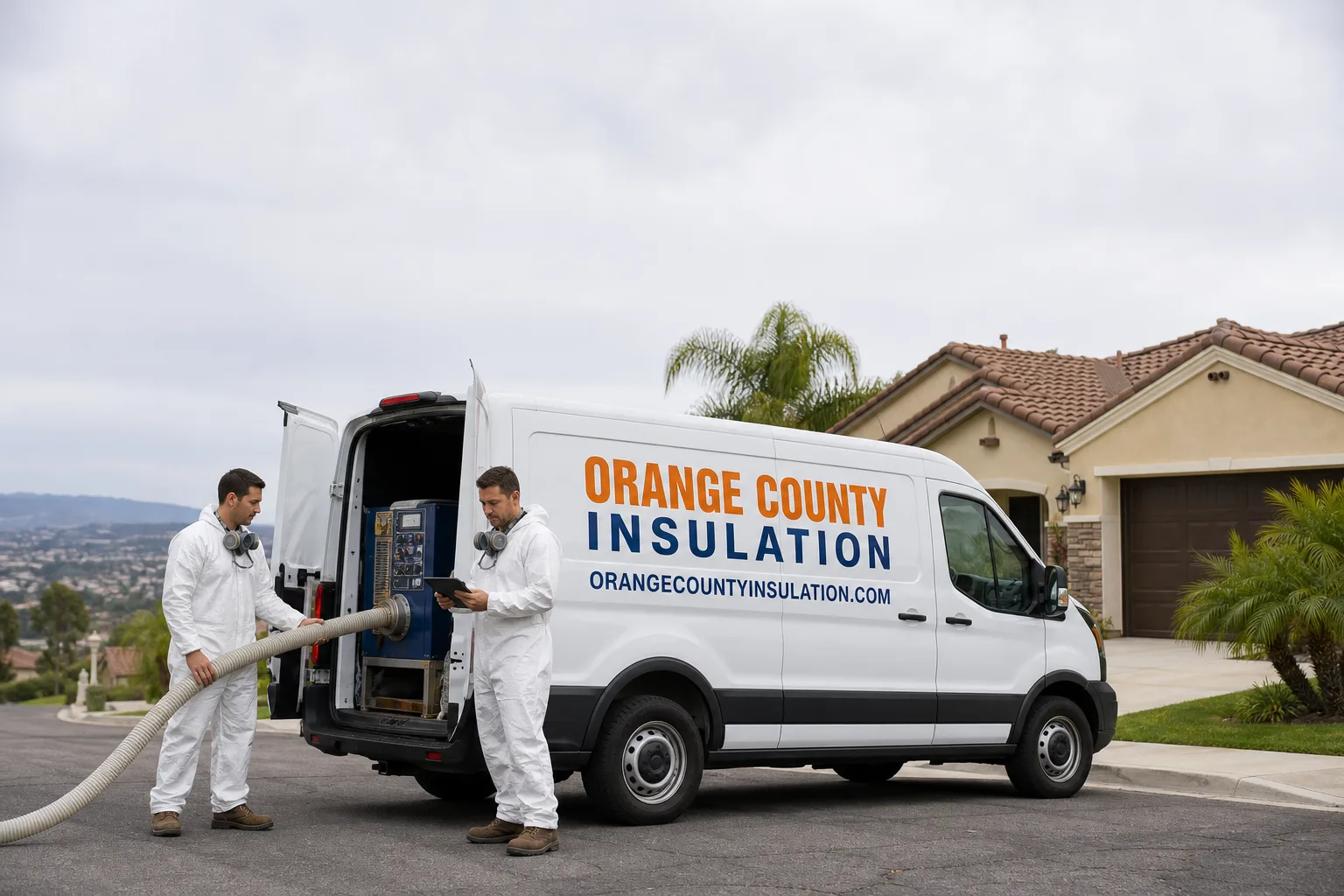
Fast, Reliable Spray Foam Insulation Across Lomita
Spray foam insulation in Lomita typically runs $2.50 to $6.00 per board foot depending on whether you need open-cell or closed-cell, and most homes here fall on the lower end of that range because our heating and cooling loads stay mild. The real reason Lomita homeowners call us isn’t usually a $400 summer electric bill. It’s the sound of the 110 freeway bleeding through a 1950s wall assembly, or fog-season dampness working its way into a shallow attic. We’re Orange County Insulation, led by Noel Carrasco, and we’ve been spraying foam into the tight, low-pitch roof cavities and rim joists of post-war Lomita homes long enough to know exactly what’s behind your specific wall. Call (877) 680-3557 and we’ll tell you straight what your house needs.
Why Orange County Insulation Is Lomita’s Preferred Spray Foam Insulation Company
We only do insulation. That’s it. No roofing, no HVAC, no plumbing. Every crew member who shows up at a Lomita job site spends their entire working week thinking about thermal envelopes, air sealing, and vapor control. Noel Carrasco built this company around a simple idea: a specialist who installs spray foam every single day will see the problems a general contractor misses. And in Lomita’s specific housing stock, those problems are everywhere.
Our crews know the bungalows off Lomita Boulevard and the 1960s condo buildings near the Harbor Freeway corridor. We’ve pulled back enough compressed 1950s attic blankets to know what awaits underneath. We’ve worked around the tight side yards of Lomita’s small-lot tract homes, where getting a spray foam rig positioned takes planning, not just horsepower. When a homeowner in Lomita calls us, the person on the phone understands their house type before they finish describing it. That’s not marketing. That’s repetition.
We stock and install products from Icynene and Demilec, two spray foam brands with different performance profiles for different situations. Open-cell for interior sound control and budget-friendly air sealing. Closed-cell for structural rigidity, moisture control, and the highest R-value per inch you can get into a shallow Lomita roof cavity. That choice matters more here than almost anywhere else in Los Angeles County, because the margin for error in a 1960s low-pitch roof assembly is thin. Literally.
Garage Spray Foam Insulation in Lomita
Garage Spray Foam Insulation in Lomita usually means one of two jobs: sealing the rim joist and band area where the garage meets the house, or foaming the garage ceiling to stop heat and freeway noise from migrating into living space above. The garage is the most under-insulated zone in most Lomita homes, and it’s also where we see the most air leakage. A typical rim joist sealing job here runs $1,200 to $2,800 depending on linear footage and access. A garage ceiling runs $1,800 to $4,200 based on square footage and whether we’re spraying open-cell for sound or closed-cell for a vapor barrier.
Rim Joist and Band Area Sealing
On Lomita’s 1945-1970 bungalows, the rim joist is the strip of framing that sits on top of the foundation wall. Builders in the 1950s stuffed fiberglass batts into that cavity, and sixty years later that batt has compressed to a thin mat that does almost nothing. Freeway noise, cold air, and fog-season dampness all move straight through it. Closed-cell spray foam applied to the rim joist and band area seals that entire plane in one pass. It’s two to three hours of work on most Lomita homes, and the difference is immediate.
Garage Ceiling and Attic Access
When a Lomita homeowner parks in a garage below living space, the garage ceiling is a direct conduit for heat gain in summer and heat loss in winter. That’s also true for attached garages on slope-side lots near Rolling Hills Estates. We spray open-cell foam on the garage ceiling when the goal is thermal comfort and sound absorption. We use closed-cell when there’s a moisture concern, which in Lomita’s marine layer is more often than people expect. The job takes a day on most single and two-car garages, and we’re in and out without disrupting the household.
Closed Cell Spray Foam Insulation in Lomita
Closed Cell Spray Foam Insulation in Lomita is the workhorse for moisture control in shallow roof cavities and for maximizing R-value where there’s almost no room to work. Lomita’s 1960s-80s apartments and condos have roof assemblies that were never designed for thick insulation. Closed-cell delivers roughly R-7 per inch, so a 2×6 rafter bay gets you an R-21 to R-28 assembly without adding inches you don’t have. A typical closed-cell attic deck spray in Lomita runs $3,500 to $8,500 depending on square footage and access difficulty. Rim joist and crawl space applications run $1,200 to $3,000.
Vapor Control in a Marine-Layer Climate
Here’s what most people don’t realize about Lomita: the morning fog isn’t just annoying. It’s a moisture source. When outdoor air at 90% humidity meets the underside of a roof deck that’s been cooled overnight, condensation forms. Closed-cell spray foam is a vapor barrier as well as insulation, which means it stops that moisture exchange at the source. This is exactly why we’re careful about application thickness in Lomita’s low-pitch roofs. Applied correctly, closed-cell protects the deck. Applied too thick in a shallow cavity, it can trap moisture against the sheathing. That’s a failure mode we see when general contractors try to spray foam without understanding coastal marine-layer dynamics.
Structural Benefits for Older Lomita Homes
Closed-cell foam adds structural rigidity to wood framing, which matters on homes built in the 1940s and 1950s when lumber dimensions and connection details were different than today’s code. For a Lomita bungalow that’s been through sixty years of settling, seismic activity, and marine air, a closed-cell application at the roof deck or rim joist quietly stiffens the entire assembly. It’s not a seismic retrofit and we’d never oversell it that way, but the racking resistance improvement is real and it’s part of why we recommend closed-cell for older Lomita homes.
Trusted Brands We Service in Lomita
We’re not married to one manufacturer, and that’s intentional. Different Lomita homes need different foam chemistry, and we carry both Icynene open-cell and Demilec closed-cell products because each solves distinct problems. Icynene open-cell is our go-to for interior wall cavities where sound control matters and the budget is moderate. Demilec closed-cell is what we reach for when we’re dealing with the shallow roof decks and moisture-prone rim joists that define so much of Lomita’s housing stock. We also install CertainTeed batt products for hybrid jobs where fiberglass in non-critical cavities keeps the budget reasonable while foam handles the high-leverage areas. We keep material stock available for Lomita jobs, which means we’re not waiting on a distributor to ship when your start date arrives. You need the right material for your house, not whatever one supplier happens to have on the shelf.
Common Spray Foam Insulation Problems We See in Lomita Homes
- Compressed attic blanket syndrome. The 1950s bungalows off Lomita Boulevard and up toward the 110 freeway were built with 2-3 inches of batt or loose-fill insulation that has settled to almost nothing. Homeowners don’t discover this until we pull back a section and show them what’s actually between their ceiling and the roof.
- Shallow cavity over-application. In the 1960s-80s Lomita apartments and condos with low-pitch roofs, a closed-cell application that’s too thick traps moisture rather than blocking it. We see this most often on jobs where a non-specialist sprayed the deck without accounting for Lomita’s fog-season humidity.
- Unsealed rim joists undermining attic work. A homeowner pays for attic foam and expects the freeway noise to disappear, but the rim joist and band area were never sealed. Sound keeps transmitting through the wall assembly at the floor line. This is the single most common miss we correct in Lomita.
- Blocked soffit venting on tight lots. Lomita’s small lots put homes close together, leaving crews almost no room to re-route airflow when soffit vents get sealed during foam application. Blocked venting leads to condensation in the roof assembly during fog season. Our crews plan vent routing before spraying, not after.
Pricing for Spray Foam Insulation in Lomita, CA
For planning purposes, here’s where Lomita spray foam work lands. Open-cell spray foam runs $2.50 to $3.50 per board foot, closed-cell $4.50 to $6.00 per board foot. A garage rim joist and band seal job runs $1,200 to $2,800. A garage ceiling starts around $1,800 and tops out near $4,200 for larger or taller spaces. Closed-cell attic deck work runs $3,500 to $8,500 based on square footage, rafter depth, and access. What moves your price: the depth of the cavity, the amount of prep work on old framing, whether we can stage equipment on the street or need to work from a narrow side yard, and whether there’s existing insulation to remove first. The estimate is free and the number we quote is the number on the invoice. Call (877) 680-3557 and we’ll walk the job with you.
We Also Serve Cities Near Lomita
Our crews serve Lomita and the surrounding South Bay communities regularly. That includes Torrance, Rolling Hills Estates, West Carson, and Manhattan Beach. If you’re anywhere in the Harbor Freeway corridor or the Palos Verdes Peninsula’s landward edge, we’re familiar with your housing stock and your access constraints. If you’re outside this immediate area, our Spray Foam Insulation team covers the broader Orange County and Los Angeles region. Call us at (877) 680-3557 and we’ll tell you if we can get to you this week.
Serving Lomita, CA — Our Local Coverage Area
We’re based in the Lomita area and know this community well. Use the map below to see our service coverage — if you’re nearby, we can almost certainly help.
FAQs About Spray Foam Insulation in Lomita
Yes, spray foam reduces freeway noise, but only if it’s applied to the right surfaces. The sound from the 110 and Pacific Coast Highway transmits through the rim joist and band area first, then through the wall assembly. Sealing the rim joist with closed-cell foam is the single most effective step for cutting that low-frequency road drone. Foaming the attic deck alone won’t solve it, and that’s exactly the problem we see when people pay for attic foam and the noise doesn’t change. Give us a call at (877) 680-3557 and we’ll identify where your specific sound path is before quoting anything.
Yes, closed-cell foam is our preferred product for shallow Lomita roof cavities because it delivers the most R-value per inch, typically R-7 per inch. The key is application thickness and understanding how marine-layer moisture behaves in a tight cavity. Our crew knows how thick to spray in a 1960s low-pitch assembly so the deck stays protected without trapping condensation. This is one of the situations where hiring an insulation-only contractor matters, because the failure mode is not obvious until fog season arrives. Call (877) 680-3557 to schedule a look.
We stage equipment on the street when possible and run lines through the shortest accessible path, which on Lomita’s tight lots usually means the side yard or a rear alley. We’re used to working around the access constraints of 1940s-60s tract homes where driveways are narrow and adjacent structures are close. If a truck needs a permit for street staging, we handle that on our end. Let us know your street and lot configuration when you call (877) 680-3557 and we’ll tell you how we’d approach it.
No, but the old compressed blanket should be removed before we spray, and we include that in our quote because leaving settled fiberglass under foam doesn’t cause the assembly to fail. It just adds no value and wastes the cavity space. The damp-air concern in Lomita is about vapor drive, and our closed-cell application acts as a barrier that stops fog-season moisture from condensing against the deck. We’ve done this on dozens of 1950s Lomita bungalows and the assemblies hold. Call (877) 680-3557 for a specific recommendation on your roof.
Yes, a sprayed garage does three jobs at once: it cuts freeway noise transmission, it stops conditioned air from leaking out through the rim joist, and it reduces the moisture that makes Lomita garages smell musty during fog season. On a 1950s Lomita home with an attached garage, the rim joist and band area are typically the biggest air leaks in the entire house. Sealing them with closed-cell foam is one of the highest-leverage improvements per dollar you can make to an older home here. Estimates are free: (877) 680-3557.
Written by Noel Carrasco, Owner at Orange County Insulation, serving Lomita and the South Bay with insulation-only expertise.