
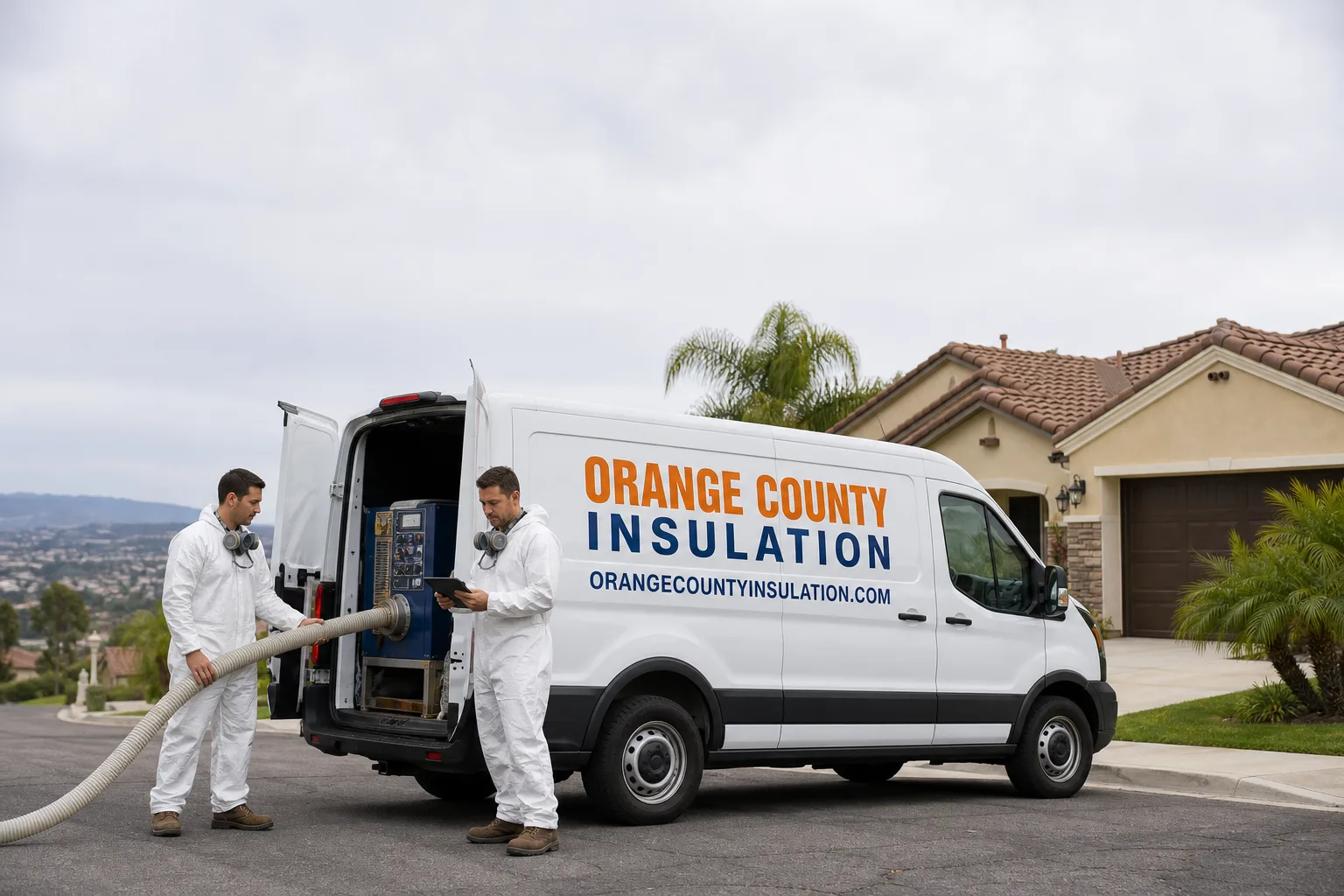
Fast, Reliable Spray Foam Insulation Across Fountain Valley
Spray foam insulation in Fountain Valley typically runs $2,800 – $6,500 for a full attic application, with rim joist work priced between $900 – $2,200 and roof deck spraying on the higher end. Most homes in the 92708 and 92728 ZIP codes need it as a corrective measure, not a new-build upgrade. We’re a Rancho Santa Margarita-based insulation-only contractor, and our crews are in Fountain Valley weekly. Call (877) 680-3557 and we’ll get someone out to inspect your attic, usually within a few days, not weeks.
The reason so many Fountain Valley homeowners call us has less to do with product marketing and more to do with how these houses were built. They’re 1960s and 1970s tract homes with attics that were never designed for modern comfort expectations. You don’t need a sales pitch; you need someone who understands what’s actually between your ceiling and your roof deck.
Why Orange County Insulation Is Fountain Valley’s Preferred Spray Foam Insulation Company
We only do insulation. That’s the entire business. No roofing side work, no HVAC installs, no remodeling crews to divide our attention. Noel Carrasco built the company around a single trade, and that focus shows up in how we approach a Fountain Valley attic. When we open a hatch off Brookhurst or Ward Street, we’re not guessing at what we see. We’ve been through enough 1960s and 1970s California tract homes to know exactly what’s waiting there.
Fountain Valley homeowners tell us the same thing repeatedly: the upstairs is hot in summer, the AC runs constantly, and nobody ever explained why. We explain it. Eight major manufacturer brands, including Spray Foam Insulation capability through Icynene and Demilec, mean we’re choosing the right product for a low-pitch 1968 ranch, not pushing whatever foam we happen to stock. That’s the difference between a specialty insulation contractor and a generalist who’ll take any job at any address.
We know the tract layouts off Ellis Avenue, the two-story California contemporaries south of Slater, the original single-story plans below Mile Square Park. That local pattern recognition keeps estimates accurate and timelines realistic. Call (877) 680-3557 for a free estimate and we’ll give you real numbers based on your actual attic, not a phone-script guess.
Spray Foam Insulation Contractors in Fountain Valley
Spray Foam Insulation Contractors in Fountain Valley face a specific challenge that newer cities never see: attics that were insulated for a 1970 energy bill, not a 2026 one. The work here means evaluating what’s already up there, which is usually original batts compressed to half their stated R-value. Spraying foam without air sealing first just locks in the failure.
A full open-cell spray foam attic in Fountain Valley typically costs $2,800 – $4,800 depending on square footage and roof pitch. Closed-cell applications run higher, usually $4,500 – $6,500, because the material costs more per board foot and cures denser. Rim joist sealing in these older homes often lands in the $900 – $2,200 range. We give you a written estimate before any material gets ordered, and the price on the estimate is the price unless we uncover something genuinely unexpected, like hidden rodent damage or a bathroom exhaust vent terminated inside the attic.
Open-Cell for Older Tract Homes
Open-cell foam is what we most often recommend in Fountain Valley’s existing attics. It expands aggressively, fills the shallow cavities between rafters on a low-pitch roof, and doesn’t trap moisture the way a closed-cell barrier can. For retrofitting a 1969 ranch, open-cell gives you the air-sealing and R-value without creating a condensation risk against the wood deck.
Closed-Cell for Specific Needs
Closed-cell makes sense when a Fountain Valley homeowner wants structural rigidity or needs maximum R-value in a tight cavity. It also holds up better in a garage ceiling application where heat and vehicle exhaust are factors. We stock both Demilec closed-cell and Icynene open-cell, so the recommendation is driven by your roof structure, not by what’s easiest for us to spray.
Spray Foam Attic Insulation in Fountain Valley
Spray Foam Attic Insulation in Fountain Valley is, in most cases, a venting-and-air-sealing job that happens to include foam. The original narrow soffit vents on these 1960s and 1970s tract homes choke once additional insulation goes in. Air can’t get into the attic to keep the roof deck cool, and the trapped heat radiates back down into the living space all summer.
We were called to a ranch tract home off Brookhurst in 92708 last July. The homeowner’s upstairs bedrooms ran 8 to 10 degrees hotter than the rest of the house every afternoon. Opening the attic showed original batts compressed to roughly half their labeled R-value and the classic narrow soffit vents packed with dust and debris. We air-sealed the top plates and can-light penetrations, cleared and baffled the soffits so the low-pitch roof deck could breathe, then sprayed Icynene to the rafter line. Upstairs heat gain dropped noticeably, and the AC stopped short-cycling in the afternoon.
A Spray Foam Attic Insulation job in Fountain Valley runs $2,800 – $5,500 for most homes in 92708 and 92728, depending on attic square footage, access difficulty, and how much air-sealing work is required before foam goes in.
Air Sealing Before Foam
If we skip air sealing in a Fountain Valley attic, we’ve skipped the actual fix. Air moves through every top plate penetration, every can light, every gap where a pipe or wire passes through drywall. Foam seals those openings if applied to the plane where they occur, but you have to locate and prep them first. Our crews do that systematically, not as an afterthought.
Roof Deck vs. Attic Floor Application
In Fountain Valley’s low-pitch attics, spraying the roof deck creates a conditioned attic that keeps ducts and air handlers in the cooler envelope. Most of these original homes have their HVAC equipment up there, baking in 140-degree summer heat. Moving the thermal boundary to the roof line is usually the right call for comfort, and we evaluate each home individually to confirm that’s the case before recommending it.
Trusted Brands We Service in Fountain Valley
We carry and install spray foam from Icynene and Demilec, which lets us approach a Fountain Valley attic without a brand bias. Icynene open-cell is our go-to for retrofit roof decks and existing cavity fills; Demilec closed-cell handles garage ceilings, rim joists, and any application where moisture resistance or structural stiffness matters. We also install Owens Corning and Johns Manville fiberglass batts for areas where foam isn’t the right answer, and GreenFiber cellulose for blown-in applications. We have not steered a single Fountain Valley homeowner toward one product because that’s all we had on the truck. The right material for your roof structure, not the easiest one for us to install.
Common Spray Foam Insulation Problems We See in Fountain Valley Homes
- Compressed original batts reading as ‘insulated.’ A 1971 attic with R-11 batts looks insulated to the naked eye, but after 50 years of settling, those batts are performing at R-6 or worse. Foam sprayed without addressing this just buries the failure.
- Blocked narrow soffit vents. The original intake vents on these low-pitch roofs get clogged by blown-in product or deliberate foam application. When intake air stops, the attic superheats, and the upstairs rooms cook even with new insulation.
- Bath and kitchen exhaust fans venting into the attic. We find this constantly in 1960s and 1970s Fountain Valley homes. The humid air collects against the foam interface, condenses on the cold wood, and starts rot that nobody notices until the drywall stains.
- Marine-layer condensation against closed-cell barriers. Fountain Valley’s coastal-inland humidity is mild compared to beach cities, but it still matters. Closed-cell foam on an aging wood-framed deck without proper venting can trap moisture against the sheathing and cause deterioration.
Pricing for Spray Foam Insulation in Fountain Valley, CA
Here are the real numbers for Fountain Valley’s market, not a national average that means nothing for a 1968 tract ranch in 92708:
- Open-cell spray foam attic (full roof deck): $2,800 – $4,800
- Closed-cell spray foam attic: $4,500 – $6,500
- Rim joist spray foam: $900 – $2,200
- Garage ceiling spray foam: $1,200 – $2,800
- Air sealing before foam application: $600 – $1,400 depending on penetrations and complexity
Square footage, roof pitch, attic access difficulty, and how much prep work the venting system needs all move the final number. A cramped attic with a 3/12 pitch and baffles that need rebuilding costs more than a straightforward open attic. Estimates are free, and we walk through the pricing line by line so you know what you’re paying for. Call (877) 680-3557 to schedule your inspection.
We Also Serve Cities Near Fountain Valley
Our crews run routes that cover Fountain Valley and the surrounding area regularly, including Midway City, Huntington Beach, Costa Mesa, and Westminster. If you’re in a neighboring ZIP and wondering whether we’ll come out, the answer is almost always yes. The same crew that handles Fountain Valley attics serves the whole corridor.
Serving Fountain Valley, CA — Our Local Coverage Area
We’re based in the Fountain Valley area and know this community well. Use the map below to see our service coverage — if you’re nearby, we can almost certainly help.
FAQs About Spray Foam Insulation in Fountain Valley
Spray foam is a fit because these attics need air sealing as much as they need R-value, and foam does both in one application. Adding more batts to a 1970 Fountain Valley attic without addressing the top plate penetrations and blocked soffit vents just leaves the air leaks in place. The foam seals the leak points and creates a thermal barrier that batts can’t match in a low-pitch, hard-to-access roof deck. Call (877) 680-3557 and we’ll evaluate whether your specific attic is a foam candidate.
It can, and a careless crew will absolutely do it. We won’t. Our Fountain Valley installs include baffling and clearing the original narrow soffit vents before any foam goes up, so the roof deck keeps its intake air. In some cases we recommend adding supplemental venting if the original 1960s setup is too restrictive to work with modern insulation levels. Skipping this step is how attics trap heat and lose the benefit of the foam entirely.
Retrofit with foam when the original batts are compressed, the upstairs runs consistently hot, or the attic contains HVAC equipment that’s fighting 130-plus degree summer heat. Repair with batts or cellulose when the existing insulation is in decent shape and the comfort problem is minor. Our crews assess condition, venting, and thermal performance before recommending anything, and we’ll tell you if a $600 air-sealing job fixes the problem without a full foam retrofit.
They can, but only when the foam is applied without a ventilation plan. The low pitch means less air volume above the insulation, so any blocked intake vent matters more than it would on a steeper roof. Marine-layer humidity can condense against the foam interface if the roof deck can’t exchange air. We address the venting first, then apply foam. That’s the entire reason we approach Fountain Valley attics differently than the average crew does.
We spray both Icynene open-cell and Demilec closed-cell foam, which means the product choice is based on your roof structure and goals, not on what’s on the truck that day. For most older Fountain Valley tract attics, Icynene open-cell is the right call; for garage ceilings, rim joists, or structural stiffening, Demilec closed-cell works better. We’ve got both, and we’ll show you the difference in the estimate. Call (877) 680-3557 for a free attic evaluation.
Written by Noel Carrasco, Owner at Orange County Insulation, serving Fountain Valley and surrounding Orange County communities as an insulation-only specialty contractor.