
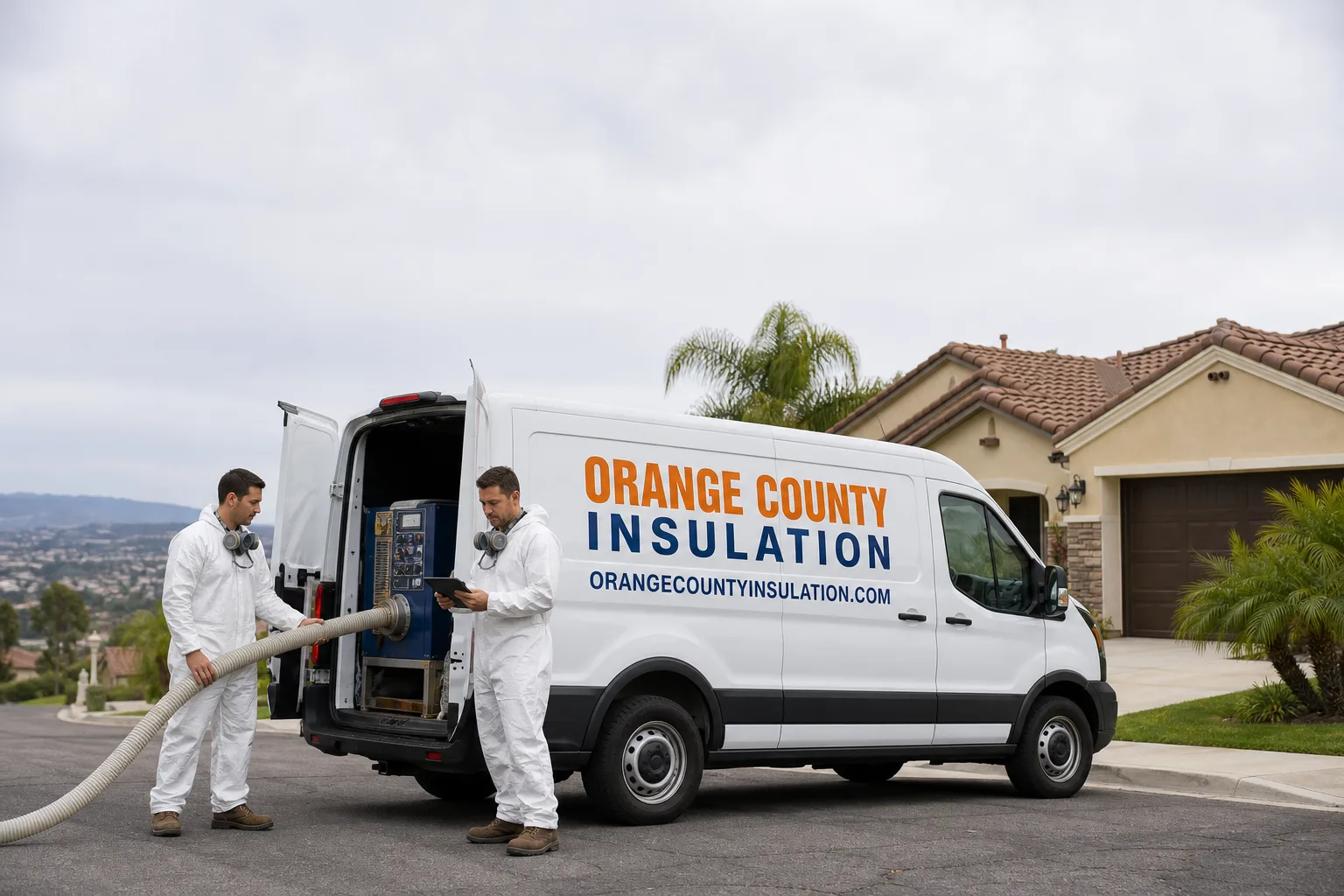
Fast, Reliable Spray Foam Insulation Across Cathedral City
Spray foam insulation in Cathedral City typically costs $2,900 – $7,800 for a full attic application, with open-cell running lower and closed-cell higher. Most homes we work on here need the work done before the next heat wave hits, and we schedule Cathedral City jobs within 5 – 9 days. Call (877) 680-3557 for a free estimate and we’ll tell you exactly what your attic needs.
Cathedral City isn’t like coastal California. Your attic isn’t losing a little heat in January. It’s absorbing 150 – 160°F of radiant punishment every afternoon from May through September. That changes what insulation should do, how it should be installed, and why the wrong material or a thin application fails fast out here. We spec spray foam for Cathedral City’s coachella valley heat load, not for a generic California climate zone.
Key Takeaways:
- Spray foam attic insulation in Cathedral City runs $2,900 – $7,800 depending on footage, roof pitch, and open-cell vs closed-cell.
- Open-cell foam is the right call for most Cathedral City attics; closed-cell is specified for flat or low-slope roof decks.
- Cathedral City’s low-pitch tile roofs over unconditioned attics routinely hit 150 – 160°F by midday, so we pair foam with radiant barrier far more often here than anywhere else.
- Orange County Insulation installs Icynene and Demilec spray foam – two dedicated brands, not one house line.
- We cover all Cathedral City ZIP codes: 92234 and 92235.
Why Orange County Insulation Is Cathedral City’s Preferred Spray Foam Insulation Company
Homeowners across Cathedral City call us because we only do insulation. Not roofing. Not HVAC. Not general remodeling. When a Sun City homeowner off Date Palm Drive asks why their back bedrooms won’t hold setpoint in July, we don’t guess. We climb into the attic, read the temperatures, check what’s collapsed or gap-prone, and tell them whether spray foam, blown-in, or batts with a radiant barrier actually solves the problem. Our Spray Foam Insulation team has sprayed enough Coachella Valley attics to know exactly what fails out here and what doesn’t.
Builders and remodelers in Cathedral City use us for the same reason: eight manufacturer brands on the roster – Owens Corning, Johns Manville, Knauf, Rockwool, CertainTeed, Icynene, Demilec, and GreenFiber. We’re not tied to one supplier’s inventory. When a remodeler needs closed-cell foam for a flat roof deck in the Date Palm corridor and the next job needs Rockwool for sound control in a shared wall, we pull both from our own material chain without switching subs. One call covers it.
Noel Carrasco runs our insulation-only crew. Every estimate, every scope decision, and every warranty conversation goes through someone whose entire trade is insulation. That’s the difference. A general contractor who installs insulation as a side service can’t match the depth of product knowledge we bring to a Cathedral City attic that’s been baking at 155°F for two decades.
We serve all of Cathedral City, including Sun City, the Date Palm corridor, Panorama Park, and the Cathedral Canyon area. Response time for estimates is typically 1 – 3 business days, and installation scheduling runs 5 – 9 days out depending on scope. Call (877) 680-3557 and you’ll talk to a person who knows insulation, not a call center.
Spray Foam Insulation Contractors in Cathedral City
Spray Foam Insulation Contractors in Cathedral City handle what is, in this climate, the single most effective retrofit for a hot, uncomfortable home. The work means applying expanding two-component foam to the attic deck, duct boots, top plates, and rim joist areas so that heat stops moving through the building envelope. For a typical Cathedral City ranch or Sun City tract home, you’re looking at $3,100 – $6,400 for open-cell attic deck coverage, and $5,000 – $7,800 when the scope includes closed-cell on a low-slope roof deck or knee walls.
Cathedral City’s 1960s – 70s block-and-stucco ranch homes have almost no wall-cavity insulation worth mentioning, but the attic is where the heat fight happens. Tile roofs soak up sun all day and then radiate that heat down into unconditioned attic air. Exposed ductwork running through that space picks up 15 – 20°F before conditioned air ever reaches a register. Foam at the roof deck line changes the entire math: the attic stops being a 150°F oven, the ducts work, and the cooling load drops.
The failure we see most often with other contractors’ work in Cathedral City is foam applied too thin over hot substrate. Two-component foam sprayed onto a 150°F tile-roof attic deck can off-gas, bubble, or lose adhesion if the surface prep is skipped and the pass is rushed. That’s why we prep, test substrate temps, and spray to manufacturer spec – not to a bid price.
Open-Cell Foam for Desert Ranch Homes
Open-cell spray foam is the right product for most Cathedral City attic decks. It expands to fill the irregular gaps behind rafters, seals top plates and duct boots, and creates an air barrier that stops most radiant and convective heat movement. In Cathedral City’s low humidity, open-cell performs exceptionally well because it doesn’t face the moisture-loading problems it can have in coastal zones.
Closed-Cell for Flat and Low-Slope Roofs
Homes in Sun City and the Date Palm corridor often have flat or very low-slope roof sections. Closed-cell spray foam is the correct product for these because it adds structural rigidity and acts as its own vapor barrier, which matters when a roof leaked five years ago and the sheathing is less than perfect. We stock and install Demilec closed-cell for these Cathedral City applications.
Spray Foam Attic Insulation in Cathedral City
Spray Foam Attic Insulation in Cathedral City means sealing the attic deck with expanding foam so that the attic becomes a semi-conditioned space instead of a heat sink. For a standard 1,400 – 2,200 square foot Cathedral City home, expect $2,900 – $5,500 for open-cell on the attic deck, and higher when the project includes the garage ceiling or a detached casita. We also frequently add a radiant barrier to the south-facing roof plane, which in Cathedral City makes a bigger difference than it does almost anywhere else in Southern California.
Here’s why this matters more in Cathedral City than in Rancho Santa Margarita or most of Orange County: your attic air hits 150 – 160°F by midday in summer. Blown-in fiberglass or cellulose on the attic floor slows that heat some, but it doesn’t stop the attic air itself from getting brutal. Ducts lie in that heat, picking up heat before cool air reaches the rooms. Foam at the deck line keeps the attic closer to 100 – 110°F even on a 112°F day, which is still warm but workable for ductwork, air handlers, and any stored items.
We recently sprayed open-cell foam across the entire attic deck of a 1970s block-and-stucco ranch off Date Palm Drive, where the original blown-in insulation had collapsed over the garage-adjacent section and left the duct runs baking at 155°F. We sealed the duct boots and top plates with Icynene foam, then added a radiant barrier to the south-facing roof plane; the homeowner reported the back bedrooms holding setpoint through the 112°F afternoon for the first time. That’s the outcome we design for.
Radiant Barrier Add-Ons
For Cathedral City’s low-pitch tile roofs, we often recommend pairing open-cell foam with a radiant barrier on the south and west roof planes. The foam handles air sealing and conductive heat. The barrier handles the direct radiation from sun-baked tiles. Without the barrier, the south-facing attic deck can still radiate enough heat to make upper rooms uncomfortable even after foaming. With it, the difference is immediately measurable.
Garage Ceiling and Rim Joist Work
Many Cathedral City homes have attached garages that sit directly below occupied rooms or share a wall with a kitchen or bedroom. Spraying the garage ceiling and rim joist zones stops heat from the garage from pushing into living space. It also reduces the dust and hot air that move into the house every time the garage door opens on a summer day.
Trusted Brands We Service in Cathedral City
We install and service Icynene open-cell and Demilec closed-cell spray foam in Cathedral City. These are two distinct product lines with different performance profiles, and we choose between them based on your roof type, attic configuration, and budget. Because we carry eight manufacturer brands overall, including Cathedral City stock for common retrofit needs, we’re not forcing one system onto every house. If a Sun City townhouse needs Demilec closed-cell on a flat roof section and a Date Palm ranch needs Icynene open-cell across the main attic, we schedule both with the right product for each. GreenFiber and CertainTeed options are also available when blown-in or batt material is the better fit for a specific cavity or budget.
Common Spray Foam Insulation Problems We See in Cathedral City Homes
- Foam applied too thin over hot attic decks. At 150°F+ substrate temps, two-component foam that’s sprayed too thin can cure poorly, sag, or peel. We’ve pulled out sagging foam from Cathedral City attics where the original installer raced the clock to finish before noon.
- Spray foam alone without addressing radiant load. Foam seals air movement, but it doesn’t stop tile roofs from radiating heat. On south and west roof planes, skipping the radiant barrier leaves rooms fighting a heat source foam alone can’t fully answer.
- Off-gassing and bubbling from hot, dusty sheathing. Tile-roof attic sheathing gets dusty, and at 150°F it’s hot enough to affect foam cure. We clean and prep every surface before spraying. Skipping this step is the most common cause of foam failures we correct in Cathedral City.
- Unsealed duct boots and top plates. The duct boots in older Cathedral City homes often have gaps or cracked mastic around them. If those aren’t foamed at the same time as the deck, the attic air still leaks into the system and the cooling bill stays high.
Pricing for Spray Foam Insulation in Cathedral City, CA
Cathedral City spray foam pricing breaks down by scope, not by square foot alone. Open-cell attic deck coverage runs $2,900 – $5,500 for most homes. Closed-cell on a low-slope or flat roof deck runs $5,000 – $7,800. Garage ceiling spray foam runs $900 – $2,200 as a standalone, and rim joist work typically adds $600 – $1,400. If you add a radiant barrier to one or two roof planes, budget $1,200 – $2,800 more.
What moves the number: roof pitch and access, how much old insulation needs removal, whether the duct boots and top plates need re-sealing, and whether you’re foaming the whole deck or just the hottest zones. We give firm, line-itemed quotes before any work starts. Call (877) 680-3557 for a free estimate and we’ll measure your Cathedral City attic, take substrate temps, and tell you exactly what we’d spec and why.
We Also Serve Cities Near Cathedral City
Our crews cover the whole Coachella Valley. In addition to Cathedral City, we work in Rancho Mirage, Palm Springs, Thousand Palms, and Palm Desert. If you’re anywhere in the valley and your attic hits 150°F by noon, we’ll come take a look. Call (877) 680-3557 and we’ll schedule a time that works for you.
Serving Cathedral City, CA — Our Local Coverage Area
We’re based in the Cathedral City area and know this community well. Use the map below to see our service coverage — if you’re nearby, we can almost certainly help.
FAQs About Spray Foam Insulation in Cathedral City
Spray foam works better because Cathedral City’s low-pitch tile roofs heat the attic air to 150 – 160°F, and blown-in insulation on the attic floor doesn’t stop that air from baking the ductwork and the ceiling below. Foam at the roof deck line turns the attic into a semi-conditioned space, so the heat never builds up in the first place. If you’ve got a low-pitch tile roof in Cathedral City, call (877) 680-3557 and we’ll tell you exactly what your attic needs.
Yes, when it’s installed correctly. Two-component spray foams are rated for high-heat exposure after curing, but they need proper surface prep and adequate thickness during application. That’s the difference between a foam job that lasts 20 years in Cathedral City and one that sags or peels after one summer. Call (877) 680-3557 and we’ll inspect your attic before recommending anything.
Most of them benefit from it. Flat and low-slope roofs take direct sun all day, and radiant heat doesn’t move through foam the same way convective heat does. A radiant barrier on the hottest roof planes cuts the radiant load that foam alone can’t fully stop. We’ll tell you whether your specific Cathedral City roof plane needs it after we measure it. Call (877) 680-3557 for a free attic evaluation.
It keeps the attic air closer to 100 – 110°F instead of 150°F, which means the ducts stop gaining 15 – 20°F of heat before air reaches the rooms. Your AC doesn’t have to fight itself. Homes we’ve foamed in Cathedral City typically hold setpoint through the afternoon heat with shorter, less frequent cooling cycles. Call (877) 680-3557 and we’ll walk you through what that looks like for your house.
Ask whether the contractor has experience with high-heat attic substrate, what substrate temperatures they’ll spray at, whether they prep dusty tile-roof sheathing before application, and whether they include duct boot and top plate sealing in the scope. Ask if they carry more than one spray foam brand. If the answer is “we use whatever the supplier stocks,” that’s a red flag for Cathedral City’s climate. We only do insulation and we carry Icynene and Demilec because different roof types need different products. Call (877) 680-3557.
Written by Noel Carrasco, Owner at Orange County Insulation, serving Cathedral City, CA.