Fast, Reliable Attic Insulation Across Universal City
If your Universal City home or studio building loses cool air in summer and heat in winter, the attic is usually the first place to check. Most homes in the 91608 ZIP need between R-38 and R-49 insulation, though hillside properties near the Cahuenga Pass often require more aggressive ventilation work alongside the insulation itself. At Orange County Insulation, we handle this every week, and our crews know the difference between a 1940s studio-era attic and a hillside home built in the 1980s. Call (877) 680-3557 and we’ll give you an honest read on what your attic actually needs.
Why Orange County Insulation Is Universal City’s Preferred Attic Insulation Company
Universal City homeowners and property managers call us because we only do insulation. No roofing. No HVAC. No general contracting. That focus means our installers understand how Attic Insulation performs in Mediterranean climates where cooling loads matter more than heating loads. We’ve worked on hillside homes near the Cahuenga Pass, on hospitality structures above the 101, and on studio-adjacent buildings where sound control is as important as temperature control. When you’re in Universal City, you don’t have time for a contractor who treats your attic like every other attic.
Noel Carrasco leads our team with a clear standard: diagnose the envelope first, then match the material to the problem. That’s why Universal City clients see specific recommendations rather than a one-size-fits-all quote. We stock options from Owens Corning, Icynene, and Demilec, so the right product actually shows up on install day.
Our response time to Universal City is quick, typically within one business day for estimates. And because we work across the 101 corridor regularly, scheduling doesn’t get pushed out weeks. That’s the practical advantage of being a specialist.
Insulation Contractors in Universal City
Insulation Contractors in Universal City face a building mix you won’t find in Studio City or Burbank. A single day might include an estimate on a hillside home off Cahuenga Boulevard West and a walkthrough of a soundstage envelope near CityWalk. Standard suburban retrofit logic doesn’t apply. Older studio-era buildings often have irregular framing, so batts get cut differently and gaps become the enemy. Homes on the hillside edge need ventilation planning alongside insulation, because trapped heat near the roof deck turns attics into ovens by late afternoon.
Hillside Home Retrofits
When we insulate a hillside home in Universal City, we start with what’s already up there. Many attics in 91608 have compressed fiberglass from the 1980s or earlier, and a lot of it has settled below code. We remove what’s failing, air-seal the top plates, and install fresh batts or blown-in material to current R-value standards. The result is a quieter, cooler home during Universal City’s hottest August weeks.
Studio Era Buildings and Irregular Framing
Buildings from Universal City’s studio years rarely have uniform joist spacing. That means off-the-shelf batt widths leave gaps, and gaps leak air. Our installation crews trim and fit insulation around odd framing rather than stuffing it in. For these structures, cellulose from GreenFiber often makes sense because it fills irregular cavities more completely than batts.
Attic Ventilation in Universal City
Attic Ventilation in Universal City matters more than in many inland LA communities because of how heat funnels through the Cahuenga Pass. Hot air gets pushed into unvented attic spaces during summer afternoons, and without balanced intake and exhaust, that heat radiates down into living areas. Homes on the hillside edge are particularly exposed. Proper ventilation also prevents moisture buildup in winter months, which can warp framing and ruin insulation.
Balanced Intake and Exhaust Systems
We install soffit vents, ridge vents, and baffle systems that keep airflow moving from low to high. In Universal City, we regularly find attics with ridge vents but no soffit intake, which creates a vacuum effect that pulls conditioned air out of the house. Fixing that imbalance is often the difference between an attic that stays under 120°F and one that spikes above 140°F.
Baffles Before Insulation
Rafter baffles belong in place before any blown-in or batt material goes down. Without them, insulation blocks the eave vents and chokes airflow. We install baffles on every Universal City job where eaves exist, including studio-era buildings with shallow roof pitches. It’s a small piece of the system that prevents big problems.
Trusted Brands We Service in Universal City
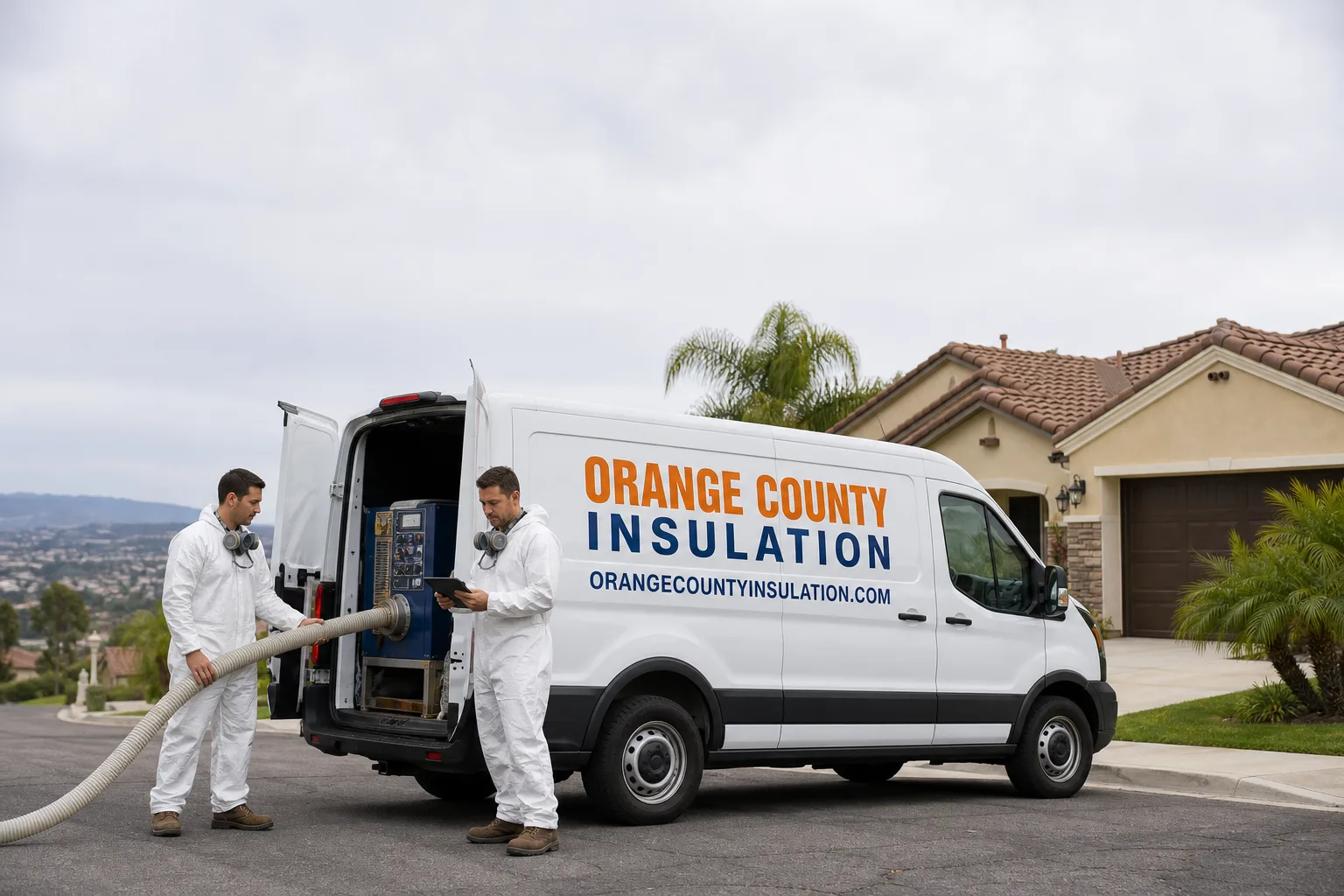
We carry and install products from three brands that fit Universal City’s unique building stock especially well. Owens Corning fiberglass batts deliver the R-value and fit needed for hillside homes. Icynene open-cell spray foam works well on soundstage ceilings and irregular cavities where air sealing is critical. Demilec closed-cell foam adds structural rigidity and moisture resistance for older studio-era attics. Because we’re an insulation-only contractor, our van arrives stocked for the job we quoted, not for whatever a supplier happened to have on hand.
Common Attic Insulation Problems We See in Universal City Homes
- Inadequate ventilation causing heat buildup: Hillside homes near the Cahuenga Pass trap hot air in unvented attics, driving cooling bills up from June through October. We see attics regularly sitting above 130°F when outside temps are in the 80s.
- Moisture damage from poor airflow: Without balanced intake and exhaust, winter condensation soaks into insulation and wood. In Universal City, that shows up as mold streaks on roof sheathing and musty odors in upper rooms.
- Acoustic leaks in studio-adjacent buildings: Soundstages and attraction buildings need insulation that handles thermal and acoustic roles simultaneously. Standard residential batts don’t address flanking noise through framing, which is why we adapt materials for these envelopes.
- Irregular framing and coverage gaps: Older studio-era attics rarely match modern batt dimensions. Gaps of even two inches can cut the effective R-value of a wall or ceiling by nearly half, so gap elimination is central to every Universal City job.
Pricing for Attic Insulation in Universal City, CA
A typical attic insulation top-up or replacement on a Universal City hillside home runs $1,800 to $4,200 depending on square footage and access difficulty. Blown-in attic insulation for a standard 1,200-square-foot attic typically lands between $1,500 and $2,800. Adding baffles and ventilation work alongside insulation runs another $400 to $1,100. Studio-adjacent buildings with acoustic requirements fall higher, often $6,000 to $12,000, because of material selection and careful sealing. These are real ranges from work we’ve done in 91608. Call (877) 680-3557 and we’ll measure your attic and give you a firm number before any work starts.
We Also Serve Cities Near Universal City
Our work in Universal City keeps us close to Studio City, North Hollywood, Hollywood, and West Hollywood every week. If you’re across the 101 or just up the hill, the same specialist crew and brand selection apply. We know the Cahuenga Pass corridor and the difference one ZIP code makes.
Serving Universal City, CA — Our Local Coverage Area
We’re based in the Universal City area and know this community well. Use the map below to see our service coverage — if you’re nearby, we can almost certainly help.
FAQs About Attic Insulation in Universal City
Hillside homes in 91608 sit on slopes where heat funnels through the Cahuenga Pass and pushes into attic spaces, so insulation must be paired with aggressive ventilation rather than installed alone. Suburban retrofits in flatter LA neighborhoods can often get away with topping up existing insulation. Hillside Universal City homes usually need air sealing, baffle installation, and balanced venting at the same time as the insulation itself. That’s why we bid these jobs as envelope work, not just batts. Call (877) 680-3557 and we’ll explain what your specific roofline needs.
Soundstages and attraction buildings need acoustic isolation combined with thermal control, which means open-cell spray foam like Icynene often fits the role. It air-seals irregular cavities while dampening sound transmission through the envelope. Closed-cell Demilec adds structural rigidity where older studio framing has shifted. Standard residential batts don’t manage flanking noise through shared walls and ceiling decks, which is why we spec materials per building rather than by habit.
Ventilation is critical because Cahuenga Pass heat loads unvented attic spaces well beyond what the rest of the San Fernando Valley sees, and trapped heat radiates into living areas after dark. Without balanced airflow, insulation itself can’t perform to its rated R-value. Adequate ventilation also prevents winter moisture from condensing on roof sheathing. Most Universal City attics we enter need vent work as much as insulation work.
We can typically reach Universal City within one business day for estimates and often start smaller jobs the same week. Same-day installation depends on current scheduling and the scope of the project. Emergency situations, like post-leak attic damage or exposed roofing after a vent failure, get prioritized. Call (877) 680-3557 in the morning and we’ll tell you honestly what’s possible today.
For hillside homes, Owens Corning fiberglass batts deliver reliable R-value per inch at a reasonable cost. For soundstage and irregular studio-era attics, Icynene open-cell spray foam air-seals while controlling sound. For older buildings needing structural help or moisture resistance, Demilec closed-cell foam makes sense. The point is we’re not locked into one brand. We pick what fits the envelope, not what’s easiest to stock. Call (877) 680-3557 for a free estimate and we’ll walk you through the options for your specific building.
Written by Noel Carrasco, Owner at Orange County Insulation, serving Universal City and the surrounding hillside communities.