
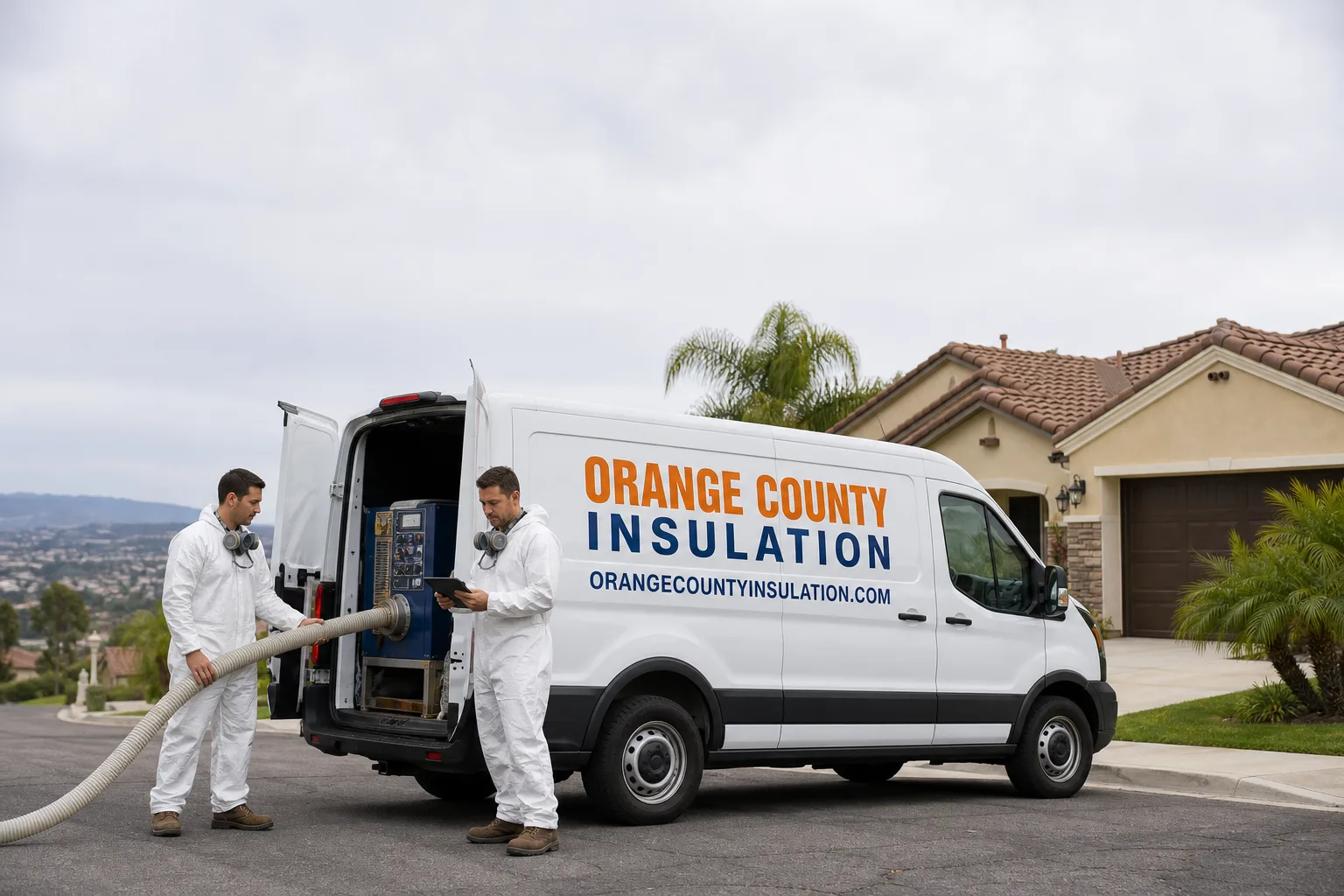
Fast, Reliable Attic Insulation Across San Marino
Attic insulation in San Marino typically runs $1,800 to $5,400 for a full retrofit on a 1920s – 1940s estate home, with most jobs completed in one to two days. The bigger question here isn’t cost, it’s method: these pre-war attics demand air sealing, baffling, and moisture control before any material goes in. We know San Marino’s housing stock, and we know what happens when insulation gets installed wrong in an old redwood-sheathed attic. Call (877) 680-3557 and we’ll walk you through what your attic actually needs.
Our crews work in San Marino every week. We’re familiar with the shallow, subdivided attic spaces off Lorain Road, the finished third-floor conversions near Huntington Drive, and the tight, low-clearance attics throughout 91108 and 91118. When you call, we schedule a walkthrough, measure the attic, check the sheathing, and give you a written scope of work before we ever open a hose. No guesswork, no generic proposal.
Why Orange County Insulation Is San Marino’s Preferred Attic Insulation Company
We only do insulation. That’s the whole business. No roofing, no HVAC, no general remodeling – just Attic Insulation, spray foam, and blown-in work, every day, for years. That single-trade focus is why San Marino homeowners and the architects and builders they work with keep calling us back: we know which material belongs in a 1928 plaster-and-lath house, and we know which one would be a mistake.
Our estimator walks every San Marino attic before quoting. That matters here because no two pre-war attics are alike. One house off Saint Albans Drive has a deep open attic with redwood sheathing and easy access. The house next door might have a finished attic room, a knee wall, and knob-and-tube wiring running through the ceiling joists. We quote based on what’s actually up there, and we explain why we’re recommending GreenFiber cellulose over fiberglass batts, or Icynene open-cell over dense-pack. Eight manufacturer brands sit on our roster: Owens Corning, Johns Manville, Knauf, Rockwool, CertainTeed, Icynene, Demilec, and GreenFiber. The right material for your home, not the easiest one for us to install.
Owner Noel Carrasco set the standard for how we handle historic attics. The rule on every San Marino job: preserve what’s original, seal what leaks, vent what needs to breathe. Insulation is the easy part. Doing it without baking a century-old cedar roof from the inside is the skill.
Insulation Contractors in San Marino
Insulation contractors in San Marino are handling a very different animal than the tract-home work happening in most of Southern California. Here, the attics are usually shallow, subdivided by original architecture, and sitting directly under redwood or cedar roof sheathing that’s nearly a hundred years old. There’s often no wall insulation at all. Plaster-and-lath ceilings seal the house differently than drywall. A contractor who treats this like a standard blow-and-go job will create problems the homeowner won’t notice until the sheathing starts cupping or the upstairs rooms stay hot through October. That’s why our scope of work on a San Marino home almost always starts with air sealing and baffle installation before any material is blown or laid.
Air Sealing Before Insulation
In a pre-war San Marino attic, the ceiling plane leaks. Recessed light cans, original electrical penetrations, plumbing chases, and the gaps around a brick chimney all pull conditioned air out of the house. If we blow insulation over those leaks, we bury the problem and cut the insulation’s effective R-value by a meaningful margin. We seal the ceiling plane first with foam and caulk, then insulate. On a 1928 house off Lorain Road, our crew found original cedar roof sheathing, no underlayment, and a shallow subdivided attic with knob-and-tube wiring overhead running right where we needed to work. We air-sealed the ceiling plane, baffled the soffits to keep the aged sheathing vented, and blew GreenFiber to an even depth on a marked gauge. Second-floor rooms dropped several degrees through 100°F San Gabriel Valley afternoons, and the plaster-and-lath below stayed untouched.
Dense-Pack for Plaster-and-Lath Walls
Many San Marino homes have no wall insulation at all, and the plaster-and-lath construction rules out standard batt retrofits. Dense-pack cellulose, blown through small access holes from the exterior or interior, fills those wall cavities without tearing out the original plaster. It’s slower, messier, and more technical than attic work, but it’s the only way to insulate a 1920s San Marino wall without destroying what makes the house worth preserving. We’ve done this work enough to know how to pack at the right density and how to avoid blowing out the lath keys.
Attic Ventilation in San Marino
Attic Ventilation in San Marino is not an afterthought, it’s the primary design constraint on every job. The city’s estate homes sit under mature tree canopies that create uneven attic temperatures, shaded cold corners next to hot sunny bays. Summer days push past 100°F, and the Santa Ana winds bring dry, punishing heat spells in September and October. Add original redwood or cedar sheathing with no modern underlayment, and you have a roof deck that will bake and cup if we trap heat against it. Insulation without correct ventilation in a San Marino attic is a slow-motion roof failure.
Soffit Baffles and Ridge Venting
When we install baffles before blowing insulation, we’re keeping the soffit vents open so outside air still moves under the sheathing. Without baffles, loose-fill insulation drifts into the eaves, blocks the intake vents, and stops the airflow that cools those old cedar boards. On San Marino homes where the original roof has no ridge vent, we assess whether adding one makes sense without changing the roofline, which the city’s design-review standards often restrict. Sometimes the answer is simply better soffit venting and a properly baffled attic floor. Sometimes it isn’t that simple.
Balancing Insulation Depth With Existing Roof Structure
In a shallow San Marino attic, there isn’t always room for the R-38 depth most climate-zone charts call for. That’s when product choice matters. Closed-cell Demilec spray foam delivers more R-value per inch than fiberglass or cellulose, and it air-seals as it’s applied. But it also changes the thermal and moisture profile of the roof deck, so we evaluate the existing sheathing condition before recommending it. On some of these homes, the right answer is a thinner layer of open-cell Icynene or dense-packed cellulose with supplemental ventilation, not more inches of fluff.
Trusted Brands We Service in San Marino
We stock and install products from eight manufacturers, and for San Marino work we lean on the ones that handle old-house conditions best, including Reflectix repair in San Marino when the job calls for it. GreenFiber cellulose dense-packs cleanly into irregular pre-war cavities and gives us recycled-content, fire-retardant coverage in attics where original wiring is a concern. CertainTeed fiberglass batts fit the standard open attic bays where airflow is already correct. And for closed-cell or open-cell spray foam, we carry both Demilec and Icynene, so we’re not steering you toward one brand because it’s all we have. Your San Marino attic gets the product that matches the sheathing, the venting, and the budget, not whatever happens to be on the truck.
We keep common loose-fill and batt materials on hand for quick scheduling in San Marino, so you’re not waiting two weeks for a specialty order. Most attic jobs in the city are quoted within a few days and scheduled within one to two weeks.
Common Attic Insulation Problems We See in San Marino Homes
- Blown insulation tight against original redwood or cedar sheathing with no baffles. This is the most common failure we correct. A previous contractor blew fiberglass right up to the roof deck, blocked the soffit vents, and the sheathing started baking. In a 1930s San Marino attic, those boards curl and cup, and the roof deck deteriorates from the inside out.
- Shallow, subdivided, or finished attics treated like a simple open retrofit. A knee wall here, a finished storage room there, a tiny scuttle access over the garage. When a contractor blows full depth everywhere without accounting for air sealing, the upstairs rooms stay hot and the insulation underperforms. San Marino’s pre-war floor plans demand a room-by-room attic assessment.
- Insulation blown over live knob-and-tube wiring without evaluation. Knob-and-tube is present in many original San Marino homes. We don’t blow insulation over active knob-and-tube without documenting it and working with the homeowner’s electrician where needed. Covered wiring can overheat, and in an old dry attic that’s a serious fire risk.
- Flat R-value everywhere, ignoring the tree canopy. San Marino’s mature oaks and camphor trees shade one side of a roof while the other side bakes. A uniform insulation depth doesn’t fix the temperature imbalance. We adjust depth, venting, and material in the hot bays and shaded corners so the whole attic floor performs evenly.
Pricing for Attic Insulation in San Marino, CA
Here’s what we see on the ground in San Marino. A straightforward open-attic cellulose blow over an existing thin layer runs $1,800 to $2,800 for a typical 2,500 – 3,500 square foot estate home. A full attic air-seal plus baffle retrofit and GreenFiber blow lands between $3,200 and $5,400, depending on attic depth, access, and how much prep the ceiling plane needs. Dense-packing exterior walls on a two-story pre-war home ranges from $6 to $10 per square foot of wall area. Spray foam, open-cell or closed-cell, runs higher per square foot but may be the only option in tight or finished attic spaces. Every quote is free, itemized, and based on a physical walkthrough of your attic, not a phone estimate.
Call (877) 680-3557 for an exact quote on your San Marino home. Estimates are free, and we’ll show you the venting condition, the sheathing condition, and what we’d recommend before you spend a dollar.
We Also Serve Cities Near San Marino
Our crews work throughout the San Gabriel Valley and beyond. If you’re in Attic Insulation in San Marino‘s neighboring communities, we cover San Gabriel, East San Gabriel, Alhambra, and East Pasadena with the same insulation-only focus and the same eight-brand material access. Same walkthrough process, same written estimate.
Serving San Marino, CA — Our Local Coverage Area
We’re based in the San Marino area and know this community well. Use the map below to see our service coverage — if you’re nearby, we can almost certainly help.
FAQs About Attic Insulation in San Marino
Yes, and this is exactly the condition we work around most often in San Marino. The key is that we don’t insulate directly against the old sheathing. We install soffit baffles to preserve airflow, verify or add ridge venting where appropriate, and keep the insulation at the attic floor level. That keeps the original cedar or redwood boards ventilated so they don’t bake from the underside. On one 1928 house off Lorain Road, we worked under original cedar sheathing with no underlayment and no ridge vent, and the solution was baffled soffits, ceiling-plane air sealing, and a measured GreenFiber blow. Sheathing stayed cool, and the upstairs rooms dropped several degrees. Call (877) 680-3557 if you want us to look at yours before any material goes in.
We change the method. A shallow attic with irregular joist depth gets dense-packed cellulose or a thinner closed-cell Demilec spray foam layer, not a deep fiberglass blow. A subdivided attic with knee walls and finished rooms gets each cavity treated separately: air sealing the ceiling plane, insulating the knee wall, and checking the floor joists under the finished space. A finished attic with sloped ceilings and no access to the rafter bays is usually a spray foam application from above or below, which is why carrying both Icynene open-cell and Demilec closed-cell matters. The material changes; the walkthrough doesn’t.
Not automatically. Knob-and-tube wiring runs hot when covered, and cellulose or fiberglass packed against it creates a fire hazard in an old dry attic. Our practice in San Marino is to identify every knob-and-tube run before we quote, flag it, and coordinate with a licensed electrician if it’s still active. Where the wiring is decommissioned, we insulate as usual. Where it’s live, we insulate around it or recommend rewiring that section first. We’d rather delay a job than bury a hazard.
Usually not for interior attic work that doesn’t change the roofline or exterior appearance. Blowing insulation, air sealing, and adding soffit baffles from inside the attic are interior alterations that typically fall outside the city’s design-review process. But if the job requires adding ridge vents, changing roof penetrations, or altering the eave appearance, that can trigger review. We plan our scope around what’s visible from the street, and we’ll tell you honestly if a venting solution crosses into territory that needs city approval. The work we do inside the attic itself stays invisible.
The tree canopy creates uneven attic temperatures. One section of roof sits in shade all afternoon while another bakes, which means a uniform depth of insulation doesn’t perform evenly across the ceiling. We compensate by checking the hot bays and shaded corners during the walkthrough and adjusting depth and venting accordingly. During Santa Ana spells, when dry heat sits over the San Gabriel Valley for days at a stretch, a properly baffled and vented attic cools down at night, and the insulation slows daytime heat gain. A poorly vented attic in those same conditions holds 140°F air overnight. Proper venting is the difference between a house that recovers and one that doesn’t.
Get a Free Estimate for Attic Insulation in San Marino
If your San Marino home runs hot upstairs, or your energy bills climb every summer, start with a real attic inspection. We’ll walk the attic, check the sheathing, locate the knob-and-tube if it’s there, measure what’s already installed, and give you a written quote with the material we’d recommend and exactly why. No pressure, no generic proposal. Call (877) 680-3557 or schedule through our site, and we’ll get out to your San Marino home within the week in most cases.
Written by Noel Carrasco, Owner at Orange County Insulation, serving San Marino with insulation-only expertise and eight manufacturer brands.