
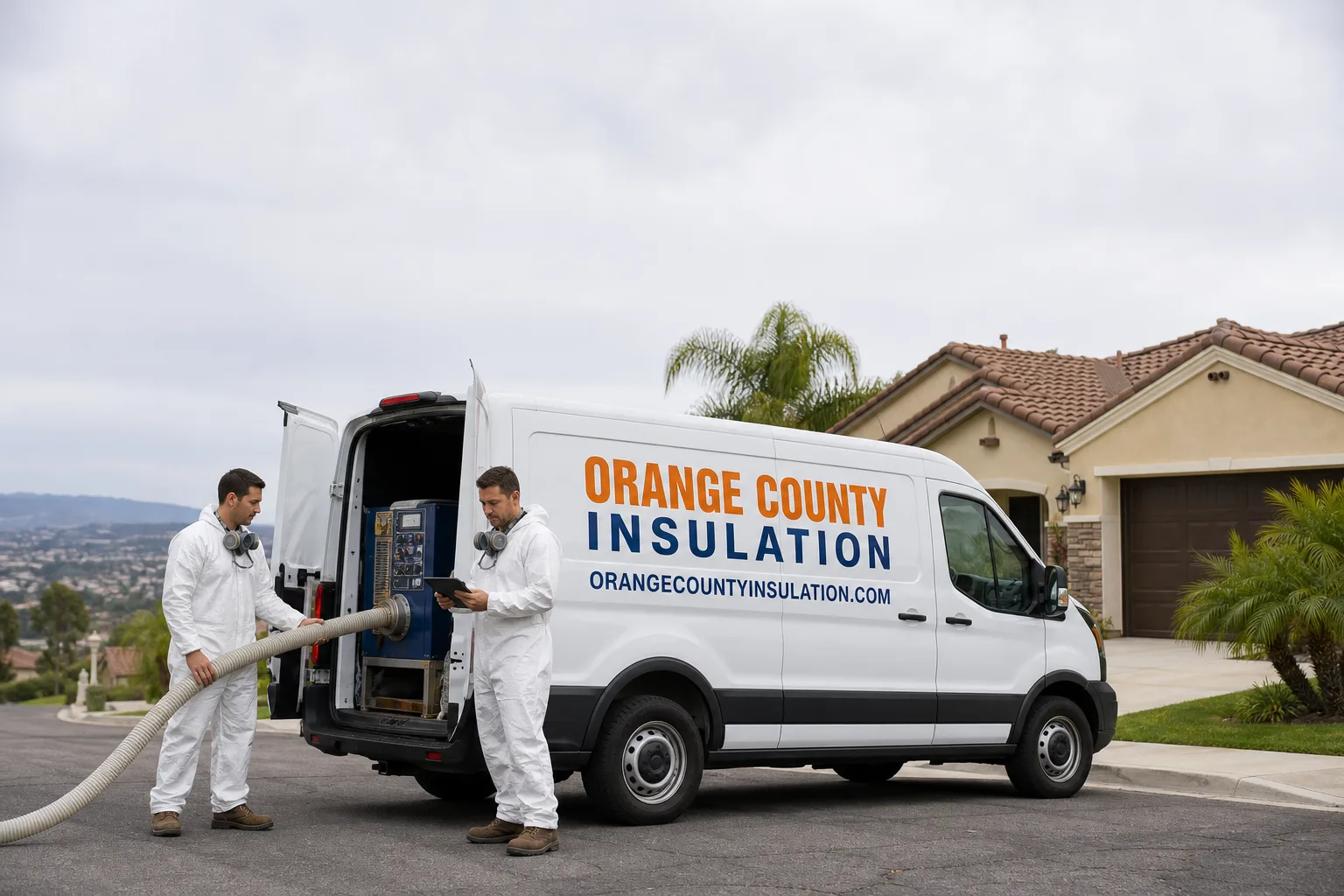
Fast, Reliable Attic Insulation Across Rowland Heights
Attic insulation replacement in Rowland Heights typically runs $1,800 – $4,600 for a standard 1,500 – 2,200 sq ft home, with top-ups starting around $900 – $1,400 and full air-sealing plus blow-in packages landing between $3,200 – $5,800. We get most Rowland Heights jobs done in a single day, and we’ll walk you through exactly what your attic needs before we touch anything. If your 91748 home still has its original 1970s batts, you’re losing cooling money every afternoon the Puente Hills sun hits your roof. Call (877) 680-3557 for a free attic inspection and a straight answer.
We work up and down the hillside tracts and through the flat-lot subdivisions off Colima Road, Fullerton Road, and Nogales Street all the time. Noel Carrasco runs our insulation-only crew, and he’s spent enough hours crouched in Rowland Heights knee-wall attics to know what 50 years of San Gabriel Valley heat does to old batts. This isn’t a side service for us. Attic insulation is the whole job.
Why Orange County Insulation Is Rowland Heights’s Preferred Attic Insulation Company
We only do insulation. No roofing, no HVAC, no remodeling. Every estimate, every crew member, and every warranty conversation centers on one trade, and that means we notice things general contractors miss. In Rowland Heights specifically, that matters because most attics in 91748 were built before modern insulation standards existed. The original R-11 and R-19 batts in those 1960s-1980s tract homes were sized for a milder climate and have since been compressed, displaced, or simply outlived their usefulness.
Homeowners in Rowland Heights call us because we carry eight manufacturer brands, including CertainTeed, Icynene, Demilec, and GreenFiber, so we’re never steering you toward whatever one supplier happens to stock. The right material for your home, not the easiest one for us to install. That’s the whole approach. When a hillside home off Pathfinder Road needs open-cell spray foam in a low-clearance attic but a flat-lot rancher near Rowland Heights Park just needs a cellulose top-up, we recommend those two different things because they’re different jobs.
Our crews are in Rowland Heights throughout the month, and we know the streets, the hillside access quirks, the Home Depot-proximate subdivisions, and the semi-custom builds along the Puente Hills ridge. We’ll give you a straight diagnosis and a price that matches the actual scope, not a template.
Attic Ventilation in Rowland Heights
Attic ventilation in Rowland Heights is the difference between an attic that holds heat at 140°F and one that sheds it. With summer highs routinely sitting at 95°F to 105°F and west- and south-facing roofs on the slopes absorbing brutal afternoon sun, ventilation isn’t optional here. A proper ventilation package for a 91748 home, including ridge vents, soffit vents, and baffle installation, runs $650 – $1,400 depending on roof line length and access. If your attic bakes, your insulation underperforms and your AC runs longer. Simple as that.
Baffle Placement in Low-Clearance Attics
Rowland Heights hillside homes often have shallow attic spaces where soffit vents get blocked by old insulation pushed too far into the eaves. We install baffles to keep airflow channels open, then air-seal the gaps around them. Without that, you’re paying to cool a house that’s fighting its own attic.
When Ventilation Alone Won’t Fix the Heat
If your attic already has working vents and the second floor still swelters by 4pm, the real problem is usually radiant heat transfer through the roof deck. Ventilation moves hot air, but it doesn’t stop the sun from heating the roof sheathing in the first place. That’s where a radiant barrier earns its cost.
Radiant Barrier in Rowland Heights
Radiant barrier in Rowland Heights makes sense for any home with a west- or south-facing roof plane, and that’s a lot of homes in 91748. A radiant barrier stapled to the underside of the roof rafters typically runs $1,200 – $2,600 depending on attic square footage and how much of the roof plane faces direct sun. We install it in attics where the existing insulation is doing its thermal job but the roof deck itself is still radiating 140°F+ heat down into the living space.
Cathedral Ceilings and Radiant Heat
Semi-custom hillside homes in Rowland Heights often have vaulted or cathedral ceilings with almost no attic cavity to insulate. In those cases, a radiant barrier against the roof deck, paired with the right insulation depth, is one of the few ways to cut that afternoon heat gain. It’s not a miracle fix, but it’s measurable.
Pairing Radiant Barrier With Blown-In Insulation
Most retrofits we do combine a radiant barrier on the sun-facing roof pitch with GreenFiber cellulose blown to R-49 across the attic floor. The two work differently: the barrier reflects radiant heat before it enters the attic, the cellulose slows conductive heat from below. On a hillside tract off Fullerton Road, we opened a knee wall into a low-clearance attic and found the original 1970s R-11 batts crushed to R-4 under a fallen HVAC duct run, with daylight visible through gaps at the roof line. After clearing debris and air-sealing, we blew in GreenFiber cellulose to R-49 and added a radiant barrier against the west-facing roof pitch to cut the 140°F+ attic heat load. That’s the kind of job Rowland Heights throws at you.
Trusted Brands We Service in Rowland Heights
We stock and install products from eight major manufacturers, and for Attic Insulation work in Rowland Heights we lean on CertainTeed for batt applications, Icynene for open-cell spray foam, Demilec for closed-cell spray foam, and GreenFiber for cellulose blow-in. Carrying all four means we spec the product that matches your attic geometry, your budget, and how much fire resistance or recycled content matters to you. If you’re in 91748, we already have the materials for your job staged or can source them within a day. No waiting on backordered product from a supplier down the hill.
Common Attic Insulation Problems We See in Rowland Heights Homes
- Compressed original batts in hillside low-clearance attics. Rows of 1960s-1980s R-11 batts get crushed under HVAC duct runs, cable installs, and decades of foot traffic, dropping their effective R-value to near nothing. We see this constantly along the sloped-lot and semi-custom builds near the Puente Hills edge.
- West-facing roofs driving 140°F+ attic temperatures. The afternoon sun on a west or south roof plane turns your attic into a heat sink, and if the insulation at the roofline is thin or missing, that heat pours straight through cathedral ceilings and into upstairs bedrooms.
- Uneven coverage in vaulted and multi-pitch roof lines. Rowland Heights hillside homes with dormers and complex roof geometry almost always have thermal bypasses where blown-in insulation can’t reach without baffles, air-sealing, and careful placement. Flat-lot homes don’t have this problem to the same degree.
- Blocked soffit vents and dead ventilation channels. Decades of old insulation pushed into the eaves chokes off airflow, so the attic stays hot even when ridge vents are installed. We fix this by clearing the channels and installing proper baffles before adding any new insulation.
Pricing for Attic Insulation in Rowland Heights, CA
Here’s what we quote in Rowland Heights, based on real 91748 jobs:
- Attic insulation top-up (blown-in cellulose to R-49): $900 – $1,400 for a standard two-story tract home.
- Full attic insulation replacement with air-sealing: $2,400 – $3,800 depending on attic access and whether old material needs removal.
- Open-cell spray foam (Icynene) in low-clearance attic: $3,500 – $5,200 for a typical hillside home roof deck.
- Closed-cell spray foam (Demilec) for unvented attics: $4,800 – $7,500 depending on square footage and roofline complexity.
- Radiant barrier installation on sun-facing roof pitches: $1,200 – $2,600.
What moves the price in Rowland Heights? Attic access. Low-clearance knee-wall attics on hillside lots take more labor than a wide-open flat-lot attic in Hacienda Heights. Cathedral ceilings and dormers add complexity. And if the original batts are so degraded they need full removal before new material goes in, that’s an extra line item. We’ll give you an exact number after one visit. No templates, no vague ranges.
We Also Serve Cities Near Rowland Heights
If you own a home in South San Jose Hills, Walnut, Valinda, or Hacienda Heights, we work those attics too. Our Rowland Heights customers often refer us to friends in neighboring 91748-adjacent communities because the housing stock and climate issues are similar, but each city’s attics have their own quirks. We know the difference.
Serving Rowland Heights, CA — Our Local Coverage Area
We’re based in the Rowland Heights area and know this community well. Use the map below to see our service coverage — if you’re nearby, we can almost certainly help.
FAQs About Attic Insulation in Rowland Heights
Almost never. Original R-11 or R-19 batts from the 1970s have usually compressed to a fraction of their rated value, especially in hillside attics where HVAC, cable, and satellite installs have displaced them over the years. Even if the batts look intact, they’re likely performing below R-10. At that point, replacement with R-49 cellulose or spray foam pays for itself in the first few Rowland Heights summers. Call (877) 680-3557 and we’ll show you what’s actually up there.
Because access takes more labor. Low-clearance attics with knee-wall entries, dormers, and multi-pitch roof lines require slower work, more baffles, and often more material to cover uneven geometry. A flat-lot rancher off Nogales Street is straightforward; a semi-custom hillside home near Schabarum Regional Park isn’t. The price difference reflects real time and material, not a markup.
Yes, and it’s one of the most effective upgrades we do for west-facing roofs in 91748. The afternoon sun on a western or southwestern roof plane is relentless here, and a radiant barrier installed against the roof deck measurably drops attic temperatures. Expect to spend $1,200 – $2,600 depending on roof plane size, and pair it with proper insulation for the biggest comfort gain.
We can, but it’s a different job than a flat-ceiling attic. Cathedral ceilings leave almost no attic cavity, so we typically spec spray foam (open-cell from Icynene or closed-cell from Demilec) against the roof deck, then add a radiant barrier where the sun hits hardest. Dormers and multi-pitch roofs need baffles and air-sealing to prevent thermal bypasses. This is exactly the kind of Rowland Heights attic we see on the hillside tracts.
We carry CertainTeed, Icynene, Demilec, and GreenFiber, plus four others, and we choose based on your attic’s geometry and your goals. GreenFiber cellulose is our go-to for blow-in top-ups and full retrofits. Icynene open-cell spray foam handles low-clearance hillside attics well. Demilec closed-cell earns its keep in unvented attics or where moisture resistance matters. We’ll tell you exactly why we’re recommending one over another.
Get a straight answer on your Rowland Heights attic. Call (877) 680-3557 for a free estimate and an inspection that actually explains what’s happening up there.
Written by Noel Carrasco, Owner at Orange County Insulation, serving Rowland Heights and surrounding San Gabriel Valley communities with insulation-only expertise.