
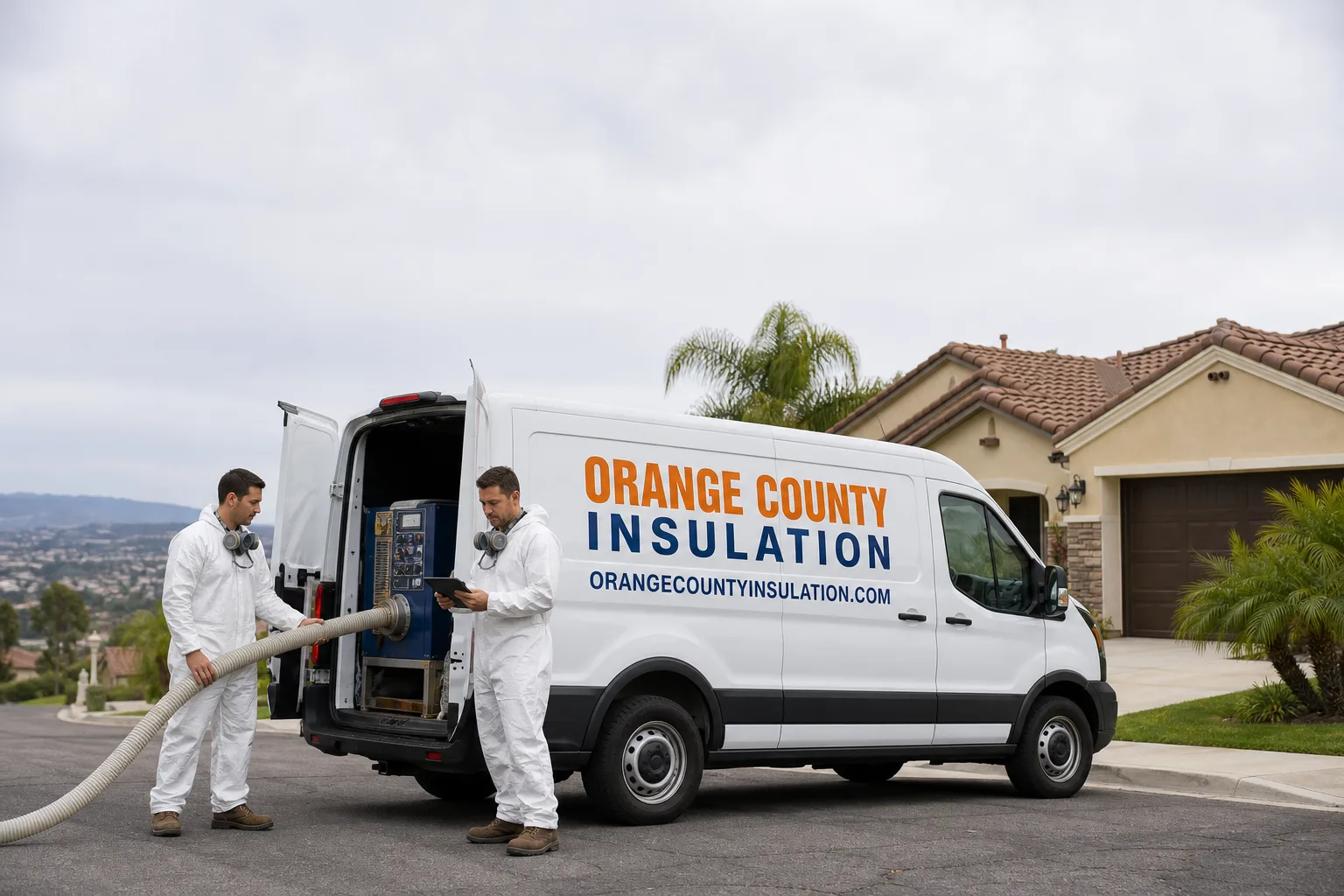
Attic Insulation in Rancho Cucamonga: The HOA and Wind-Drift Reality Most Contractors Miss
Attic insulation in Rancho Cucamonga isn’t a generic job, and treating it like one is why so many homeowners in this city still get $400 summer cooling bills despite having “plenty” of insulation up there. The two forces that reshape insulation performance here more than anywhere else in the Inland Empire are the Cajon Pass wind corridor and the HOA-era tract housing stock that dominates zip codes 91730, 91737, 91739, and 91701. Wind-driven attic venting literally pushes loose fiberglass away from the living-space ceiling, and burned-out radiant barriers under low-pitch tile roofs let 100°F-plus roof-deck heat pour straight down into whatever insulation remains. Fixing that combination is what we do every week across Rancho Cucamonga.
If you’re a homeowner in Rancho Cucamonga trying to figure out why your upstairs rooms won’t hold temperature, call us at (877) 680-3557. We’ll tell you what’s actually happening in your attic, not what a generic brochure says should be happening.
Why Orange County Insulation Is Rancho Cucamonga’s Preferred Attic Insulation Contractor
We only do insulation. That’s the whole business. No roofing side jobs, no HVAC division, no bathroom remodels that happen to include a little fiberglass. Every estimate we write in Rancho Cucamonga, every crew we send out, and every warranty conversation we have centers on one trade. That focus matters here because Rancho Cucamonga’s attic problems are rarely a simple “add more R-value” fix. They’re wind-washing, air-sealing, radiant-barrier, and ventilation corrections that general contractors tend to overlook entirely.
Our crews have spent enough time in the 1980s Mediterranean stucco tracts off Etiwanda and the newer foothill builds in 91737 to know what they’re going to find before the ladder even goes up. Builder-grade batts that have sagged and compressed against low-pitch decks. Loose fill that’s drifted toward the eaves. Radiant barriers torn to shreds by years of wind movement. Rancho Cucamonga homeowners don’t need a contractor who has to diagnose this from scratch on every job. They need one who’s seen it a hundred times and knows exactly what to do about it. That’s us.
Key Takeaways
- Rancho Cucamonga’s Cajon Pass winds push attic insulation toward the eaves, leaving living-space ceilings under-insulated even when total depth looks normal.
- HOA-era tile roofs and low-pitch decks make radiant barrier and ventilation work as critical as the insulation itself.
- We stock products from eight manufacturers, including CertainTeed, Icynene, Demilec, and GreenFiber, so the material we recommend is the right one for your attic, not the one we happen to have in the truck.
- Every Rancho Cucamonga estimate is free, and we service all four city zip codes.
Attic Ventilation in Rancho Cucamonga
Attic Ventilation in Rancho Cucamonga is the difference between insulation that works for 15 years and insulation that fails in five. The city’s position at the base of the Cajon Pass means attic air isn’t just hot – it moves. Hard. When soffit and ridge venting is undersized, blocked, or improperly balanced for a low-pitch tile roof, the attic becomes a convection oven. Hot air trapped under the deck radiates down through the insulation and into the living space, pushing cooling loads through the roof in summer. Proper ventilation gives that heat somewhere to go. In Rancho Cucamonga’s climate, ventilation and air movement through the attic are non-negotiable parts of an insulation job.
A typical attic ventilation correction in Rancho Cucamonga runs $400 to $1,500 depending on the venting configuration, the size of the attic, and whether we’re adding baffles, correcting eave-to-ridge flow, or replacing damaged soffit vents. We’ll open up a low-pitch tract attic and show you exactly where the air is stalling before we change anything.
Eave and Ridge Airflow Correction
Most 1980s and 1990s Rancho Cucamonga homes have soffit vents that are still functional but grossly undersized for the attic volume they’re supposed to serve. When that low-pitch tile roof heats up, the air has nowhere to go. We correct the eave-to-ridge balance, add baffles where insulation has been pushed against the soffits, and make sure the wind actually moves through the attic the way it was designed to – not the way it’s currently stuck.
Wind-Washing Sealing
The Cajon Pass winds that push Rancho Cucamonga attic insulation around don’t just move material – they strip heat from the underside of the insulation constantly. That’s wind-washing, and in these wind-corridor tracts it’s a bigger thermal loss than the R-value deficit alone. We seal the top plates where attic air moves over the insulation, block the wind path at the eave line, and give the insulation a still-air environment where it can actually do its job.
Radiant Barrier in Rancho Cucamonga
Radiant Barrier in Rancho Cucamonga is the layer that keeps roof-deck heat from turning your attic into a broiler. On a 105°F August afternoon, the underside of a tile roof on a two-story stucco tract home off Etiwanda can hit 140°F. That heat doesn’t need air movement to reach your insulation. It radiates straight down through the attic, and no amount of fiberglass stops radiant heat by itself. A properly installed radiant barrier reflects most of that heat back before it ever touches the insulation or the ceiling below. In Rancho Cucamonga’s sun-and-wind exposure pattern, this is not an add-on. It’s baseline performance work.
Radiant barrier installation or repair in Rancho Cucamonga typically costs $600 to $2,000 depending on attic size, roof configuration, and whether we’re stapling new barrier to rafters or repairing existing material. If your 1980s home still has the original barrier under the tile, it’s probably torn and useless. We’ll show you before we quote anything.
Rafter-Mounted Barrier on Tile Roofs
The HOA-era tile roofs common across Rancho Cucamonga have a specific problem: the tile holds heat long after sunset, and the original radiant barriers installed with those tract homes were stapled loose and have been flapping in Cajon Pass wind movement for 30 years. We re-staple or replace the barrier with proper sags, tight overlaps, and no gaps. The difference in ceiling temperature on the second floor is immediate on hot afternoons.
Barrier Repair Before Insulation Upgrades
Here’s what we tell every Rancho Cucamonga homeowner with a 1980s or 1990s home: if your radiant barrier is compromised and you just blow more insulation on top of it, you’re paying for R-value that’s fighting a losing battle against radiant heat. We repair the barrier in the same visit as the insulation upgrade. Doing them together costs less than doing them separately, and the combined result is what actually cuts cooling costs in this climate.
Trusted Brands We Service in Rancho Cucamonga
We stock and install insulation from eight major manufacturers, and for Rancho Cucamonga attics we lean on the materials that handle this specific climate profile best. Attic Insulation work in the Inland Empire means choosing between fiberglass, cellulose, mineral wool, open-cell foam, and closed-cell foam, not just grabbing whatever’s on the truck. CertainTeed batts hold their R-value through years of temperature swings. Icynene open-cell foam air-seals and insulates in one pass, which matters in wind-corridor attics. Demilec closed-cell foam handles the hot low-pitch roofs without sagging. GreenFiber cellulose is our go-to for re-blowing those wind-drifted attics off Etiwanda. When a Rancho Cucamonga homeowner asks which one is right, the answer is always based on what’s above their ceiling, not what’s easiest for us to install.
Common Attic Insulation Problems We See in Rancho Cucamonga Homes
- Wind-drifted fiberglass piled at the eaves. The constant Cajon Pass and Santa Ana air movement through open attic vents physically pushes loose fiberglass off the ceiling plane and packs it against the eave line. The insulation depth over the living room drops to nearly nothing, while the eave end looks overfilled. This is the single most common problem we find in 91730 and 91701 tract homes.
- Sagged, compressed builder-grade batts on low-pitch tile roofs. The original fiberglass batts in 1980s Mediterranean stucco homes were installed between trusses and against low-pitch decking that leaves almost no room for proper depth. Thirty-five years of gravity and heat have compressed them to a fraction of their original R-value. Roof-deck temperatures north of 110°F bake out whatever performance was left.
- Torn or missing radiant barriers. Many of these homes had radiant barriers installed at the roof deck during the original build, and the HOA-era tile roofs were never designed to protect them from wind movement. Years of Cajon Pass gusts have left them shredded. A homeowner adds insulation expecting a huge difference, and the torn barrier undercuts most of the gain.
- Unsealed recessed cans and top plates leaking conditioned air. Wind-driven attic air doesn’t just move insulation. It also drives conditioned air out of the living space through every unsealed penetration. In two-story tract homes, the second floor is especially bad. The attic insulation can be perfect, but if the can lights and wall top plates aren’t sealed, the rooms still won’t hold temperature on hot afternoons.
Pricing for Attic Insulation in Rancho Cucamonga, CA
Attic insulation work in Rancho Cucamonga runs a genuine range depending on what the attic actually needs. A straightforward blown-in top-up over existing material in a 1,500-square-foot tract home typically runs $1,200 to $2,200. Full removal and replacement, which is what most of the original 1980s fiberglass actually needs after years of wind drift and compression, usually falls between $2,800 and $5,500 for that same footprint. Adding air-sealing to the scope typically adds $800 to $1,800, and radiant barrier work runs $600 to $2,000 depending on the attic size and deck configuration. Spray foam is a different conversation entirely: open-cell foam on a standard Rancho Cucamonga attic starts around $3,500 and goes up from there based on depth and complexity. No two attics in this city are identical, and we’d rather walk yours and give you a real number than guess down the phone. Estimates in Rancho Cucamonga are free, and you won’t get a hard sales push. Call (877) 680-3557 and we’ll schedule a time that works.
We Also Serve Cities Near Rancho Cucamonga
Our crews cover the whole inland corridor around Rancho Cucamonga, and we spend just as much time in the surrounding communities. San Antonio Heights, Upland, Ontario, and Fontana all have the same wind-driven attic patterns, the same 1980s and 1990s tract housing, and the same radiant-barrier failures. If you’re in one of those cities and wondering whether your attic has the Rancho Cucamonga drift problem, call us. We’ll come look.
Serving Rancho Cucamonga, CA — Our Local Coverage Area
We’re based in the Rancho Cucamonga area and know this community well. Use the map below to see our service coverage — if you’re nearby, we can almost certainly help.
FAQs About Attic Insulation in Rancho Cucamonga
No, interior attic work like insulation, air-sealing, and radiant barrier installation does not require HOA architectural review approval in Rancho Cucamonga because it doesn’t change the exterior appearance of the home. The work is done entirely inside the attic, out of sight. What does sometimes require HOA attention is adding new roof vents or changing soffit venting that’s visible from the street. We’ll tell you before we quote anything whether your specific community’s CC&Rs might trigger a review for visible vent changes. Call (877) 680-3557 and we’ll walk through your situation.
Your insulation is drifted because the Cajon Pass wind corridor pushes air through your open attic vents and physically moves loose fiberglass toward the eave line. In Rancho Cucamonga’s 1980s boom tract homes, the low-pitch tile roofs and open eave venting create a wind tunnel effect that strips insulation off the ceiling over the living space and piles it against the eaves. The fix is re-blowing the insulation to uniform depth, then air-sealing and correcting the ventilation so the wind can’t keep doing it. This is the exact problem our crews see weekly in 91730 and 91701.
No, R-value alone is not enough in Rancho Cucamonga’s foothill zips. Those newer larger two-story homes in 91737 and 91739 have attic kneewalls, cathedral ceiling sections, and bigger roof surfaces exposed to full inland sun. If the air-sealing is weak at the kneewalls and top plates, adding R-value just gives conditioned air more material to leak through. Wind-washing at the eaves strips whatever you blow in. Radiant heat from unshielded roof decking undercuts the insulation. R-value matters, but in Rancho Cucamonga it’s only one leg of a three-leg stool that includes air-sealing and radiant barrier performance.
Yes, radiant barrier repair or replacement happens inside the attic at the rafter level, so it never alters the exterior appearance and doesn’t trigger HOA review in Rancho Cucamonga. The barrier itself isn’t visible from the street or even from the roof. We match the existing barrier type where it’s viable and replace it entirely where it’s shredded beyond saving. The work is done from inside, and no exterior surface changes. If you’re in an HOA community with specific concerns, ask us during the estimate and we’ll point out exactly what’s visible versus what’s not.
Attic ventilation directly controls how much heat gets trapped against your insulation and how hard your AC has to work to push back. In Rancho Cucamonga’s summer climate, where roof-deck temperatures regularly exceed 120°F, a poorly ventilated attic cooks the insulation from above and radiates heat into the living space from below. Good ventilation moves that heat out before it saturates the insulation. The wind that causes drift problems in these tract homes, when managed correctly with proper baffles and balanced eave-to-ridge flow, becomes the asset that keeps your attic cooler. Call (877) 680-3557 for a free attic inspection in Rancho Cucamonga, and we’ll show you exactly what your current ventilation is doing.
Get Your Rancho Cucamonga Attic Fixed Right
If you’re tired of hot upstairs rooms, high summer bills, or an attic that looks like the wind’s been using it for storage, call us. The inspection is free. The explanation is specific to your house, not a script. And the fix is insulation done right – because that’s all we do. Reach Orange County Insulation at (877) 680-3557 and we’ll set up a time to get into your attic and show you what’s really going on.
Written by Noel Carrasco, Owner at Orange County Insulation, serving Rancho Cucamonga and the surrounding Inland Empire communities.