
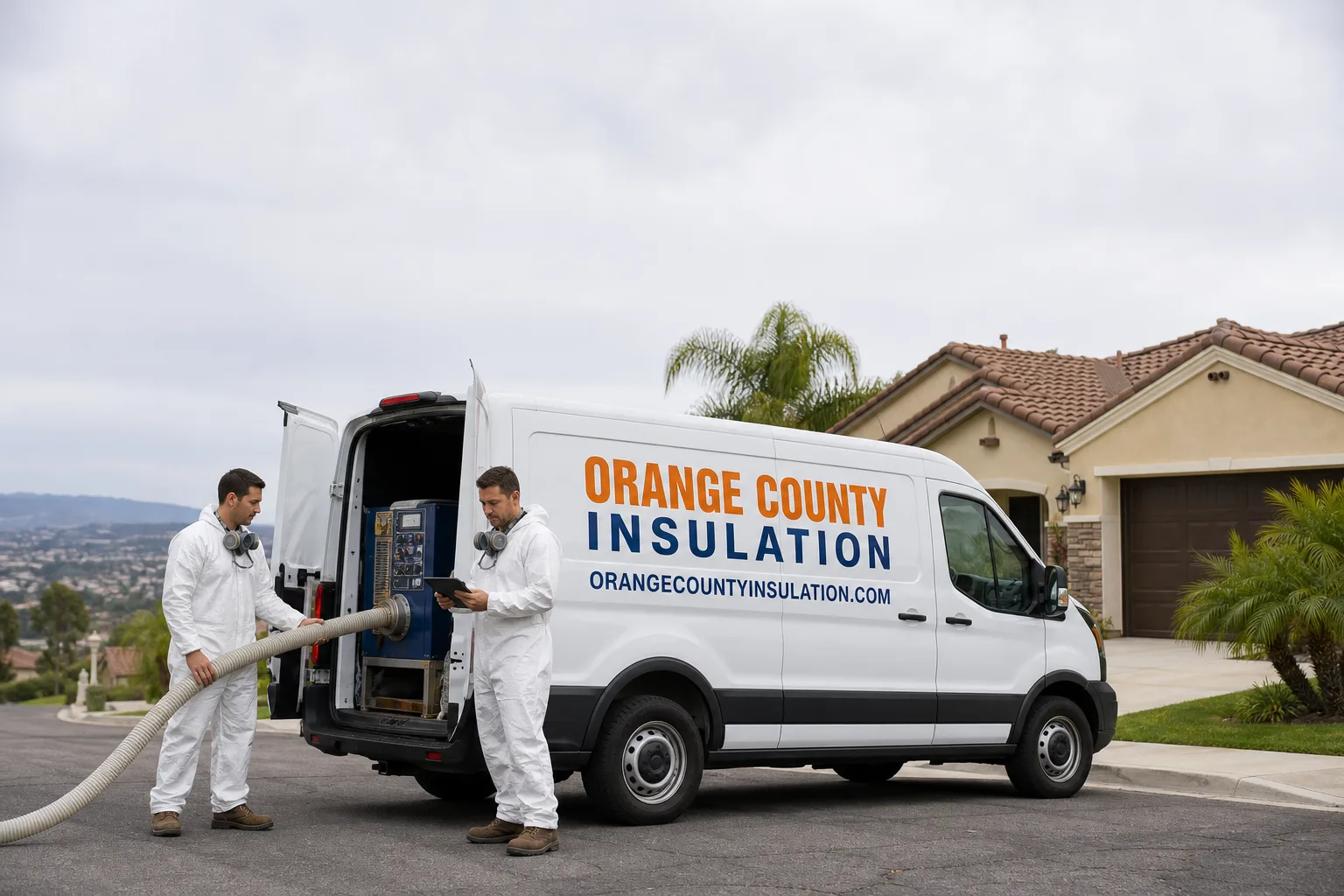
Fast, Reliable Attic Insulation Across Pico Rivera
Attic insulation in Pico Rivera means working with homes built between 1948 and 1965, when energy codes were thin and attic venting was an afterthought. Most of the single-story stucco tract homes along Rosemead Boulevard, Whittier Boulevard, and Washington Boulevard still have their original attic conditions: settled batts, bare spots, and vents that were sized for a house that was never meant to hold R-38. That changes how we approach every job here. We’re not just pumping material into a roof cavity. We’re solving heat gain on 100°F afternoons, high cooling bills in July and August, and the dust and allergy issues that come from a leaky attic floor over a 60-year-old house. Call us at (877) 680-3557 and we’ll take a straight look at what’s actually happening above your ceilings.
Why Orange County Insulation Is Pico Rivera’s Preferred Attic Insulation Company
We only do insulation. That sentence matters more in Pico Rivera than it does in most places because the homes here have very specific problems that a general contractor won’t catch. When a 1958 home near Mines Avenue still has its original venting and a homeowner just wants new insulation blown in, the easy answer is to sell the material and leave. The right answer is to explain that those vents are too small for modern R-values, and if we don’t add ventilation first, the new insulation won’t perform and moisture can build up. We have that conversation daily with Pico Rivera customers. Our Attic Insulation crews work on 90660, 90661, and 90662 homes every week, so we know exactly what the houses off Passons Boulevard and Paramount Boulevard look like inside the roof cavity.
Noel Carrasco built this business around a specific idea: the right material for the home, not the one that’s easiest to install. That’s why we stock and install products from eight manufacturers, including Owens Corning, Johns Manville, Knauf, Rockwool, CertainTeed, Icynene, Demilec, and GreenFiber. For a Pico Rivera home, which means an inland San Gabriel Valley climate with long, hot summers, that breadth means we match the material to the heat load, the existing venting, and the wiring we find in the attic. A contractor with one brand has one answer for every house. Most of the houses in this town need a different answer.
Response time to Pico Rivera from our Rancho Santa Margarita base is under an hour on most routes, but it’s the local knowledge that saves you time. We don’t need to guess what’s in your attic. We know that a house built in 1954 near Rivera Park likely has original framing, early Romex, and zero air sealing. We know that the pre-war homes near the older core around the civic center need a different touch than the postwar tracts further out. You get an estimate that reflects the actual house, not a template.
Attic Mold Removal in Pico Rivera
Attic Mold Removal in Pico Rivera is usually a consequence of trapped moisture in an under-vented attic. When the original vents can’t exhaust the heat and humidity that builds up inside a 1950s or 1960s roof cavity, condensation forms on the underside of the roof deck, and that’s where the mold starts. It shows up as dark staining on the plywood or rafters, a musty smell that drifts down into the house, and often it’s discovered during a routine insulation estimate. In Pico Rivera’s inland heat, the cycle is worse than on the coast: the attic bakes all day, then cools at night, and the temperature swing creates condensation faster than most homeowners realize. If you see dark spots on your roof sheathing or smell something stale in the hall closet that shares a wall with the attic, it’s worth a look before it spreads.
We remove the mold at the source and fix the reason it grew: ventilation. That’s the difference between a patch job and a permanent fix in this climate. A typical mold remediation plus new venting job in a Pico Rivera attic falls in the $1,800 – $4,200 range depending on square footage, how much sheathing is affected, and how many new vents the roof needs. If you’re in the 90660 or 90662 ZIP and you’ve got dark sheathing or a persistent musty odor, call (877) 680-3557. The estimate is free and we’ll tell you honestly if it’s minor surface staining or a structural moisture problem.
Mold Source Correction
Removing visible mold without changing the attic’s airflow is a temporary fix in Pico Rivera. The inland heat pushes attic temperatures past 140°F on summer afternoons, and when that hot, moisture-heavy air has nowhere to go, the mold returns. Our crews treat the affected sheathing, then calculate exactly how much net-free vent area the roof needs for the new insulation level. That usually means adding ridge venting or low-profile vents like O’Hagin units to an older tract home.
Mold and Old Insulation
In a Pico Rivera attic where vermiculite or original thin batts have been sitting for 60 years, mold rarely limits itself to the roof deck. The old insulation soaks up moisture too, holds it against the ceiling joists, and becomes a sponge that keeps the attic damp. That’s why mold removal often pairs with full insulation removal on these homes. We won’t blow new material over a moldy, damp base.
Attic Insulation Removal in Pico Rivera
Attic Insulation Removal in Pico Rivera is something we do on nearly half of the 1950s and 1960s homes we work on. The reason is simple: the original material is either gone, settled to a fraction of an inch, contaminated, or all three. On a 1958 stucco tract home near Mines Avenue, our crew found a classic Pico Rivera attic floor: the original vermiculite had settled to less than an inch, and it was laced with chipped, aging wiring. You can’t add new insulation over a base like that. The old vermiculite insulates almost nothing, holds moisture, and hides wiring that should be inspected before anything new is installed. We remove it all, from the oldest pre-war homes near the civic center to the newer 1960s tracts off Paramount Boulevard, and we leave the attic floor ready for whatever material fits the house.
Removal costs in Pico Rivera run from $1.50 to $3.00 per square foot depending on the material and how deep it’s piled. For the typical 1,100 to 1,400 square foot ranch home here, most jobs land in the $1,800 – $3,500 range. It’s a full-day job for our two-person crew: HEPA vacuum for the loose fill or vermiculite, hand bagging for the old batts, then a clean sweep of the joist cavities. The payoff isn’t something you see. It’s a fresh, dry attic floor that actually supports the new R-value you’re paying for, and a safer environment for your wiring. We’re insulation-only, so removal is paired with the new material, not farmed out to a third crew.
Vermiculite and Legacy Materials
Vermiculite is common in Pico Rivera attics because it was the cheap loose-fill option during the postwar building boom. It looks like small, shiny, accordion-shaped pellets, and after 60 years it’s usually settled to one inch or less. We treat it as a removal job, not a top-up job. We bag it, vacuum the cavities, and inspect the electrical path underneath before any new insulation goes in.
Wet and Contaminated Insulation
When the original attic vents were too small, decades of trapped moisture can soak the old insulation and hold it against the ceiling joists. That’s a mold risk and a performance killer. In Pico Rivera homes near Santa Fe Springs and Bell Gardens, the inland heat accelerates the condensation cycle, so wet insulation is more common than homeowners expect. We remove it and correct the venting at the same time.
Trusted Brands We Service in Pico Rivera
We stock and install insulation from eight manufacturers, but the three we reach for most often in Pico Rivera are Owens Corning, CertainTeed, and GreenFiber. Owens Corning blown-in fiberglass gives us the R-value control we need in older, shallow attic cavities, and it air-seals well over a settled vermiculite base we’ve removed. CertainTeed batts are a clean fit for attics with open, regular joist spacing, common in the postwar tracts. GreenFiber cellulose is the answer when a homeowner wants recycled content and a tighter air barrier, and it performs well in the 100°F-plus heat Pico Rivera sees each summer. For spray foam on the occasional new build or whole-attic air-seal job, Icynene open-cell and Demilec closed-cell round out the lineup. We keep materials stocked for Pico Rivera jobs, so you’re not waiting on a supply order from a distributor across the county.
Common Attic Insulation Problems We See in Pico Rivera Homes
- Settled or missing original insulation. Most 1950s and 1960s homes here left the factory with thin batts or loose fill. Sixty years later, that material has compacted to R-2 or R-3 at best, leaving the attic floor effectively bare over the living space. The upstairs bedrooms roast in summer, and the furnace runs nonstop in winter.
- Undersized attic vents. The original vents on these tract homes were sized for an uninsulated roof, not for R-38. When new insulation is blown in without adding ventilation, heat and moisture get trapped, condensation forms, and insulation performance drops. On older Pico Rivera homes, adding venting is part of the job, not an upsell.
- Aging electrical wiring under the insulation. Knob-and-tube and early Romex are common in the attics here, and both are rated for cooler, exposed conditions, not buried under a thick blanket of new insulation. We inspect and clear the wiring path before blowing in material, because a covered circuit that overheats is a fire hazard.
- Dust, rodent droppings, and legacy debris. A 60-year-old attic has seen things: old newspapers from the Eisenhower era, squirrel nests, decades of roof grit. That debris sits in the air you breathe and degrades indoor air quality. Removal is the first step, then the new material goes over a clean, air-sealed attic floor.
Pricing for Attic Insulation in Pico Rivera, CA
Cost depends on the job, but here’s the honest range for Pico Rivera. A straightforward blown-in fiberglass job over an existing, clean attic floor runs $1.60 – $2.40 per square foot installed. A full removal and replacement, where we pull out old vermiculite or wet batts, air-seal, add venting, and blow in R-38, runs $3.50 – $5.50 per square foot. A typical 1,200 square foot attic in the 90660 ZIP lands somewhere around $4,200 – $6,600 for the full job. Attic top-ups over existing, settled insulation that is still in decent shape run $1.20 – $1.80 per square foot. Spray foam is the premium option, at $2.80 – $4.00 per board foot, and it’s usually the right call only on specific roofs. We give you a written line-item estimate before any work starts, and that estimate is free. Call (877) 680-3557 to schedule one.
We Also Serve Cities Near Pico Rivera
Our crews work throughout the Gateway Cities and the San Gabriel Valley. If you’re searching for Pico Rivera insulation help, you may be right on the border of West Whittier-Los Nietos, Montebello, Santa Fe Springs, or Bell Gardens, and we cover all of them with the same insulation-only focus and the same straight answers about your attic.
Serving Pico Rivera, CA — Our Local Coverage Area
We’re based in the Pico Rivera area and know this community well. Use the map below to see our service coverage — if you’re nearby, we can almost certainly help.
FAQs About Attic Insulation in Pico Rivera
We do not recommend insulating over vermiculite in a Pico Rivera home, and here’s why: the settled vermiculite provides almost no R-value, holds moisture, and hides the electrical wiring underneath that should be inspected before anything new goes in. Our standard practice on these 1950s and 1960s homes is full removal first, then we inspect the wiring path, air-seal the top plates, and blow in the correct material for the attic’s depth and venting. The removal adds to the cost, but covering old vermiculite with new insulation is a shortcut that sacrifices performance and safety. Call (877) 680-3557 and we’ll walk through what your specific attic needs.
Yes, and this is the most common issue we see on postwar tract homes here. The original vents on most Pico Rivera houses were sized for an uninsulated roof, not for R-38. When you add insulation without adding venting, the attic holds more heat, condensation forms on the roof sheathing, and the insulation loses effectiveness. Our standard approach on these homes is to calculate the net-free vent area before we install, and add low-profile vents like O’Hagin units where needed. Insulation and ventilation go together on a Pico Rivera roof. Getting one without the other creates a new problem.
For Pico Rivera and the inland San Gabriel Valley, we recommend R-38 to R-49 for attic floors, depending on the depth of the existing cavities. That’s above the California Title 24 baseline because the summer heat here is extreme: prolonged afternoons in the 90s and 100s push attic temperatures well past 140°F. R-38 is the minimum we install on most homes here, and for homes with shallow joist bays where R-38 won’t physically fit, we use a dense-packing technique with blown-in fiberglass or cellulose to get as close to that target as the cavity allows.
In most cases, yes. Because we are an insulation-only contractor with dedicated removal equipment, our crews handle both the old material and the mold remediation on the same trip. We remove the contaminated insulation, treat the mold on the roof sheathing, install or upgrade the venting that caused the moisture problem, and then blow in the new material, all in a single workday for a typical Pico Rivera ranch home. The sequence matters: removal first, then mold treatment, then venting, then new insulation, otherwise the mold and moisture cycle returns. The estimate is free, and we’ll tell you exactly what the one-day scope covers for your house.
We inspect it and clear it, yes. Pico Rivera’s postwar homes frequently have knob-and-tube or early Romex wiring in the attic, and neither is rated to be buried under a thick layer of new insulation. Burying old wiring in blown-in fiberglass or cellulose can cause the circuit to overheat, which is a fire risk. Our crews identify the wiring path before any material is installed, and we either clear the area around the wiring or work alongside a licensed electrician if the wiring is in poor condition. We won’t blow insulation over unsafe electrical work, and that’s part of why we’re the right call for these older homes. Call (877) 680-3557 for an on-site look.
If your Pico Rivera attic has been ignored for 60 years, the first step is a free estimate from a contractor who only works in attics. Call Orange County Insulation at (877) 680-3557 and we’ll schedule a no-pressure walkthrough, measure the actual R-value you have now, and give you a written plan for what the right fix looks like.
Written by Noel Carrasco, Owner at Orange County Insulation, serving Pico Rivera and the inland San Gabriel Valley with insulation-only expertise and eight manufacturer brands under one roof.