Attic Insulation in Lake Arrowhead: Stop Fighting a Losing Battle
Attic insulation in Lake Arrowhead, CA is not the same job as it is down the mountain. At 5,000+ feet, your home deals with snow loads, hard freezes, and summer attic temperatures that can hit 140 degrees. The fix usually costs $1,800 to $6,500 in this market, depending on whether your cabin has a standard attic cavity or the vaulted open-beam ceilings we see all over the mountain. If you’re tired of frozen pipes, ice damming, and rooms that never hold temperature, call us at (877) 680-3557 and we’ll tell you exactly what your house needs and why.
We only do insulation. That’s it. No roofing side jobs, no HVAC add-ons, no general contracting drift. Every estimate, crew member, and warranty conversation at Orange County Insulation centers on one thing: getting your Lake Arrowhead home sealed and comfortable for all four seasons. And on this mountain, all four seasons hit hard.
Fast, Reliable Attic Insulation Across Lake Arrowhead
Lake Arrowhead homeowners call us when the problem stops being theoretical. The bedroom over the garage won’t warm up in January. The ice dams along the eaves get worse every winter. The second floor bakes in July even with the windows open. We know these houses, and we know the roads up here, from the switchbacks off Highway 18 to the side streets winding through the pines.
Our crews work in Lake Arrowhead regularly, and we schedule around mountain weather. Snow doesn’t stop the work; it just changes how we stage materials. If you need a straight answer about whether your insulation is doing anything at all, call us at (877) 680-3557. We’ll come up, look at what’s actually inside your ceiling and walls, and give you a straight read.
Why Orange County Insulation Is Lake Arrowhead’s Preferred Attic Insulation Company
The reason we’ve won so much work in Lake Arrowhead is simple: we’re a pure insulation contractor with access to eight major manufacturer brands, and we don’t steer you toward whatever one supplier happens to stock. Owens Corning, Johns Manville, Knauf, Rockwool, CertainTeed, Icynene, Demilec, and GreenFiber are all on our roster. That means when we look at a 1960s A-frame in Arrowhead Villas, we’re choosing the right product for that structure, not the easiest one for us to install.
Noel Carrasco built this company around a single trade, and every crew member, every estimate, and every warranty conversation reflects that focus. General contractors do insulation as one line on an invoice. We do it as the whole job. That’s a different level of attention when you’re dealing with vaulted ceilings, skip sheathing, and crawlspaces that leak cold air all winter.
Lake Arrowhead homeowners also tell us the same thing: they called other companies and got a price over the phone without anyone looking at the house. We don’t do that. Every job starts with an inspection, because without seeing what’s actually above that wood paneling, any price is a guess.
Attic Mold Removal in Lake Arrowhead
Attic mold removal in Lake Arrowhead is a service we handle more often here than almost anywhere else, because snowmelt and poor ventilation combine to create exactly the conditions mold loves. Homes with vaulted or low-slope roofs trap moisture under the sheathing, and the original insulation wicks it up and never dries. What starts as a small dark patch becomes a full removal job by the time anyone notices the smell or the staining on the ceiling.
A typical Attic Insulation mold situation in Lake Arrowhead ranges from $1,200 to $4,000, depending on the square footage, how much insulation has absorbed moisture, and whether the source of the moisture is still active. You can’t just spray over it. The affected material has to come out, the framing has to dry, and the ventilation issue has to be corrected before new insulation goes back in.
When mold means removal, not replacement
Mold in fiberglass or cellulose insulation doesn’t just sit on the surface. It penetrates the material, and the spores keep circulating through the house. If you have staining on the ceiling drywall, a musty smell that gets stronger in winter, or visible mold on the underside of roof sheathing, the insulation has to go. We’ll remove it, clean the enclosure, and tell you exactly what created the moisture problem in the first place, whether that’s blocked soffit vents, a bathroom fan venting into the attic, or snowmelt backing up under the eaves.
The ventilation piece most people skip
Removing moldy insulation without fixing ventilation means you’ll be taking it out again in three years. We inspect soffit and ridge vent capacity before anything gets reinstalled. In Lake Arrowhead, where snow can block intake vents for weeks at a time, we often rework vent placement or add baffles to keep airflow moving. That’s the difference between a job that lasts and a job that comes back.
Attic Insulation Removal in Lake Arrowhead
Attic insulation removal in Lake Arrowhead is often the first step in an upgrade, not a standalone emergency, though sometimes it’s both. Between rodent damage, water intrusion from snowmelt, and decades of settling, a lot of what we pull out of these cabins is doing nothing except blocking the cavity and hiding the actual problems. Full removal runs $1,500 to $4,500 for a typical Lake Arrowhead home, depending on access and material type. You need it when the existing insulation is wet, moldy, pest-damaged, or so compressed it’s no longer stopping heat movement. But the local twist is that many of these houses force us to work from inside, through ceiling cavities, rather than from a walkable attic. We’re used to that, and we’ll tell you up front what the access path looks like. The original insulation in many of these places was installed to a standard that barely applied even when it was new. You can’t build on a foundation that’s already failed.
What removal actually involves
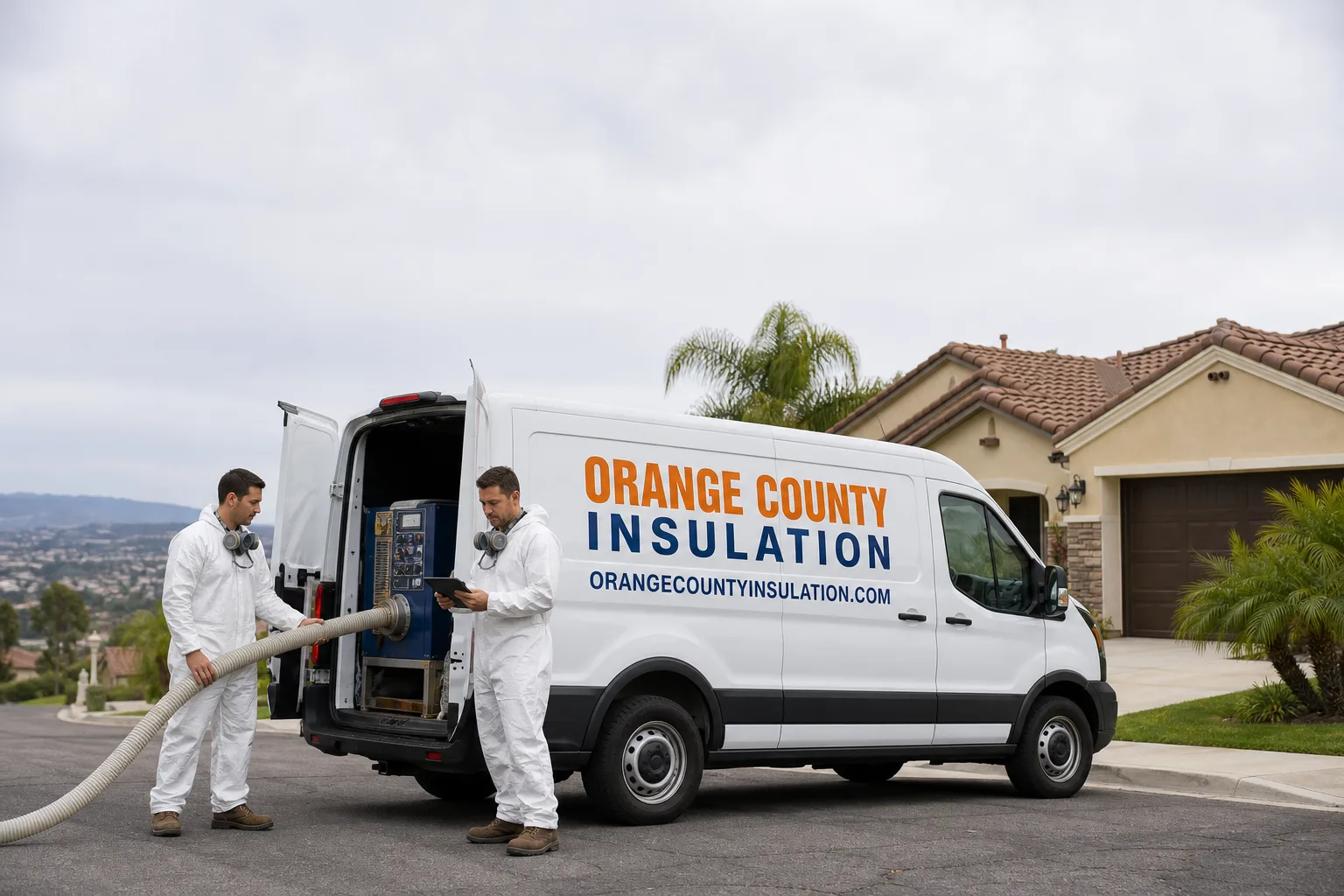
We use vacuum extraction equipment that pulls old fiberglass or cellulose out without spreading dust through the living space. The equipment is powerful enough to reach the far edges of a low-slope ceiling, and the containment setup keeps the job clean. Once the cavity is empty, we inspect what’s behind the insulation: wiring that’s been buried, framing that’s been wet, and air gaps that have been hidden for decades. That’s the real value of removal. You finally see what your house is actually doing.
Replacement material that fits the structure
After removal, the choice of replacement material depends entirely on the ceiling design. A standard attic cavity can take blown-in fiberglass or cellulose at a lower cost per square foot. A vaulted open-beam ceiling usually calls for rigid foam board or closed-cell spray foam, because there’s no cavity to blow into and the air sealing has to happen from the conditioned side. We carry GreenFiber for cellulose jobs that prioritize recycled content, Demilec for closed-cell spray foam where air sealing is critical, and CertainTeed for fiberglass. We’ll explain the performance difference in plain language and recommend the one that actually fits your ceilings.
Trusted Brands We Service in Lake Arrowhead
We stock and install products from Owens Corning, Johns Manville, Knauf, Rockwool, CertainTeed, Icynene, Demilec, and GreenFiber, and we keep the most-used materials available for mountain work to avoid delays. For Lake Arrowhead specifically, we keep rigid foam board and spray foam kits on the truck schedule more often than in lower-elevation markets, because the open-beam cabins need them. If you’re replacing Rockwool, upgrading to Icynene open-cell, or pulling out old CertainTeed batts that have settled, we can match or upgrade your material without waiting on a special order.
Common Attic Insulation Problems We See in Lake Arrowhead Homes
- Vaulted open-beam ceilings with no attic cavity. This is the defining challenge of Lake Arrowhead construction. When there’s no space to blow insulation into, the home loses heat straight through the roof deck all winter. We address it with rigid foam board or spray foam applied between the exposed rafters, which is the only way to stop the heat flow without altering the interior look.
- Settled 1970s and 1980s fiberglass behind wood paneling. After 40 or 50 years, those batts have compressed to a fraction of their original R-value, and gaps have opened at the top of the walls. The paneling hides it, so homeowners only notice the cold rooms and the frozen pipes. We find this in nearly every older cabin we open up.
- Uninsulated floors over vented crawlspaces. Cold air moves up through the floor system all winter, freezing the underside of the house before it ever reaches the attic. Fiberglass batting under the floor joists or spray foam on the crawlspace walls blocks that path. This is often the missing piece in a house that still feels drafty after the attic is done.
- Mold from snowmelt and poor attic ventilation. Snow piles up on the roof, the attic warms from below, the snow melts at the bottom edge, and the water backs up under the shingles and into the insulation. A few seasons of that and the insulation needs full removal and replacement. We covered the mold problem earlier, but it’s worth repeating because we see it constantly.
Pricing for Attic Insulation in Lake Arrowhead, CA
We Also Serve Cities Near Lake Arrowhead
We work throughout the San Bernardino Mountains, including Crestline, Running Springs, Highland, and Muscoy. If you’re in one of those communities and dealing with the same cold-winter, warm-summer dynamic, the same Attic Insulation expertise applies. Call us at (877) 680-3557 and we’ll schedule a visit wherever you are on the mountain.
Serving Lake Arrowhead, CA — Our Local Coverage Area
We’re based in the Lake Arrowhead area and know this community well. Use the map below to see our service coverage — if you’re nearby, we can almost certainly help.
FAQs About Attic Insulation in Lake Arrowhead
No, and anyone who tells you otherwise is guessing. An open-beam or vaulted ceiling has no cavity to blow into, so blown-in insulation physically cannot be installed there. The right approach is rigid foam board or closed-cell spray foam applied between the exposed rafters, which insulates from the conditioned side and preserves the wood look. Call (877) 680-3557 and we’ll assess your ceiling and quote the correct approach.
The practical options are blown-in cellulose or foam injected behind the paneling through small access holes, or removing the paneling and insulating the stud bays properly from the inside. The first is less expensive and less intrusive. The second delivers a better air seal and often reveals hidden moisture problems. We’ll walk you through both and give you a real cost comparison before you decide.
You need removal if the existing insulation is wet, moldy, rodent-damaged, or compressed to the point where it’s no longer doing its job. Water staining on the ceiling, a musty smell in winter, or visible mouse trails in the insulation are all removal triggers. If you’re not sure, we’ll come up and inspect it, and we’ll tell you honestly whether removal is necessary or if a top-up is enough.
Yes, in most homes it makes a significant difference. Ice dams form when heat escapes through the attic and melts snow at the roof deck, which then refreezes at the cold eave edge. Stopping that heat loss keeps the roof deck cold and the snowpack stable. For open-beam ceilings that can’t take standard attic insulation, rigid foam or spray foam between the rafters addresses the same mechanism.
We use CertainTeed fiberglass batt or blow-in, GreenFiber cellulose for recycled-content applications, Icynene open-cell spray foam for full air sealing, and Demilec closed-cell spray foam where moisture resistance and higher R-value per inch matter. The brand choice follows the specific ceiling design and your budget. We’re not tied to any single supplier, so you get the product that fits the job, not the one we happen to stock.
Often we can, and we keep response windows tight for Lake Arrowhead calls because the problems up here are rarely seasonal. If you have a frozen pipe or a ceiling that’s actively leaking heat, call us at (877) 680-3557 and we’ll give you a straight answer on today’s availability and a free estimate.
Why Most Attic Insulation Advice Fails Lake Arrowhead Homes
A lot of what’s published about Attic Insulation assumes the house has an attic. Yours probably doesn’t, or if it does, it’s a shallow crawl space above a sloped ceiling that was never meant to hold insulation. The generic advice to blow in a foot of cellulose and call it done simply doesn’t apply to an A-frame built in 1972 with tongue-and-groove pine under the roof deck.
Here’s the specific reality for Lake Arrowhead. Many of these cabins started as weekend retreats, built cheap, with little or no insulation behind the wood paneling and board ceilings. The owners were fine with a fireplace and a few space heaters. Then the house became full-time, or it became a rental, or the new owners just wanted to be comfortable in December and July. The building hasn’t changed, but the expectations for it have, and that’s where we come in.
Our recent work on a 1970s chalet near Blue Jay illustrates the point. Vaulted open-beam ceiling, a thin layer of settled fiberglass above the boards, and an owner who was tired of ice damming on the roof edge every winter. There was no attic cavity to work in, so our crew sealed and insulated from the inside: rigid foam board between the exposed rafters, gaps sealed with spray foam, Owens Corning products throughout. The homeowner called us back after the first snow to report warmer floors and no ice dams for the first time in years. That job taught us nothing new, but it confirmed what we already know: on this mountain, you insulate the house you have, not the house a textbook assumes.
How We Insulate the House You Actually Have
This is where the insulation-only specialty pays off. A general contractor might tell you the vaulted ceiling is too hard, or they might bid it based on a standard attic that doesn’t exist. We send a technician who’s worked on dozens of open-beam Lake Arrowhead cabins, and the estimate reflects what’s actually up there.
For standard attic cavities, we top up or replace with blown-in fiberglass or cellulose. That’s the straightforward job, and it works. For vaulted ceilings, we use rigid foam board, closed-cell spray foam, or a combination, applied from the interior. For the floor, we insulate from the crawlspace or from below, because cold air rising through the floor is a major source of winter discomfort and frozen pipes. For the walls behind wood paneling, we inject cellulose or foam through small holes and patch them to near invisibility.
Every one of those methods solves a different problem. The trick is knowing which problem you’re actually solving, and that requires looking at the house. Nothing on the internet can tell you whether your roof has skip sheathing or solid decking, and that detail changes everything. We’ll come up, open the right access point, and tell you what you’re working with.
Contact Orange County Insulation for Attic Insulation in Lake Arrowhead
If you live in Lake Arrowhead and you’re done guessing why your energy bills climb every winter and your house won’t hold temperature in July, call us. We’ll come up the mountain, inspect what’s really in your ceiling, and give you a straight answer on what it costs to fix. Call (877) 680-3557 for your free estimate. One trade. One specialty. Insulation, done right for Lake Arrowhead’s climate and the houses it was actually built with.
Written by Noel Carrasco, Owner at Orange County Insulation, serving Lake Arrowhead and the San Bernardino Mountains with insulation-only expertise.