
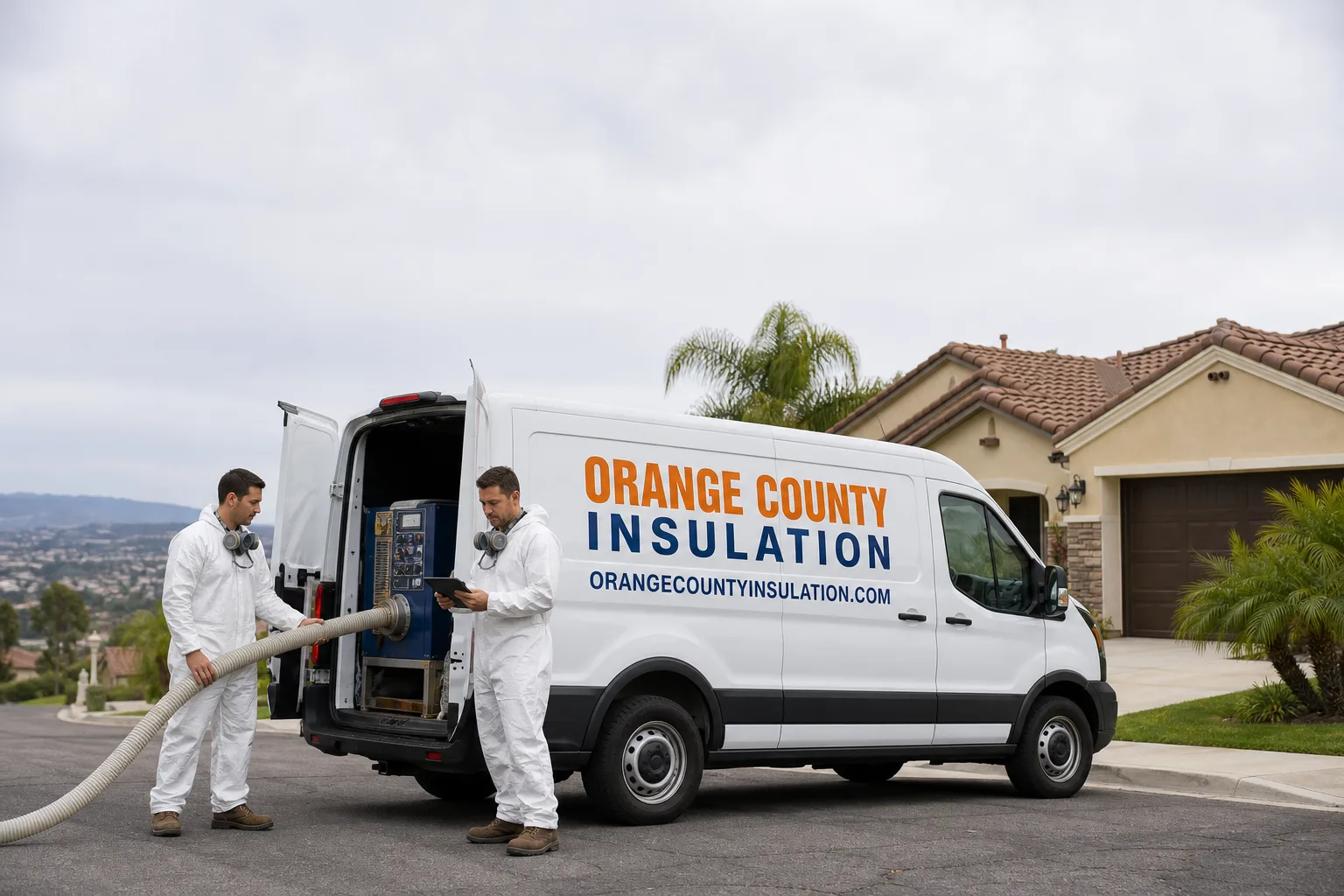
Fast, Reliable Attic Insulation Across Crestline
Attic insulation in Crestline solves a different problem than it does down the hill. Most Crestline homes were built between the 1950s and 1980s as mountain cabins, weekend getaways, and second homes. Many have open-beam ceilings with no attic cavity at all, minimal original insulation, and wood-frame construction on sloped lots. At 4,500 to 5,000 feet, winter heat loss is the real battle here, not summer cooling. Our crew knows Crestline’s housing stock because we work in it. Call (877) 680-3557 for a free estimate, and we’ll send a specialist who understands mountain envelope work, not a general contractor guessing at it.
Key Takeaways:
- Attic insulation in Crestline typically runs $1,800 to $6,500 depending on whether you need conventional blown-in work, roof-deck closed-cell foam, or removal plus replacement.
- Crestline’s elevation and open-beam cabin stock mean attic insulation is often a roof-deck job, not a floor-blown job.
- WUI fire-resistance requirements shape every material decision here.
- We only do insulation. That focus matters when your roofline is tricky and the wrong product fails fast.
Why Orange County Insulation Is Crestline’s Preferred Attic Insulation Company
Our crews have worked on cabins along Lake Gregory Drive, throughout the 92325 ZIP, and up the winding roads off Highway 138. That matters because Crestline access is not like tract-home work in the valley. Driveways angle uphill, roof pitches are steep, and the roof deck is often the only route to fix a ceiling assembly that was never insulated properly in the first place.
Noel Carrasco, who leads our team, builds estimates around one question: what does this specific house need? A 1960s A-frame near Lake Gregory and a 1980s conventional ranch off Crest Forest Drive call for different products and different installation methods. We carry eight manufacturer brands, including CertainTeed, Icynene, Demilec, and GreenFiber, so the answer is never “whatever we happen to have on the truck.” We only do insulation, which means we do it better. Builders and remodelers in Crestline use us for the same reason homeowners call directly: we can explain exactly why one material outperforms another in mountain conditions.
Attic Insulation Removal in Crestline
Attic insulation removal in Crestline is usually not optional. Original fiberglass batts in mid-century cabins compress, settle, and lose their R-value after decades of hard freezes and thaw cycles. When batts pull away from roof edges, you get air gaps where condensation forms and ice damming starts. Removal is also required after rodent damage, water intrusion from snow melt, or when a previous homeowner installed the wrong product for a vaulted assembly. A full removal and disposal for a typical Crestline cabin runs $1,200 to $2,800. Wall and roofline access problems on sloped lots can push the higher end. Call (877) 680-3557 to schedule an inspection before winter sets in.
When Removal Is the Only Real Fix
You cannot top up insulation that has been saturated by roof leaks or shredded by rodents. In Crestline, snow melt finds its way through older shake and shingle roofs, and the resulting moisture in fiberglass batts destroys thermal performance and invites mold. We remove it, assess the cavity, and then match the replacement product to what the assembly actually needs, often closed-cell foam against the roof deck rather than more batts.
Removal and WUI Compliance
Removing old insulation from a Crestline attic is also the moment to check ember-entry gaps and fire-spread paths. WUI requirements apply to the exterior envelope, and when we open up a ceiling or roof deck, we look for gaps that embers could enter during wildfire season. Sealing those while the cavity is open is cheaper than reopening it later.
Insulation Contractors in Crestline
Insulation contractors in Crestline need to understand mountain load paths, hard-freeze condensation, and WUI exterior envelope codes. General contractors from the valley often spec products meant for cooling-dominated climates, and those fail up here. Our team works exclusively on insulation, so we do not split attention between roofing, HVAC, or remodeling. That focus shortens the learning curve on difficult Crestline projects and gets the product choice right the first time.
Open-Beam and Vaulted Ceiling Work
Many Crestline cabins have open-beam ceilings with no attic floor to blow loose fill into. Insulating those assemblies means working from the roof deck or spraying foam against the underside of the roof sheathing. Closed-cell foam from Demilec or open-cell from Icynene are the common choices, depending on budget and whether you need the moisture-barrier properties of closed-cell at rim and ridge locations.
Conventional Attic Floor Work
For Crestline homes that do have an accessible attic floor, blown-in cellulose from GreenFiber or fiberglass from CertainTeed remain the standard options. The right specification depends on whether the attic floor is shallow, the roof venting is adequate, and whether baffles are in place at the eaves. We handle baffle installation and ventilation prep as part of the job.
Trusted Brands We Service in Crestline
We stock and install products from CertainTeed, Icynene, Demilec, and GreenFiber, among others. That brand roster means a Crestline homeowner gets the product that matches their roofline, budget, and fire-resistance needs, not whatever one distributor happened to have in stock. We carry the materials for both conventional blown-in work and roof-deck spray foam applications, so Crestline projects do not stall waiting on parts from down the hill. We do not push one product line. We’ll tell you exactly which one fits your situation and why.
Common Attic Insulation Problems We See in Crestline Homes
- Blown-in insulation under an open-beam ceiling does almost nothing for the living space. In a 1960s or 1970s cabin with a vaulted ceiling, there is no attic floor to hold loose fill, so heat pours straight through the roof deck all winter.
- Compressed original batts leave air gaps at roof edges. Those gaps let warm indoor air hit cold sheathing, and at Crestline’s elevation that means condensation and ice damming along the eaves during hard freezes.
- Rodent and water damage in shallow attic cavities. Mountain cabins attract rodents, and snow melt finds roof leaks. Both ruin insulation and require removal before any top-up makes sense.
- Missing or collapsed baffles at the eaves. Shallow roof pitches on many Crestline cabins squeeze the eave area. When baffles fail, ventilation stops and condensation follows.
Pricing for Attic Insulation in Crestline, CA
For a conventional attic floor, blown-in cellulose or fiberglass in a Crestline home typically runs $1,800 to $3,400. Adding baffles and ventilation prep pushes $400 to $1,200 more, depending on eave access. Roof-deck closed-cell foam for open-beam cabins runs $4,500 to $9,500 for a typical 1,200 to 1,800 square foot cabin, because the work is more material-intensive and takes place on steep, sloped-lot roofs. Attic insulation removal runs $1,200 to $2,800. Batts for accessible attics run $1,500 to $3,000. The biggest cost driver in Crestline is access: if our crew is working from ladders on a hillside lot, expect the upper end of these ranges. Call (877) 680-3557 for a free, site-specific estimate.
We Also Serve Cities Near Crestline
Beyond Crestline, our Attic Insulation crews serve Crestline neighbors across the San Bernardino Mountains and the Inland Empire. That includes Lake Arrowhead, Muscoy, San Bernardino, and Highland. If you own a mountain cabin or a valley home, call us for the same insulation-only service and multi-brand product access, wherever the property sits.
Serving Crestline, CA — Our Local Coverage Area
We’re based in the Crestline area and know this community well. Use the map below to see our service coverage — if you’re nearby, we can almost certainly help.
FAQs About Attic Insulation in Crestline
Because there is no attic floor cavity to blow loose fill into. Standard blown-in insulation drops onto a flat attic floor. An open-beam or vaulted ceiling has no such floor, which means the insulation must be installed against the roof deck itself, usually as closed-cell spray foam. Call (877) 680-3557 for an assessment of your specific ceiling assembly, free of charge.
Yes. Crestline’s winter heating load is much larger than the cooling load that drives insulation specs in the valleys below. That means air sealing matters more, R-values at roof edges matter more, and condensation control at the ridge and eaves matters more. Closed-cell foam is often the correct choice at Crestline elevation where an open-cell or fiberglass product would be fine in San Bernardino.
WUI stands for wildland-urban interface. Crestline sits inside a high fire hazard zone, and exterior envelope materials, including attic and roof assemblies, must meet fire-resistance requirements. Insulation choices affect ember-entry sealing and fire-spread paths, which is why we inspect and seal eave and soffit gaps during attic work. This is a mountain-specific requirement that lowland contractors often miss.
When the existing material is water-damaged, rodent-infested, compressed below useful R-value, or simply the wrong product for the assembly. In Crestline, we see all four. Topping up bad insulation traps moisture and smell, and does nothing for the air gaps at roof edges. Removal is the honest fix, and then we install the right product for mountain conditions.
Yes. We work sloped-lot roofs regularly, including cabins around Lake Gregory and Crest Forest Drive where ladders are set on grades that make valley crews nervous. The job takes longer and costs more than a flat-lot tract home, but it is routine for us. Call (877) 680-3557 and we can look at your roofline and give you a straight answer.
Replace or Retrofit: A Crestline-Specific Choice
Most insulation decisions in Crestline come down to whether the house has an attic cavity at all. If it does, you can often retrofit: top up the existing loose fill or batts, add baffles, and air seal at the floor level. That runs $1,800 to $3,400 and makes sense for many conventional ranch-style homes in the 92325 ZIP. If it does not have a cavity, you are replacing the thermal envelope from the roof deck down, and that is a different project entirely.
On a 1960s open-beam cabin off Crestline’s Lake Gregory area, our crew found the original ceiling had no cavity to blow into, so we installed closed-cell foam directly against the roof deck to seal the vaulted assembly and stop heat loss, then finished with a WUI-rated exterior assembly. With hard freezes hitting the exposed roof edges, that airtight deck-side approach eliminated the condensation the owners had been seeing. That is the kind of work that cannot be copy-pasted from a valley job. The roof deck is the attic in these houses, and treating it like a conventional ceiling wastes money.
Bottom line: if your Crestline cabin leaks heat all winter and no one can explain why, the answer is usually in the ceiling assembly. Call (877) 680-3557 and we’ll send someone who can diagnose it correctly. Estimates are free.
Written by Noel Carrasco, Owner at Orange County Insulation, serving Crestline and the San Bernardino Mountains with insulation-only expertise.